
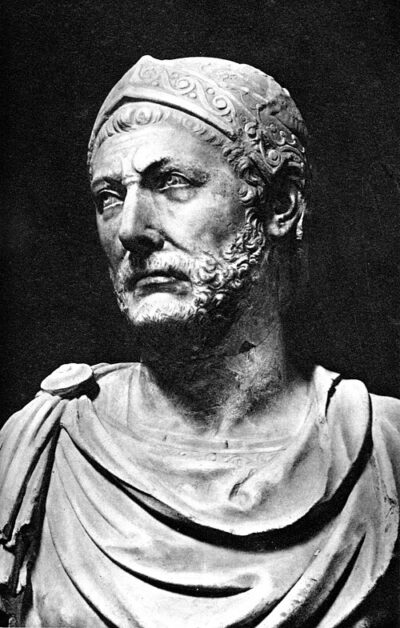
Hannibal
Hannibal was a Carthaginian general (247–183/181 BC). Born 247 BC, in Carthage. Died 183 BC, in Gebze. Awards include illustrious son.
Facts
19 facts · 0 confirmed by two sources · 7 cited · 12 from one source
Where this comes from
Papalocal keeps its own record. It started from these sources; what each one said is kept here as it was copied, so a change on their side never changes this page by itself. Tap one to read its version.
What Wikidata says · copied November 16, 2026 · revision 2567479377
- Described as
- Carthaginian general (247–183/181 BC)
- Other names
- Ḥannibaʿl, Ḥannobaʿal, Hannibal son of Hamilcar, Ḥannibaʿal, Ḥanniba'al, Annibal, Hannibal the Barcid, Hannibal Barca, Ḥannoba'al, Hanibal, Hannibal, son of Hamilcar, Gannibal
- Born
- 247 BC · 1 reference
- Died
- 183 BC · 1 reference
- Born in
- Carthage · 1 reference
- Died in
- Gebze
- Cause of death
- intoxication
- Citizen of
- Ancient Carthage
- Occupation
- politician · 1 reference; military leader · 1 reference
- Awards
- illustrious son · 1 reference
- Spouse
- Imilce
- Children
- Haspar Barca
- Father
- Hamilcar Barca · 1 reference
- Siblings
- third daughter of Hamilcar Barca; Hasdrubal Barca · 2 references; Mago · 1 reference; eldest daughter of Hamilcar Barca; middle daughter of Hamilcar Barca
- Military branch
- military of ancient Carthage · 1 reference
- Military rank
- commander-in-chief
- Wikipedias with a page
- 141
Wikidata item Q36456 (wikidata.org/wiki/Q36456), public domain (CC0). Copied November 16, 2026.
What Wikipedia says · copied November 16, 2026 · revision 1385925002
Hannibal (; Punic: 𐤇𐤍𐤁𐤏𐤋; 247 – between 183 and 181 BC) was a Carthaginian general and statesman who commanded the forces of Carthage in their battle against the Roman Republic during the Second Punic War. Hannibal lived during a period of great tension in the Mediterranean Basin, triggered by the emergence of the Roman Republic as a great power with its defeat of Carthage in the First Punic War. Revanchism prevailed in Carthage, symbolized by the pledge that Hannibal made to his father to "never be a friend of Rome".
In 218 BC Hannibal attacked Saguntum (modern Sagunto, Spain), an ally of Rome in Hispania, and this attack sparked the Second Punic War. Hannibal invaded Italy by crossing the Alps with North African war elephants. In his first few years in Italy, as the leader of a Carthaginian and partially Celtic army, he won a succession of victories at the battles of Ticinus, Trebia, Lake Trasimene, and Cannae, inflicting heavy losses on the Romans. Hannibal was distinguished for his ability to determine both his and his opponent's respective strengths and weaknesses and to plan battles accordingly. His well-planned strategies allowed him to conquer and ally with several Italian cities that were previously allied to Rome. Hannibal occupied most of southern Italy for 15 years. The Romans, led by Fabius Maximus, avoided directly engaging him, instead waging a war of attrition (the Fabian strategy). Carthaginian defeats in Hispania prevented Hannibal from being reinforced, and he was unable to win a decisive victory. A counter-invasion of North Africa, led by the Roman general Scipio Africanus, forced him to return to Carthage. Hannibal was defeated at the Battle of Zama, ending the war in a Roman victory.
After the war, Hannibal successfully ran for the office of sufet. He enacted political and financial reforms to enable the payment of the war indemnity imposed by Rome. Those reforms were unpopular with members of the Carthaginian aristocracy and in Rome, and he fled into voluntary exile. During this time, he lived at the Seleucid court, where he acted as military advisor to Antiochus III the Great in his war against Rome. Antiochus met defeat at the Battle of Magnesia and was forced to accept Rome's terms, and Hannibal fled again, making a stop in the Kingdom of Armenia. His flight ended in the court of Bithynia. He was betrayed to the Romans and, poisoning himself, died by suicide.
Hannibal is considered one of the greatest military tacticians and generals of antiquity, alongside Alexander the Great, Julius Caesar, Scipio Africanus, and Pyrrhus. According to Plutarch, Scipio asked Hannibal "who the greatest general was", to which Hannibal replied "either Alexander or Pyrrhus, then myself".
From the Wikipedia article “Hannibal” (en.wikipedia.org/wiki/Hannibal), by its contributors, under CC BY-SA 4.0 (creativecommons.org/licenses/by-sa/4.0/). Copied November 16, 2026; not changed.
Confirmed Two sources agree. Cited One source, and it names where it got it. One source One source, without a reference of its own. Sources disagree The sources disagree. We show the best-supported value and keep theirs below.
