
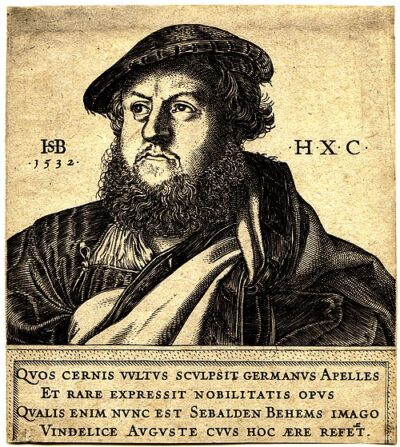
Hans Sebald Beham was a German artist. Born 1500, in Nuremberg. Died November 22, 1550, in Frankfurt.
Facts
14 facts · 2 confirmed by two sources · 9 cited · 3 from one source
Where this comes from
Papalocal keeps its own record. It started from these sources; what each one said is kept here as it was copied, so a change on their side never changes this page by itself. Tap one to read its version.
What Wikidata says · copied November 18, 2026 · revision 2565528378
- Described as
- German artist (1500-1550)
- Other names
- Seb. Bæhm, Hans Bohm, Hans Sebald Beheim, Hans Seboldt Boehm, Hans-Sebald Behem, Hans Seboldt Beheim, Sebald Beham, Hans-Sebald Böhm, Hans Sebald Boehm, Sebaldt de Been, Hans-Sebald Beham, Sebald Boehm
- Born
- 1500 · 7 references
- Died
- November 22, 1550 · 2 references
- Born in
- Nuremberg · 1 reference
- Died in
- Frankfurt · 1 reference
- Citizen of
- Free Imperial City of Nuremberg; Germany · 1 reference
- Occupation
- painter · 2 references; illustrator · 1 reference; printmaker · 3 references; exlibrist · 1 reference; draftsperson · 1 reference
- Field
- painting
- Spouse
- Anna Beham · 1 reference
- Siblings
- Barthel Beham · 1 reference
- Wikipedias with a page
- 22
Wikidata item Q507825 (wikidata.org/wiki/Q507825), public domain (CC0). Copied November 18, 2026.
What Wikipedia says · copied November 18, 2026 · revision 1374236222
Sebald Beham (1500–1550) was a German painter and printmaker, mainly known for his very small engravings. Born in Nuremberg, he spent the later part of his career in Frankfurt. He was one of the most important of the "Little Masters", the group of German artists making prints in the generation after Dürer.
His name is often given as Hans Sebald Beham although there is no documentary evidence that he ever used that additional forename.He produced approximately 252 engravings, 18 etchings and 1500 woodcuts, including woodcut book illustrations. He worked extensively on tiny, highly detailed, engravings, many as small as postage stamps, placing him in the German printmaking school known as the "Little Masters" from the size of their prints. Those works were printed and published by him, and his much larger woodcuts were mostly commissioned work. The engravings found a ready market among German bourgeois collectors. He also made prints for use as playing cards and wallpaper.His engravings cover a range of subjects, but he is especially known for scenes of peasant life and scenes from classical myth or history, both of which often had an erotic element. His early work was done under the shadow of Dürer, who was still working in Nuremberg, and one early woodcut "Head of Christ", to which the "AD" monogram was added in the second state (though probably not by Beham), was long misattributed to Dürer by Adam Bartsch and others. He also borrowed from his brother Barthel's rather more original works. In his later work he boldly re-interpreted many of Dürer's most famous prints in works such as his Melancholia of 1539, exploiting the difference in scale between his work and the original. His dark backgrounds may have been inspired by Italian Niello prints.
- Born, in its opening lines
- 1500
- Died, in its opening lines
- 1550
From the Wikipedia article “Sebald Beham” (en.wikipedia.org/wiki/Sebald_Beham), by its contributors, under CC BY-SA 4.0 (creativecommons.org/licenses/by-sa/4.0/). Copied November 18, 2026; not changed.
Confirmed Two sources agree. Cited One source, and it names where it got it. One source One source, without a reference of its own. Sources disagree The sources disagree. We show the best-supported value and keep theirs below.
