
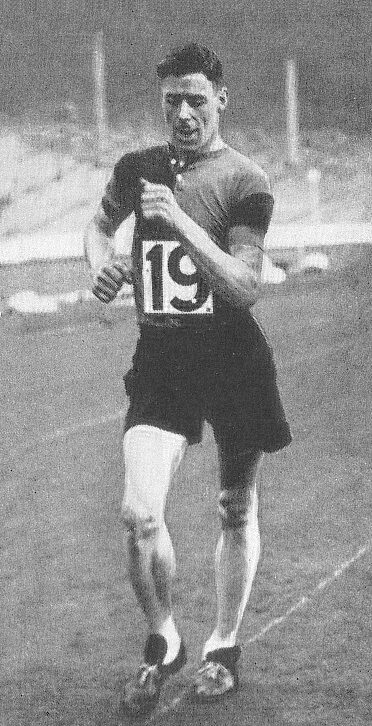
Harold Whitlock
Harold Whitlock was a British athlete. Born December 16, 1903, in Hendon. Died December 27, 1985, in Wicklewood. Educated at Hendon School.
Facts
9 facts · 2 confirmed by two sources · 0 cited · 7 from one source
Where this comes from
Papalocal keeps its own record. It started from these sources; what each one said is kept here as it was copied, so a change on their side never changes this page by itself. Tap one to read its version.
What Wikidata says · copied November 18, 2026 · revision 2546050904
- Described as
- British athlete (1903–1985)
- Other names
- Hector Harold Whitlock
- Born
- December 16, 1903
- Died
- December 27, 1985
- Born in
- Hendon
- Died in
- Wicklewood
- Citizen of
- United Kingdom; United Kingdom of Great Britain and Ireland (–1927)
- Occupation
- athletics competitor
- Education
- Hendon School
- Sport
- athletics
- Wikipedias with a page
- 23
Wikidata item Q940029 (wikidata.org/wiki/Q940029), public domain (CC0). Copied November 18, 2026.
What Wikipedia says · copied November 18, 2026 · revision 1369315759
Hector Harold Whitlock (16 December 1903 – 27 December 1985) was a British athlete who competed mainly in the 50 kilometre walk. He attended Hendon School, then Hendon County School, in North London, where he planted in 1936 an oak tree sapling presented to him, along with his gold medal, by Adolf Hitler at the Olympic Games.
Whitlock won his first national title in 1933. Two years later, he set a new world record for a 30-mile walk, finishing in 4 hours, 29 minutes, 31.8 seconds. In the same year, he also became the first recorded man to walk between London and Brighton in under eight hours.
His main achievement came in 1936, where he won the gold medal in the 50 kilometre walk at the Summer Olympics held in Berlin, Germany, representing Great Britain, finishing in a time of 4 hours, 30 minutes, 41.4 seconds. He gained this victory despite being affected by sickness about 38 kilometres into the race. This sickness, apparently food-related, also affected his fellow British competitors Tebbs Lloyd Johnson and Joe Hopkins.
During the 1936 Olympics, oak saplings were given to gold medallists. Rather than planting the oak in his garden, Whitlock offered his as a gift to his former school, Hendon School. The oak remained at the school until 2007, when it had to be removed due to a dangerous amount of rot.
He continued to represent Britain at international level until 1952, when he came 11th at the Helsinki Olympics behind his younger brother Rex, who finished fourth. Competing at the age of 48, Harold Whitlock was Britain's oldest ever international athlete.
After this, Whitlock continued as a coach and judge. Notably, he coached Don Thompson, who won gold in the 50 kilometre walking event at the 1960 Olympics. Thompson would eventually take over his world record for the 30 miles (48 kilometres) walk. Whitlock also served as an official at those same Olympics.
He died on 27 December 1985 at the age of 82. In 2011, he was inducted into the England Athletics Hall of Fame.
- Born, in its opening lines
- December 16, 1903
- Died, in its opening lines
- December 27, 1985
From the Wikipedia article “Harold Whitlock” (en.wikipedia.org/wiki/Harold_Whitlock), by its contributors, under CC BY-SA 4.0 (creativecommons.org/licenses/by-sa/4.0/). Copied November 18, 2026; not changed.
Confirmed Two sources agree. Cited One source, and it names where it got it. One source One source, without a reference of its own. Sources disagree The sources disagree. We show the best-supported value and keep theirs below.
