
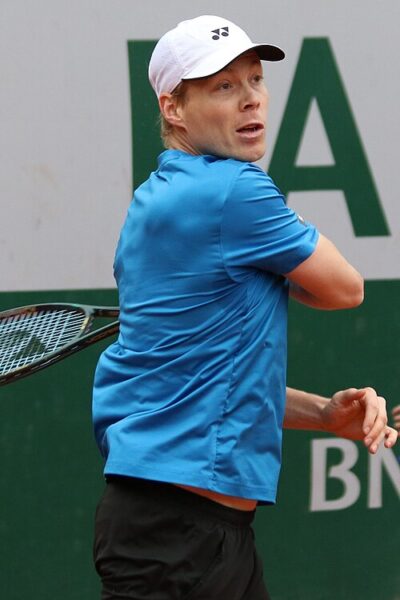
Harri Heliövaara
Harri Heliövaara is a Finnish tennis player. Born June 4, 1989, in Helsinki. Educated at Aalto University.
Facts
8 facts · 1 confirmed by two sources · 2 cited · 5 from one source
Where this comes from
Papalocal keeps its own record. It started from these sources; what each one said is kept here as it was copied, so a change on their side never changes this page by itself. Tap one to read its version.
What Wikidata says · copied November 18, 2026 · revision 2517786566
- Described as
- Finnish tennis player (born 1989)
- Born
- June 4, 1989 · 1 reference
- Born in
- Helsinki · 1 reference
- Citizen of
- Finland
- Occupation
- tennis player
- Education
- Aalto University
- Sport
- tennis · 1 reference
- Lived in
- Helsinki
- Height
- 1.88 m (6 ft 2 in)
- Wikipedias with a page
- 22
Wikidata item Q13534 (wikidata.org/wiki/Q13534), public domain (CC0). Copied November 18, 2026.
What Wikipedia says · copied November 18, 2026 · revision 1384868864
Harri Heliövaara (born 4 June 1989) is a Finnish professional tennis player who specializes in doubles. He has a career-high doubles ranking of world No. 1 by the ATP, achieved on 8 June 2026. He is a four-time Grand Slam champion in both doubles, at 2024 and 2026 Wimbledon and at the 2025 Australian Open with Henry Patten and in mixed doubles at the 2023 US Open with Anna Danilina.
Heliövaara has won 16 doubles titles on the ATP Tour. He also won 20 ITF Futures in doubles and eight ITF Futures titles in singles. He won the 2007 Australian Open boys' doubles title with Graeme Dyce.
He also attained his career-high singles ranking of No. 194 in December 2011. Heliövaara announced his retirement from professional tennis in 2013 but made a comeback in 2017.
- Born, in its opening lines
- June 4, 1989
From the Wikipedia article “Harri Heliövaara” (en.wikipedia.org/wiki/Harri_Heliövaara), by its contributors, under CC BY-SA 4.0 (creativecommons.org/licenses/by-sa/4.0/). Copied November 18, 2026; not changed.
Confirmed Two sources agree. Cited One source, and it names where it got it. One source One source, without a reference of its own. Sources disagree The sources disagree. We show the best-supported value and keep theirs below.
