
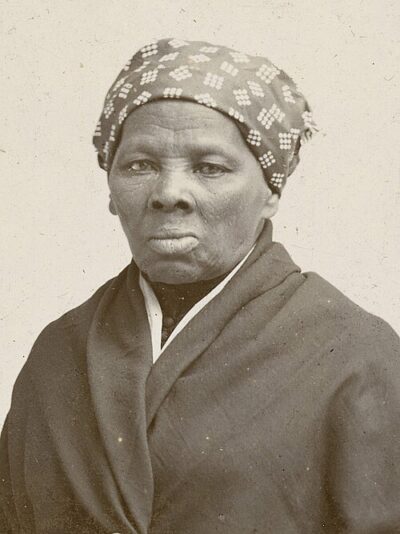
Harriet Tubman
Harriet Tubman was an African-American abolitionist. Born 1822, in Dorchester County. Died March 10, 1912, in Auburn. Awards include National Women's Hall of Fame, New Jersey Hall of Fame and Maryland Women's Hall of Fame.
Facts
31 facts · 1 confirmed by two sources · 19 cited · 10 from one source · 1 where the sources disagree
What’s different
- Born: we show 1822 (Confirmed). Wikidata also lists 1821 and 1820
- Died: we show March 10, 1912 (Sources disagree). Wikipedia says March 10, 1913
Where this comes from
Papalocal keeps its own record. It started from these sources; what each one said is kept here as it was copied, so a change on their side never changes this page by itself. Tap one to read its version.
What Wikidata says · copied November 13, 2026 · revision 2568724840
- Described as
- African-American abolitionist (1822–1913)
- Other names
- Harriet Tubman Davis, Araminta Ross Broadus, Minty Ross, Araminta Ross, Araminta Harriet Ross, Garriet Tabman, Black Moses, Harriet Ross Tubman
- Born
- 1821 · 5 references; 1820 · 1 reference; 1822 · 1 reference
- Died
- March 10, 1912
- Born in
- Dorchester County · 1 reference
- Died in
- Auburn · 2 references
- Buried in
- Harriet Tubman grave
- Cause of death
- pneumonia
- Name at birth
- Araminta Ross
- Citizen of
- United States · 3 references
- Occupation
- writer · 3 references; nurse · 1 reference; human rights defender · 1 reference; abolitionist · 1 reference; political activist · 1 reference; spy · 1 reference; suffragist; feminist · 2 references
- Worked for
- Harriet Tubman Home for the Aged · 1 reference
- Awards
- National Women's Hall of Fame (1973) · 1 reference; New Jersey Hall of Fame (2008) · 1 reference; Maryland Women's Hall of Fame (1985) · 1 reference; Person of National Historic Significance · 1 reference
- Field
- abolitionism · 1 reference; women's rights · 1 reference; active suffrage · 1 reference
- Spouse
- John Tubman (1844–1851) · 1 reference; Nelson Davis
- Children
- Gertie Davis
- Religion
- Christianity · 1 reference
- Lived in
- United States (–1859)
- Nickname
- Moses of her people; Moses · 1 reference
- Wikipedias with a page
- 108
Wikidata item Q102870 (wikidata.org/wiki/Q102870), public domain (CC0). Copied November 13, 2026.
What Wikipedia says · copied November 13, 2026 · revision 1380244851
Harriet Tubman (born Araminta Ross, c. March 1822 – March 10, 1913) was an American abolitionist and social activist. After escaping slavery, Tubman made some 13 missions to rescue approximately 70 enslaved people, including her family and friends, using the network of antislavery activists and safe houses known collectively as the Underground Railroad. During the American Civil War, she served as an armed scout and spy for the Union Army. In her later years, Tubman was an activist in the movement for women's suffrage.
Born into slavery in Dorchester County, Maryland, Tubman was beaten and whipped by enslavers as a child. Early in life, she suffered a traumatic head wound when an irate overseer threw a heavy metal weight, intending to hit another slave, but hit her instead. The injury caused dizziness, pain, and spells of hypersomnia, which occurred throughout her life. After her injury, Tubman began experiencing strange visions and vivid dreams, which she ascribed to premonitions from God. These experiences, combined with her Methodist upbringing, led her to become devoutly religious.
In 1849 Tubman escaped to Philadelphia, only to return to Maryland to rescue her family soon after. Slowly, one group at a time, she brought relatives with her out of the state, guiding dozens of other enslaved people to freedom. Tubman (or "Moses", as she was called) traveled by night and in extreme secrecy, and she later said she "never lost a passenger". After the Fugitive Slave Act of 1850 was passed, she helped guide escapees farther north into British North America (Canada) and helped newly freed people find work. Tubman met John Brown in 1858 and helped him plan and recruit supporters for his 1859 raid on Harpers Ferry.
When the Civil War began, Tubman worked for the Union Army, first as a cook and nurse and then as an armed scout and spy. For her guidance of the raid at Combahee Ferry, which liberated more than 700 enslaved people, she is widely credited as the first woman to lead an armed military operation in the United States. After the war, she retired to the family home on property she had purchased in 1859 in Auburn, New York, where she cared for her aging parents. She was active in the women's suffrage movement until illness overtook her and she was admitted to a home for elderly African Americans, which she had helped establish years earlier. Tubman is commonly viewed as an icon of courage and freedom.
- Born, in its opening lines
- March 1822
- Died, in its opening lines
- March 10, 1913
From the Wikipedia article “Harriet Tubman” (en.wikipedia.org/wiki/Harriet_Tubman), by its contributors, under CC BY-SA 4.0 (creativecommons.org/licenses/by-sa/4.0/). Copied November 13, 2026; not changed.
Confirmed Two sources agree. Cited One source, and it names where it got it. One source One source, without a reference of its own. Sources disagree The sources disagree. We show the best-supported value and keep theirs below.
