
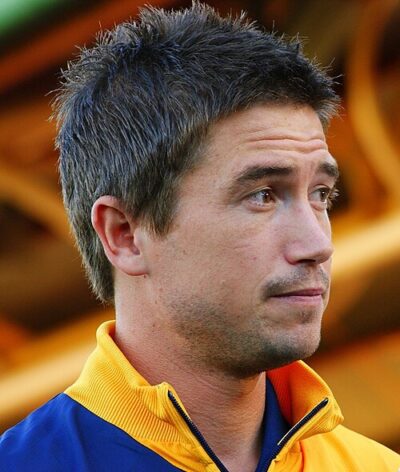
Harry Kewell
Harry Kewell is an Australian association football player and coach. Born September 22, 1978, in Sydney. Teams include Melbourne Victory FC (2011–2012), Leeds United F.C. (1996–2003) and Galatasaray S.K. (2008–2011). Educated at St Johns Park High School and Westfields Sports High School. Awards include Athlete Member of the Sport Australia Hall of Fame.
Facts
20 facts · 1 confirmed by two sources · 1 cited · 18 from one source
Where this comes from
Papalocal keeps its own record. It started from these sources; what each one said is kept here as it was copied, so a change on their side never changes this page by itself. Tap one to read its version.
What Wikidata says · copied November 16, 2026 · revision 2564543847
- Described as
- Australian association football player and coach (born 1978)
- Other names
- Harold Kewell, Kewell
- Born
- September 22, 1978 · 3 references
- Born in
- Sydney
- Citizen of
- Australia
- Occupation
- association football player (–2013); association football coach
- Education
- St Johns Park High School; Westfields Sports High School
- Teams
- Melbourne Victory FC (2011–2012); Leeds United F.C. (1996–2003); Galatasaray S.K. (2008–2011); Liverpool F.C. (2003–2008); Al-Gharafa SC (2013); Melbourne City FC (2013–2014); Australia national under-17 association football team (1994–1995); Australia men's national under-20 soccer team (1997); Australia men's national soccer team (1996–2012)
- Sport
- association football
- Awards
- Athlete Member of the Sport Australia Hall of Fame (2018) · 1 reference
- Spouse
- Sheree Murphy
- Height
- 1.80 m (5 ft 11 in)
- Wikipedias with a page
- 48
Wikidata item Q204429 (wikidata.org/wiki/Q204429), public domain (CC0). Copied November 16, 2026.
What Wikipedia says · copied November 16, 2026 · revision 1385932321
Harry Kewell (born 22 September 1978) is an Australian soccer manager and former professional player who is currently the head coach of V.League 1 club Hanoi FC.
As a domestic player, Kewell represented Leeds United, Liverpool, Galatasaray, Melbourne Victory, Al-Gharafa, and Melbourne Heart. While at Leeds, he was named the PFA Young Player of the Year in 2000. Internationally, he received 58 caps and scored 17 goals while playing for Australia. A left winger also capable of playing as an attacking midfielder or second striker, he is often regarded by the media as "Australia's finest soccer export", despite his career being blighted by injury. In 2012, Kewell was named Australia's greatest soccer player in a vote by fans, players, and the media.
Kewell scored a crucial goal against Croatia that took Australia through to the knockout stages of the 2006 FIFA World Cup, only the Australian national team's second World Cup appearance. He is a member of the Executive Committee of the Australian Professional Footballers' Association. Kewell also holds a British passport through his father's heritage. Former Middlesbrough midfielder-turned-pundit Robbie Mustoe named Kewell as one of the greatest players he had faced but questioned his consistency and attitude following his initial injuries. Former German international Michael Ballack has also highlighted both Kewell's ability and his inconsistency.
Kewell represented Australia at the 1995 FIFA U-17 World Championship, the 1997 FIFA Confederations Cup (where Australia finished as runners-up), the 2004 OFC Nations Cup (which Australia claimed for the fourth time), the 2006 FIFA World Cup, the 2007 AFC Asian Cup, the 2010 FIFA World Cup, and the 2011 AFC Asian Cup (where Australia finished as runners-up).
Kewell is the only Australian man to have played in a UEFA Champions League final, featuring in the Liverpool squad that won the 2005 UEFA Champions League final.
- Born, in its opening lines
- September 22, 1978
From the Wikipedia article “Harry Kewell” (en.wikipedia.org/wiki/Harry_Kewell), by its contributors, under CC BY-SA 4.0 (creativecommons.org/licenses/by-sa/4.0/). Copied November 16, 2026; not changed.
Confirmed Two sources agree. Cited One source, and it names where it got it. One source One source, without a reference of its own. Sources disagree The sources disagree. We show the best-supported value and keep theirs below.
