
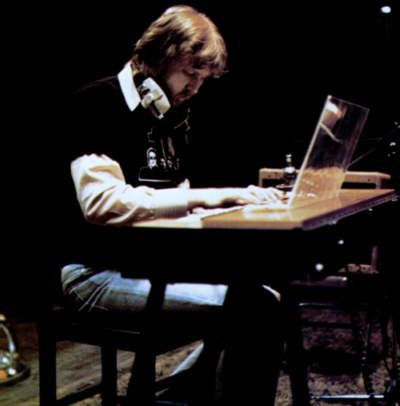
Harry Nilsson
Harry Nilsson was an American singer-songwriter. Born June 15, 1941, in Brooklyn. Died January 15, 1994, in Agoura Hills. Known for Nilsson Schmilsson and Everybody's Talkin'. Educated at Daniel Murphy High School. Awards include Grammy Award for Best Male Pop Vocal Performance (2 times).
Facts
37 facts · 2 confirmed by two sources · 16 cited · 18 from one source · 1 where the sources disagree
What’s different
- Born in: we show Brooklyn (Sources disagree). Wikidata also lists New York City
Where this comes from
Papalocal keeps its own record. It started from these sources; what each one said is kept here as it was copied, so a change on their side never changes this page by itself. Tap one to read its version.
What Wikidata says · copied November 15, 2026 · revision 2563901895
- Described as
- American singer-songwriter (1941–1994)
- Other names
- Harry Edward Nilsson III, Nilsson
- Born
- June 15, 1941 · 7 references
- Died
- January 15, 1994 · 7 references
- Born in
- Brooklyn · 2 references; New York City · 1 reference
- Died in
- Agoura Hills · 3 references
- Buried in
- Valley Oaks Memorial Park · 1 reference
- Cause of death
- heart failure · 1 reference
- Name at birth
- Harry Edward Nilsson III · 1 reference
- Citizen of
- United States · 2 references
- Occupation
- singer-songwriter · 1 reference; musician · 3 references; singer · 2 references; composer · 2 references; songwriter · 2 references; pianist; actor · 1 reference; screenwriter · 1 reference
- Education
- Daniel Murphy High School
- Genre
- rock music; soft rock; baroque pop; psychedelic rock; sunshine pop; Brill Building
- Instrument
- guitar · 1 reference; piano · 1 reference; voice · 1 reference
- Record label
- Tower Records; RCA Records; Mercury Records; RCA Victor; Musicor Records; PolyGram
- Known for
- Nilsson Schmilsson · 1 reference; Everybody's Talkin' · 1 reference
- Awards
- Grammy Award for Best Male Pop Vocal Performance (2 times) (1970, 1973) · 2 references
- Field
- gun control
- Website
- http://www.harrynilsson.com
- Wikipedias with a page
- 39
Wikidata item Q281034 (wikidata.org/wiki/Q281034), public domain (CC0). Copied November 15, 2026.
What Wikipedia says · copied November 15, 2026 · revision 1385056409
Harold Edward Nilsson III (June 15, 1941 – January 15, 1994), usually credited as Harry Nilsson, sometimes credited as Nilsson, was an American singer and songwriter known for his versatile tenor range, pioneering use of vocal overdubbing, explorations of the Great American Songbook, and Caribbean fusion sounds. He was one of the few major pop-rock artists to achieve significant commercial success without touring or performing large-scale public concerts.
Born in Brooklyn, Nilsson moved to Los Angeles as a teenager to escape his family's poor financial situation and, starting in 1962, pursued songwriting while working as a computer programmer at a bank. He debuted on RCA Victor with the 1967 album Pandemonium Shadow Show, which began a creative partnership with arranger George Tipton that lasted until 1971. His albums over this period included Nilsson Sings Newman, a collaboration with Randy Newman, and The Point!, an original children's story. Between 1968 and 1974, nine of his singles reached the U.S. or UK top 40, including the top 10 hits "Everybody's Talkin'", "Without You", and "Coconut"; other artists enjoyed success with his songs "One" and "The Puppy Song". His albums Nilsson Schmilsson and Son of Schmilsson, produced under Richard Perry, were certified gold by the RIAA, indicating over 500,000 units sold each.
In the early to mid-1970s, Nilsson was affected by periods of substance abuse and erratic behavior; his voice degraded markedly after A Little Touch of Schmilsson in the Night, which preceded the popular trend of standards albums by a decade. Sometimes called "the American Beatle", he formed close friendships with John Lennon, who produced his album Pussy Cats, and Ringo Starr, together sharing a core studio ensemble, record appearances, and membership in the Hollywood Vampires drinking club. His recording output diminished following his final RCA album, Knnillssonn and, after providing songs to the musical film Popeye, he increasingly referred to himself as "a retired musician". Responding to Lennon's 1980 murder, he focused on gun control activism and subsequently recorded sporadically. He died of heart failure in 1994 before he was able to finish his last album, Papa's Got a Brown New Robe.
Nilsson received two Grammy Awards (for "Everybody's Talkin'" and "Without You") and was voted number 62 in Rolling Stone's 2015 list of the "100 Greatest Songwriters of All Time", where he was described as "a pioneer of the Los Angeles studio sound" and "a crucial bridge" between 1960s psychedelia and the 1970s singer-songwriter era. He is credited with creating the first remix album (Aerial Pandemonium Ballet) and mashup song ("You Can't Do That"), as well as influencing a movement of indie rock musicians through his songwriting and the defiant attitude he projected. His songs have featured prominently in many film and television soundtracks since the 1990s.
- Born, in its opening lines
- June 15, 1941
- Died, in its opening lines
- January 15, 1994
From the Wikipedia article “Harry Nilsson” (en.wikipedia.org/wiki/Harry_Nilsson), by its contributors, under CC BY-SA 4.0 (creativecommons.org/licenses/by-sa/4.0/). Copied November 15, 2026; not changed.
Confirmed Two sources agree. Cited One source, and it names where it got it. One source One source, without a reference of its own. Sources disagree The sources disagree. We show the best-supported value and keep theirs below.
