
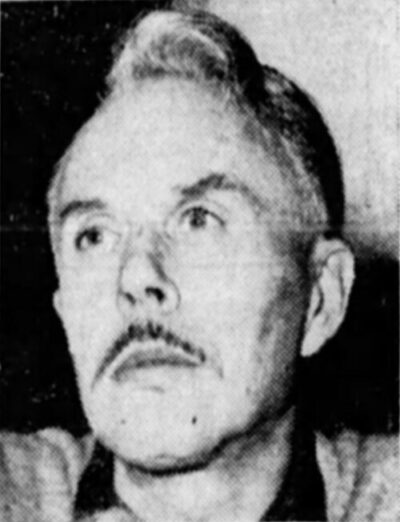
Harry Partch
Harry Partch was an American composer, music theorist, creator of musical instruments. Born June 24, 1901, in Oakland. Died September 3, 1974, in San Diego. Awards include Guggenheim Fellowship (3 times).
Facts
17 facts · 2 confirmed by two sources · 5 cited · 9 from one source · 1 where the sources disagree
What’s different
- Born in: we show Oakland (Sources disagree). Wikidata also lists California
Where this comes from
Papalocal keeps its own record. It started from these sources; what each one said is kept here as it was copied, so a change on their side never changes this page by itself. Tap one to read its version.
What Wikidata says · copied November 15, 2026 · revision 2533933037
- Described as
- American composer, music theorist, creator of musical instruments
- Born
- June 24, 1901 · 7 references
- Died
- September 3, 1974 · 9 references
- Born in
- California; Oakland · 2 references
- Died in
- San Diego · 1 reference
- Cause of death
- myocardial infarction
- Citizen of
- United States
- Occupation
- composer · 2 references; musicologist; music theorist; musical instrument maker · 1 reference; inventor · 1 reference
- Genre
- avant-garde · 1 reference; outsider music
- Instrument
- viola; experimental musical instrument
- Record label
- Columbia Records
- Awards
- Guggenheim Fellowship (3 times) (1943, 1944, 1950) · 1 reference
- Wikipedias with a page
- 36
Wikidata item Q201494 (wikidata.org/wiki/Q201494), public domain (CC0). Copied November 15, 2026.
What Wikipedia says · copied November 15, 2026 · revision 1382874167
Harry Partch (June 24, 1901 – September 3, 1974) was an American composer, music theorist, and creator of unique musical instruments. He composed using scales of unequal intervals in just intonation, and was one of the first 20th-century composers in the West to work systematically with microtonal scales, alongside Lou Harrison. He built his own instruments in these tunings on which to play his compositions, and described the method behind his theory and practice in his book Genesis of a Music (1947).
Partch composed with scales dividing the octave into 43 unequal tones derived from the natural harmonic series; these scales allowed for more tones of smaller intervals than in standard Western tuning, which uses twelve equal intervals to the octave. To play his music, Partch built many unique instruments, with such names as the Chromelodeon, the Quadrangularis Reversum, and the Zymo-Xyl. Partch described his music as "corporeal" (emphasizing its physical/visceral elements), and distinguished it from abstract music, which he perceived as the dominant trend in Western music since the time of J.S. Bach, whose seminal book of preludes and fugues called The Well-tempered Clavier (in German, Das wohltemperierte Klavier) is often cited as the pivot point beyond which older mean-tone and ancient just intonation tunings were abandoned (in the late-18th century) and the then-future of Western Classical (and popular) instruments were (and most are still) based, for exploitation of all 24 theoretical key signatures. Partch's earliest compositions were small-scale pieces to be intoned with simple folkloric-like string instrumental backing; his later works were large-scale (like a fusion of theater and music decidedly related to but quite apart from Wagnerian opera), they were integrated theater productions in which he expected each of the performers to sing, dance, speak, and play instruments in a "corporeal apotheosis". Ancient Greek theatre and Japanese Noh and kabuki heavily influenced Harry Partch's music theatre.
Encouraged by his mother, Partch learned several instruments at a young age. By fourteen, he was composing, and in particular took to setting dramatic situations. He dropped out of the University of Southern California's School of Music in 1922, dissatisfied with the quality of his teachers. He took to self-study in San Francisco's libraries, where he discovered Hermann von Helmholtz's Sensations of Tone, which convinced him to devote himself to music based on scales tuned in just intonation. In 1930, he burned all his previous compositions in a rejection of the European concert tradition. Partch frequently moved around the US. Early in his career, he was a transient worker, and sometimes a hobo; later he depended on grants, university appointments, and record sales to support himself. In 1970, supporters created the Harry Partch Foundation to administer Partch's music and instruments.
- Born, in its opening lines
- June 24, 1901
- Died, in its opening lines
- September 3, 1974
From the Wikipedia article “Harry Partch” (en.wikipedia.org/wiki/Harry_Partch), by its contributors, under CC BY-SA 4.0 (creativecommons.org/licenses/by-sa/4.0/). Copied November 15, 2026; not changed.
Confirmed Two sources agree. Cited One source, and it names where it got it. One source One source, without a reference of its own. Sources disagree The sources disagree. We show the best-supported value and keep theirs below.
