
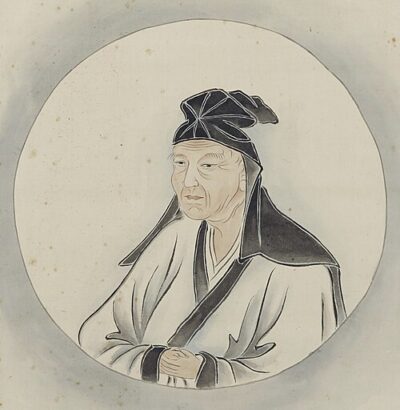
Hayashi Razan was a Japanese philosopher. Born August 1583, in Kyoto. Died March 7, 1657, in Edo. Known for Honchō Tsugan and Kan'ei Shoka Keizuden. Educated at Kennin-ji Temple.
Facts
15 facts · 2 confirmed by two sources · 1 cited · 12 from one source
Where this comes from
Papalocal keeps its own record. It started from these sources; what each one said is kept here as it was copied, so a change on their side never changes this page by itself. Tap one to read its version.
What Wikidata says · copied November 18, 2026 · revision 2570657478
- Described as
- Japanese philosopher (1583–1657)
- Other names
- Hayashi Nobukatsu, Hayashi Dōshun
- Born
- August 1583 · 1 reference
- Died
- March 7, 1657 · 1 reference
- Born in
- Kyoto
- Died in
- Edo
- Buried in
- Ichigaya-Yamabushichō
- Name at birth
- 信勝
- Citizen of
- Japan
- Occupation
- philosopher; scholar · 1 reference
- Education
- Kennin-ji Temple
- Known for
- Honchō Tsugan; Kan'ei Shoka Keizuden
- Children
- Hayashi Gahō; Hayashi Dokkōsai
- Religion
- Confucianism
- Wikipedias with a page
- 21
Wikidata item Q558279 (wikidata.org/wiki/Q558279), public domain (CC0). Copied November 18, 2026.
What Wikipedia says · copied November 18, 2026 · revision 1350827504
Hayashi Razan (林 羅山; 1583 – March 7, 1657), also known as Hayashi Dōshun, was a Japanese historian, philosopher, political consultant, and writer, serving as a tutor and an advisor to the first four shōguns of the Tokugawa bakufu. He is also attributed with first listing the Three Views of Japan. Razan was the founder of the Hayashi clan of Confucian scholars.
Razan was an influential scholar, teacher and administrator. Together with his sons and grandsons, he is credited with establishing the official neo-Confucian doctrine of the Tokugawa shogunate. Razan's emphasis on the values inherent in a static conservative perspective provided the intellectual underpinnings for the Edo bakufu. Razan also reinterpreted Shinto, and thus created a foundation for the eventual development of Confucianised Shinto in the 20th century.
The intellectual foundation of Razan's life's work was based on early studies with Fujiwara Seika (1561–1619), the first Japanese scholar who is known for a close study of Confucius and the Confucian commentators. This kuge noble had become a Buddhist priest; but Fujiwara's dissatisfaction with the philosophy and doctrines of Buddhism led him to a study of Confucianism. In due course, Fujiwara drew other similarly motivated scholars to join him in studies which were greatly influenced by the work of Chinese Neo-Confucianist Zhu Xi, a philosopher of the Song dynasty. Zhu Xi and Fujiwara emphasized the role of the individual as a functionary of a society which naturally settles into a certain hierarchical form. He separated people into four distinct classes: samurai (ruling class), farmers, artisans and merchants.
- Born, in its opening lines
- 1583
- Died, in its opening lines
- March 7, 1657
From the Wikipedia article “Hayashi Razan” (en.wikipedia.org/wiki/Hayashi_Razan), by its contributors, under CC BY-SA 4.0 (creativecommons.org/licenses/by-sa/4.0/). Copied November 18, 2026; not changed.
Confirmed Two sources agree. Cited One source, and it names where it got it. One source One source, without a reference of its own. Sources disagree The sources disagree. We show the best-supported value and keep theirs below.
