
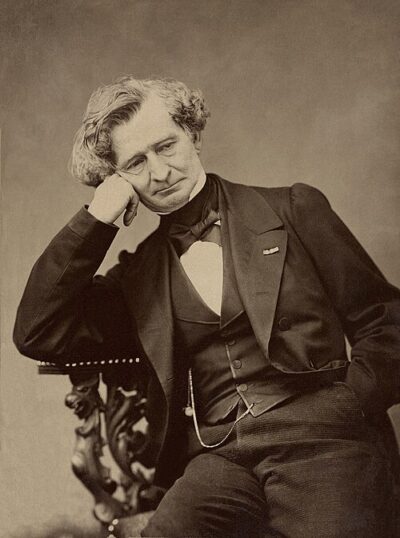
Hector Berlioz
Hector Berlioz was a French composer and conductor. Born December 11, 1803, in La Côte-Saint-André. Died March 8, 1869, in Paris. Known for Requiem, Roméo et Juliette and Symphonie fantastique. Educated at Conservatoire de Paris. Awards include Prix de Rome, Officer of the Legion of Honour and Knight of the Legion of Honour.
Facts
51 facts · 2 confirmed by two sources · 16 cited · 33 from one source
Where this comes from
Papalocal keeps its own record. It started from these sources; what each one said is kept here as it was copied, so a change on their side never changes this page by itself. Tap one to read its version.
What Wikidata says · copied November 16, 2026 · revision 2568846132
- Described as
- French composer and conductor (1803–1869)
- Other names
- Ludovicus Hector Berlioz, Hector Louis Berlioz, Гектор Берлиоз, ルイ・エクトル・ベルリオーズ, Louis Hector Berlioz, Ludoviko Hektoro Berlioz, Берлиоз, Гектор Луи, Hektors Berliozs, Louis-Hector Berlioz, Ettore Berlioz, ベルリオーズ, Гектор Луи Берлиоз
- Born
- December 11, 1803 · 20 references
- Died
- March 8, 1869 · 17 references
- Born in
- La Côte-Saint-André · 2 references
- Died in
- Paris · 4 references
- Buried in
- Montmartre Cemetery · 1 reference
- Name at birth
- Louis-Hector Berlioz
- Citizen of
- France
- Occupation
- conductor · 1 reference; writer · 2 references; autobiographer; music critic · 2 references; librettist; virtuoso; librarian; composer · 3 references
- Education
- Conservatoire de Paris
- Member of
- Royal Swedish Academy of Music; Académie des beaux-arts (1856–1869); Prussian Academy of Arts (1845–1869) · 1 reference
- Genre
- opera; symphony; classical music; Romantic music
- Instrument
- guitar; flageolet · 1 reference; flute · 1 reference; saxophone
- Known for
- Requiem; Roméo et Juliette; Symphonie fantastique; La damnation de Faust; Les Troyens; Le carnaval romain; Les Nuits d'Été; Béatrice et Bénédict; Benvenuto Cellini
- Awards
- Prix de Rome; Officer of the Legion of Honour (1864) · 1 reference; Knight of the Legion of Honour (1839)
- Field
- art music · 1 reference; music · 1 reference; music composing · 2 references; conducting · 1 reference; composed musical work · 1 reference; music composition · 1 reference
- Spouse
- Harriet Smithson · 1 reference; Marie Recio · 1 reference
- Children
- Louis Berlioz · 1 reference
- Father
- Louis Berlioz
- Religion
- atheism
- Website
- http://www.hberlioz.com
- Wikipedias with a page
- 135
Wikidata item Q1151 (wikidata.org/wiki/Q1151), public domain (CC0). Copied November 16, 2026.
What Wikipedia says · copied November 16, 2026 · revision 1378120952
Louis-Hector Berlioz (11 December 1803 – 8 March 1869) was a French Romantic composer, conductor and critic. His output includes orchestral works such as the Symphonie fantastique and Harold in Italy, choral pieces including the Requiem and L'Enfance du Christ, his three operas Benvenuto Cellini, Les Troyens and Béatrice et Bénédict, and works of hybrid genres such as the "dramatic symphony" Roméo et Juliette and the "dramatic legend" La Damnation de Faust.
The elder son of a provincial physician, Berlioz was expected to follow his father into medicine, and he attended a Parisian medical college before defying his family by taking up music as a profession. His independence of mind and refusal to follow traditional rules and formulas put him at odds with the conservative musical establishment of Paris. He briefly moderated his style sufficiently to win France's premier music prize – the Prix de Rome – in 1830, but he learned little from the academics of the Paris Conservatoire. Opinion was divided for many years between those who thought him an original genius and those who viewed his music as lacking in form and coherence.
At the age of twenty-four Berlioz fell in love with the Irish Shakespearean actress Harriet Smithson, and he pursued her obsessively until she finally accepted him seven years later. Their marriage was happy at first but eventually foundered. Harriet inspired his first major success, the Symphonie fantastique, in which an idealised depiction of her occurs throughout as an idée fixe.
Berlioz completed three operas, the first of which, Benvenuto Cellini, was an outright failure. The second, the epic Les Troyens (The Trojans), was so large in scale that it was never staged in its entirety during his lifetime. His last opera, Béatrice et Bénédict – based on Shakespeare's comedy Much Ado About Nothing – was a success at its premiere but did not enter the regular operatic repertoire. Meeting only occasional success in France as a composer, Berlioz increasingly turned to conducting, in which he gained an international reputation. He was highly regarded in Germany, Britain and Russia both as a composer and as a conductor. To supplement his earnings he wrote musical journalism throughout much of his career; some of it has been preserved in book form, including his Treatise on Instrumentation (1844), which was influential in the 19th and 20th centuries. Berlioz died in Paris at the age of 65.
- Born, in its opening lines
- December 11, 1803
- Died, in its opening lines
- March 8, 1869
From the Wikipedia article “Hector Berlioz” (en.wikipedia.org/wiki/Hector_Berlioz), by its contributors, under CC BY-SA 4.0 (creativecommons.org/licenses/by-sa/4.0/). Copied November 16, 2026; not changed.
Confirmed Two sources agree. Cited One source, and it names where it got it. One source One source, without a reference of its own. Sources disagree The sources disagree. We show the best-supported value and keep theirs below.
