
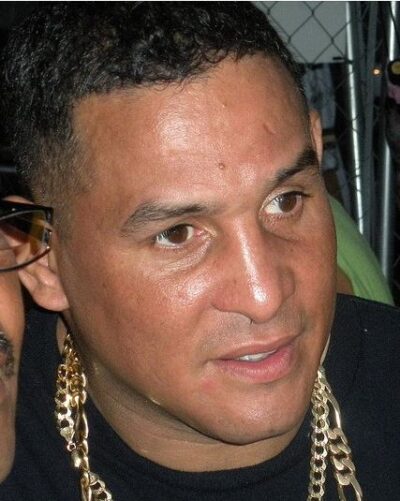
Héctor Camacho
Héctor Camacho was a Puerto Rican boxer. Born May 24, 1962, in Bayamón. Died November 24, 2012, in San Juan. Awards include WBO World Junior Welterweight Champion, International Boxing Hall of Fame and WBC World Lightweight Champion.
Facts
14 facts · 2 confirmed by two sources · 4 cited · 8 from one source
Where this comes from
Papalocal keeps its own record. It started from these sources; what each one said is kept here as it was copied, so a change on their side never changes this page by itself. Tap one to read its version.
What Wikidata says · copied November 16, 2026 · revision 2569217755
- Described as
- Puerto Rican boxer (1962–2012)
- Other names
- Hector Camacho
- Born
- May 24, 1962 · 1 reference
- Died
- November 24, 2012 · 1 reference
- Born in
- Bayamón
- Died in
- San Juan
- Buried in
- Saint Raymond's Cemetery
- Citizen of
- United States
- Occupation
- boxer · 1 reference
- Sport
- boxing
- Awards
- WBO World Junior Welterweight Champion (1989–1992) · 1 reference; International Boxing Hall of Fame (2016) · 1 reference; WBC World Lightweight Champion (1985–1987) · 1 reference; WBC World Super Featherweight Champion (1983–1984) · 1 reference
- Children
- Héctor Camacho, Jr.
- Height
- 1.69 m (5 ft 7 in)
- Wikipedias with a page
- 21
Wikidata item Q114355 (wikidata.org/wiki/Q114355), public domain (CC0). Copied November 16, 2026.
What Wikipedia says · copied November 16, 2026 · revision 1373840407
Héctor Luís Camacho Matías (May 24, 1962 – November 24, 2012), commonly known by his nickname "Macho Camacho", was a Puerto Rican professional boxer. Known for his quickness in the ring and flamboyant style, Camacho competed professionally from 1980 to 2010, and was a world champion in three weight classes. He held the WBC super featherweight title from 1983 to 1984, the WBC lightweight title from 1985 to 1987, and the WBO junior welterweight title twice between 1989 and 1992.
In a storied amateur career, Camacho won three New York Golden Gloves tournaments, beginning with the Sub-Novice 112 lbs championship in 1978. During his professional career, Camacho had many notable fights against some of the biggest names in boxing, defeating Rafael Limon, Jose Luis Ramirez, Edwin Rosario, Ray Mancini, Vinny Paz, Greg Haugen, Roberto Durán twice late in Duran's career, and knocking out Sugar Ray Leonard. He also fought Julio César Chávez, Félix Trinidad, and Oscar De La Hoya, among others.
During his later years, Camacho expanded his popular role and appeared on a variety of Spanish-language reality television shows including Univision's' dancing show Mira Quien Baila and a weekly segment on the popular show El Gordo y La Flaca, named "Macho News". However, he also had much-publicized troubles with drug abuse and criminal charges. In 2005, was sentenced to seven years in prison for burglarizing a computer store, but the judge suspended six years, allowing him to serve one year under house arrest and two years of probation if monitored by Puerto Rican authorities. He also faced a separate drug charge after ecstasy pills were found in his hotel room. In 2011 he was shot at three times by would-be carjackers in San Juan, but was uninjured. In late 2012, Camacho was awaiting trial in Florida on charges of physical abuse of one of his sons.
On November 20, 2012, Camacho was shot and seriously wounded while sitting in a car outside a bar in his native Bayamón; the driver, a childhood friend, was killed in the shooting. Camacho died four days later; after he was declared clinically brain dead, his mother requested the doctors remove him from life support. After lying in repose for two days in Santurce, Camacho's remains were transported to New York for burial at the request of his mother.
- Born, in its opening lines
- May 24, 1962
- Died, in its opening lines
- November 24, 2012
From the Wikipedia article “Héctor Camacho” (en.wikipedia.org/wiki/Héctor_Camacho), by its contributors, under CC BY-SA 4.0 (creativecommons.org/licenses/by-sa/4.0/). Copied November 16, 2026; not changed.
Confirmed Two sources agree. Cited One source, and it names where it got it. One source One source, without a reference of its own. Sources disagree The sources disagree. We show the best-supported value and keep theirs below.
