
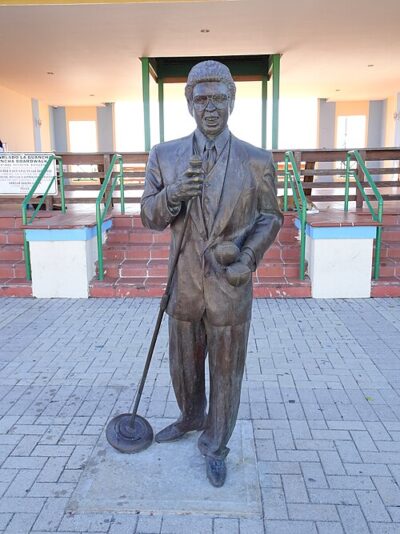
Héctor Lavoe
Héctor Lavoe was a Puerto Rican salsa singer. Born September 30, 1946, in Ponce. Died June 29, 1993, in New York City. Educated at Instituto de Música Juan Morel Campos.
Facts
20 facts · 2 confirmed by two sources · 3 cited · 14 from one source · 1 where the sources disagree
What’s different
- Buried in: we show Saint Raymond's Cemetery (Sources disagree). Wikidata also lists Cementerio Civil de Ponce
Where this comes from
Papalocal keeps its own record. It started from these sources; what each one said is kept here as it was copied, so a change on their side never changes this page by itself. Tap one to read its version.
What Wikidata says · copied November 16, 2026 · revision 2569398014
- Described as
- Puerto Rican salsa singer (1946–1993)
- Other names
- Héctor Juan Pérez Martínez
- Born
- September 30, 1946 · 1 reference
- Died
- June 29, 1993 · 2 references
- Born in
- Ponce
- Died in
- New York City
- Buried in
- Saint Raymond's Cemetery; Cementerio Civil de Ponce
- Citizen of
- United States
- Occupation
- singer · 1 reference; composer; record producer; musician · 1 reference; songwriter · 1 reference
- Education
- Instituto de Música Juan Morel Campos
- Member of
- Fania All-Stars (1968–1990); Willie Colón & Héctor Lavoe
- Genre
- salsa
- Instrument
- maraca; voice
- Record label
- Fania Records
- Height
- 1.73 m (5 ft 8 in)
- Website
- http://www.hectorlavoe.com/
- Wikipedias with a page
- 23
Wikidata item Q555195 (wikidata.org/wiki/Q555195), public domain (CC0). Copied November 16, 2026.
What Wikipedia says · copied November 16, 2026 · revision 1378693060
Héctor Juan Pérez Martínez (September 30, 1946 – June 29, 1993), better known as Héctor Lavoe, was a Puerto Rican salsa singer. Widely regarded as one of salsa's most important and influential vocalists, Lavoe played a pivotal role in popularizing the genre throughout the 1960s, 1970s, and 1980s. His charismatic persona and artistic vision propelled him to become one of the most successful Latin music artists of all time.
Lavoe was born and raised in the Machuelo Abajo barrio of Ponce, Puerto Rico. Early in his life, he attended Escuela Libre de Música de Ponce, known today as the Instituto de Música Juan Morel Campos and, inspired by Jesús Sánchez Erazo, developed an interest in music. He moved to New York City on May 3, 1963, at the age of sixteen. Shortly after his arrival, he worked as the singer in a sextet formed by Roberto García. During this period, he performed with several other groups, including Orquesta New York, Kako All-Stars, and Johnny Pacheco's band.
In 1967, Lavoe joined Willie Colón's band as its vocalist, recording several hit songs, including "El Malo" and "Canto a Borinquen." Lavoe moved on to become a soloist and formed his own band performing as lead vocalist. As a soloist, Lavoe recorded several hits including: "El cantante" composed by Rubén Blades, "Bandolera" composed by Colón, and "Periódico de ayer", composed by Tite Curet Alonso. During this period he was frequently featured as a guest singer with the Fania All-Stars recording numerous tracks with the band.
In 1979, Lavoe became deeply depressed and sought the help of a high priest of the Santería faith to treat his drug addiction. After a short rehabilitation, he relapsed following the deaths of his father, son, and mother-in-law. These events, along with being diagnosed with HIV from intravenous drug use, drove Lavoe to attempt suicide by jumping off the 9th floor of a Condado hotel room balcony in San Juan, Puerto Rico on June 26, 1988. He survived the attempt and recorded an album before his health began failing. Lavoe died on June 29, 1993, from a complication of AIDS.
- Born, in its opening lines
- September 30, 1946
- Died, in its opening lines
- June 29, 1993
From the Wikipedia article “Héctor Lavoe” (en.wikipedia.org/wiki/Héctor_Lavoe), by its contributors, under CC BY-SA 4.0 (creativecommons.org/licenses/by-sa/4.0/). Copied November 16, 2026; not changed.
Confirmed Two sources agree. Cited One source, and it names where it got it. One source One source, without a reference of its own. Sources disagree The sources disagree. We show the best-supported value and keep theirs below.
