
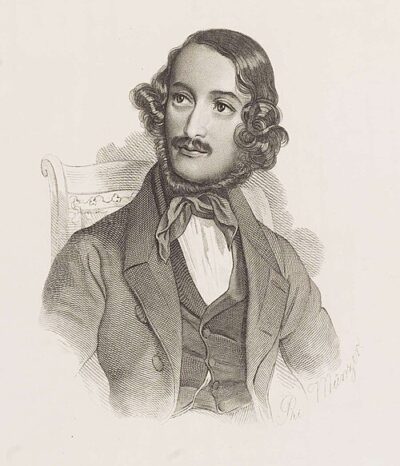
Heinrich Wilhelm Ernst
Heinrich Wilhelm Ernst was a Czech violinist, composer and violist. Born June 8, 1812, in Brno. Died October 8, 1865, in Nice.
Facts
14 facts · 2 confirmed by two sources · 7 cited · 5 from one source
Where this comes from
Papalocal keeps its own record. It started from these sources; what each one said is kept here as it was copied, so a change on their side never changes this page by itself. Tap one to read its version.
What Wikidata says · copied November 18, 2026 · revision 2568805995
- Described as
- Czech violinist, composer and violist (1814-1865)
- Born
- June 8, 1812 · 4 references
- Died
- October 8, 1865 · 5 references
- Born in
- Brno · 6 references
- Died in
- Nice · 3 references
- Citizen of
- Austrian Empire
- Occupation
- composer · 1 reference; violinist · 2 references; musician · 1 reference; violist · 1 reference
- Genre
- classical music
- Instrument
- viola; violin
- Field
- classical music · 1 reference
- Spouse
- Amélie Siona Ernst
- Wikipedias with a page
- 21
Wikidata item Q528748 (wikidata.org/wiki/Q528748), public domain (CC0). Copied November 18, 2026.
What Wikipedia says · copied November 18, 2026 · revision 1356493841
Heinrich Wilhelm Ernst (8 June 1812 – 8 October 1865) was a Moravian-Jewish violinist, violist and composer. He was seen as the outstanding violinist of his time and one of Niccolò Paganini's greatest successors. He contributed to polyphonic playing and discovered new ways to compose polyphonic violin music. His most famous, and technically difficult, compositions include the sixth of his Polyphonic Studies "Die letzte Rose", and Grand Caprice on Schubert's "Erlkönig".
- Born, in its opening lines
- June 8, 1812
- Died, in its opening lines
- October 8, 1865
From the Wikipedia article “Heinrich Wilhelm Ernst” (en.wikipedia.org/wiki/Heinrich_Wilhelm_Ernst), by its contributors, under CC BY-SA 4.0 (creativecommons.org/licenses/by-sa/4.0/). Copied November 18, 2026; not changed.
Confirmed Two sources agree. Cited One source, and it names where it got it. One source One source, without a reference of its own. Sources disagree The sources disagree. We show the best-supported value and keep theirs below.
