
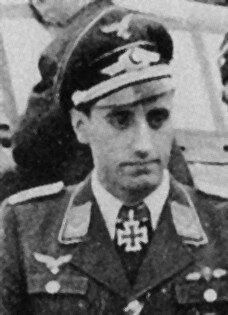
Heinz-Wolfgang Schnaufer
Heinz-Wolfgang Schnaufer was a German officer and fighter pilot during World War II. Born February 16, 1922, in Calw. Died July 15, 1950, in Bordeaux. Awards include German Cross in Gold and Knight's Cross of the Iron Cross with Oak Leaves, Swords and Diamonds.
Facts
13 facts · 2 confirmed by two sources · 0 cited · 11 from one source
Where this comes from
Papalocal keeps its own record. It started from these sources; what each one said is kept here as it was copied, so a change on their side never changes this page by itself. Tap one to read its version.
What Wikidata says · copied November 17, 2026 · revision 2552947369
- Described as
- German officer and fighter pilot during World War II (1922–1950)
- Other names
- Heinz Schnaufer
- Born
- February 16, 1922 · 1 reference
- Died
- July 15, 1950 · 1 reference
- Born in
- Calw
- Died in
- Bordeaux
- Buried in
- Calw
- Cause of death
- traffic collision
- Citizen of
- German Reich
- Occupation
- aircraft pilot; military personnel
- Awards
- German Cross in Gold; Knight's Cross of the Iron Cross with Oak Leaves, Swords and Diamonds
- Military branch
- Luftwaffe
- Military rank
- Major
- Wikipedias with a page
- 24
Wikidata item Q61156 (wikidata.org/wiki/Q61156), public domain (CC0). Copied November 17, 2026.
What Wikipedia says · copied November 17, 2026 · revision 1386247515
Heinz-Wolfgang Schnaufer (16 February 1922 – 15 July 1950) was a German Luftwaffe night-fighter pilot and the highest-scoring night fighter ace in the history of aerial warfare. A flying ace is a military aviator credited with shooting down five or more enemy aircraft during combat. All Schnaufer's 121 victories were claimed during World War II, mostly against British four-engine bombers, for which he was awarded the Knight's Cross of the Iron Cross with Oak Leaves, Swords and Diamonds, Germany's highest military decoration at the time, on 16 October 1944. He was nicknamed "The Spook of St. Trond", from the location of his unit's base in occupied Belgium.
Born in Calw, Schnaufer grew up in the Weimar Republic and Nazi Germany. Already a glider pilot at school, he began military service in the Wehrmacht by joining the Luftwaffe in 1939. After training at various pilot and fighter-pilot schools, he was posted to Nachtjagdgeschwader 1 (NJG 1—1st Night Fighter Wing), operating on the Western Front, in November 1941. He flew his first combat sorties in support of Operation Cerberus, the breakout of the German ships Scharnhorst, Gneisenau, and Prinz Eugen from Brest. Schnaufer participated in the Defence of the Reich campaign from 1942 onwards, in which he would achieve most of his success. He claimed his first aerial victory on the night of 1/2 June 1942. As the war progressed, he accumulated further victories and later became a squadron leader and group commander. He was awarded the Knight's Cross of the Iron Cross on 31 December 1943 for reaching 42 aerial victories.
Schnaufer achieved his 100th aerial victory on 9 October 1944 and was awarded the Diamonds to his Knight's Cross of the Iron Cross with Oak Leaves and Swords on 16 October. He was appointed Geschwaderkommodore (wing commander) of Nachtjagdgeschwader 4 (NJG 4) on 4 November. By the end of hostilities, Schnaufer's night-fighter crew held the unique distinction that every member—radio operator and air gunner—was decorated with the Knight's Cross of the Iron Cross. Schnaufer was taken prisoner of war by British forces in May 1945. After his release a year later, he returned to his home town and took over the family wine business. He sustained injuries in a road accident on 13 July 1950 during a wine-purchasing visit to France, and died in a Bordeaux hospital two days later.
- Born, in its opening lines
- February 16, 1922
- Died, in its opening lines
- July 15, 1950
From the Wikipedia article “Heinz-Wolfgang Schnaufer” (en.wikipedia.org/wiki/Heinz-Wolfgang_Schnaufer), by its contributors, under CC BY-SA 4.0 (creativecommons.org/licenses/by-sa/4.0/). Copied November 17, 2026; not changed.
Confirmed Two sources agree. Cited One source, and it names where it got it. One source One source, without a reference of its own. Sources disagree The sources disagree. We show the best-supported value and keep theirs below.
