
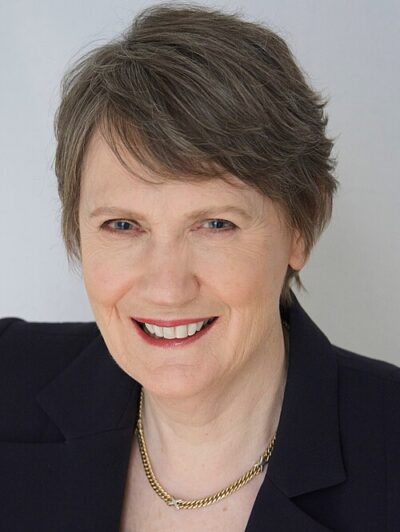
Helen Clark
Helen Clark is a Prime Minister of New Zealand from 1999 to 2008. Born February 26, 1950, in Te Pahu. Positions held include Administrator of the United Nations Development Programme (2009–), Prime Minister of New Zealand (1999–2008) and Leader of the Opposition (1993–1999). Educated at University of Auckland and Goodenough College. Awards include Order of New Zealand, Star of the Solomon Islands and Champions of the Earth.
Facts
35 facts · 1 confirmed by two sources · 8 cited · 26 from one source
Where this comes from
Papalocal keeps its own record. It started from these sources; what each one said is kept here as it was copied, so a change on their side never changes this page by itself. Tap one to read its version.
What Wikidata says · copied November 16, 2026 · revision 2570053792
- Described as
- Prime Minister of New Zealand from 1999 to 2008
- Other names
- Helen Elizabeth Clark, The Right Honourable Helen Elizabeth Clark, Helen E. Clark
- Born
- February 26, 1950 · 7 references
- Born in
- Te Pahu
- Name at birth
- Helen Elizabeth Clark
- Citizen of
- New Zealand · 1 reference
- Occupation
- politician · 1 reference; university teacher; political scientist · 1 reference
- Positions held
- Administrator of the United Nations Development Programme (2009–); Prime Minister of New Zealand (1999–2008); Leader of the Opposition (1993–1999); Deputy Prime Minister of New Zealand (1989–1990); Minister of Health (1989–1990); Member of the Privy Council of the United Kingdom (1990–) · 1 reference; Minister of Foreign Affairs (2008) · 1 reference; Minister of Conservation (1987–1989) · 1 reference; Member of the New Zealand Parliament · 1 reference
- Political party
- New Zealand Labour Party
- Worked for
- United Nations
- Education
- University of Auckland; Goodenough College
- Member of
- American Academy of Arts and Sciences; The Elders (2023–) · 1 reference
- Awards
- Order of New Zealand (2009–) · 1 reference; Star of the Solomon Islands (2005–); Champions of the Earth (2008–); honorary doctor of the University of Auckland (2009) · 2 references; BBC 100 Women (2013) · 1 reference; Order of Francisc Skorina (2016); Order of Friendship of Tajikistan · 1 reference; honorary doctor of the University of Waikato (2017) · 1 reference; Lifetime Achievement award (2017); New Zealand Suffrage Centennial Medal 1993 (1993) · 1 reference; Grand Cordon of the Order of the Rising Sun (2017)
- Spouse
- Peter Davis (1981–)
- Lived in
- Wellington (1993) · 1 reference
- Wikipedias with a page
- 79
Wikidata item Q180383 (wikidata.org/wiki/Q180383), public domain (CC0). Copied November 16, 2026.
What Wikipedia says · copied November 16, 2026 · revision 1385920074
Helen Elizabeth Clark (born 26 February 1950) is a New Zealand politician who served as the 37th prime minister of New Zealand from 1999 to 2008 and was the administrator of the United Nations Development Programme from 2009 to 2017. She was New Zealand's fifth-longest-serving prime minister, and the second woman to hold that office.
Clark was brought up on a farm outside Hamilton. She entered the University of Auckland in 1968 to study politics and became active in the New Zealand Labour Party. After graduating she lectured in political studies at the university. Clark entered local politics in 1974 in Auckland but was not elected to any position. Following one unsuccessful attempt, she was elected to Parliament in 1981 as the member for Mount Albert, an electorate she represented until 2009.
Clark held numerous Cabinet positions in the Fourth Labour Government, including minister of housing, minister of health and minister of conservation. She was the 11th deputy prime minister of New Zealand from 1989 to 1990 serving under prime ministers Geoffrey Palmer and Mike Moore. After Labour's narrow defeat in the 1993 election, Clark challenged Moore for leadership of the party and won, becoming the leader of the Opposition. Following the 1999 election, Labour formed a governing coalition, and Clark was sworn in as prime minister on 10 December 1999.
Clark led the Fifth Labour Government, which implemented several major economic initiatives including Kiwibank, the New Zealand Superannuation Fund, the New Zealand Emissions Trading Scheme and KiwiSaver. Her government also introduced the Foreshore and Seabed Act 2004, which caused major controversy. In foreign affairs, Clark sent troops to the Afghanistan War, but did not contribute combat troops to the Iraq War, and ordered deployment to the 2006 East Timorese crisis. She was ranked by Forbes as the 20th-most powerful woman in the world in 2006. She advocated a number of free-trade agreements with major trading partners, including becoming the first developed nation to sign such an agreement with China. After three successive electoral victories, her government was defeated in the 2008 election; Clark resigned as prime minister and party leader on 19 November 2008. She was succeeded as prime minister by John Key of the National Party, and as leader of the Labour Party by Phil Goff.
Clark resigned from Parliament in April 2009 to become the first female head of the United Nations Development Programme (UNDP). In 2016, she stood for the position of secretary-general of the United Nations, but was unsuccessful. She left her UNDP administrator post on 19 April 2017 at the end of her second four-year term and was succeeded by Achim Steiner. In 2019, Clark became the patron of the Helen Clark Foundation.
- Born, in its opening lines
- February 26, 1950
From the Wikipedia article “Helen Clark” (en.wikipedia.org/wiki/Helen_Clark), by its contributors, under CC BY-SA 4.0 (creativecommons.org/licenses/by-sa/4.0/). Copied November 16, 2026; not changed.
Confirmed Two sources agree. Cited One source, and it names where it got it. One source One source, without a reference of its own. Sources disagree The sources disagree. We show the best-supported value and keep theirs below.
