
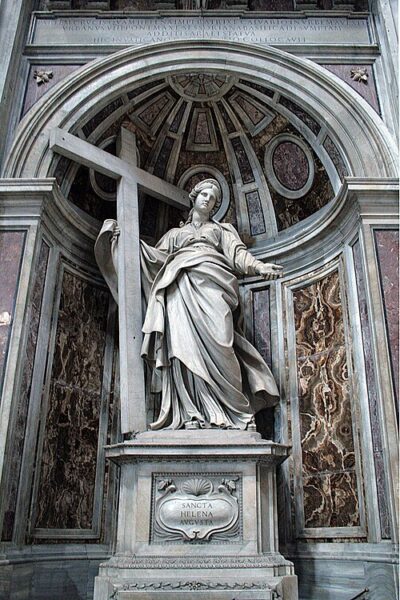
Helena Augusta
Helena Augusta was a saint, first wife of Roman emperor Constantius Chlorus, and mother of Emperor Constantine the Great. Born 250, in Helenopolis. Died August 18, 330, in Nicomedia.
Facts
10 facts · 1 confirmed by two sources · 1 cited · 6 from one source · 2 where the sources disagree
What’s different
- Born: we show 250 (Sources disagree). Wikipedia says 248
- Buried in: we show Mausoleum of Helena (Sources disagree). Wikidata also lists Cathedral of Trier and Vatican Museums
Where this comes from
Papalocal keeps its own record. It started from these sources; what each one said is kept here as it was copied, so a change on their side never changes this page by itself. Tap one to read its version.
What Wikidata says · copied November 16, 2026 · revision 2563662947
- Described as
- saint, first wife of Roman emperor Constantius Chlorus, and mother of Emperor Constantine the Great (250-330)
- Other names
- Aelena, St. Helen, Saint Helena, Julia Flavia Helena, Flavia Julia Aelena, Beata Aelena, St. Helena, Santa Helena, Flavia Helena, Julia Augusta, Helena of Constantinople, Sancta Helena
- Born
- 250 · 1 reference
- Died
- August 18, 330
- Born in
- Helenopolis
- Died in
- Nicomedia
- Buried in
- Mausoleum of Helena; Cathedral of Trier; Vatican Museums
- Citizen of
- Ancient Rome
- Occupation
- politician
- Spouse
- Constantius Chlorus
- Children
- Constantine the Great · 2 references
- Religion
- Christianity
- Wikipedias with a page
- 72
Wikidata item Q170164 (wikidata.org/wiki/Q170164), public domain (CC0). Copied November 16, 2026.
What Wikipedia says · copied November 16, 2026 · revision 1385203373
Flavia Julia Helena (; Ancient Greek: Ἑλένη, Helénē; c. AD 246/248 – 330), also known as Helena of Constantinople and in Christianity as Saint Helena, was an Augusta of the Roman Empire and mother of Emperor Constantine the Great as well as a canonized saint in both Catholic and Orthodox Churches for her pivotal role in the spread of Christianity. She was born in the lower classes traditionally in the city of Drepanon, Bithynia, in Asia Minor, which was renamed Helenopolis.
Helena ranks as an important figure in the history of Christianity. In her final years, she made a religious tour of Syria Palaestina and Jerusalem, during which ancient tradition claims that she discovered the True Cross. The Eastern Orthodox Church, Catholic Church, Oriental Orthodox Churches, Anglican Communion, and the Lutheran Church revere her as a saint.
- Born, in its opening lines
- 248
- Died, in its opening lines
- 330
From the Wikipedia article “Helena, mother of Constantine I” (en.wikipedia.org/wiki/Helena,_mother_of_Constantine_I), by its contributors, under CC BY-SA 4.0 (creativecommons.org/licenses/by-sa/4.0/). Copied November 16, 2026; not changed.
Confirmed Two sources agree. Cited One source, and it names where it got it. One source One source, without a reference of its own. Sources disagree The sources disagree. We show the best-supported value and keep theirs below.
