
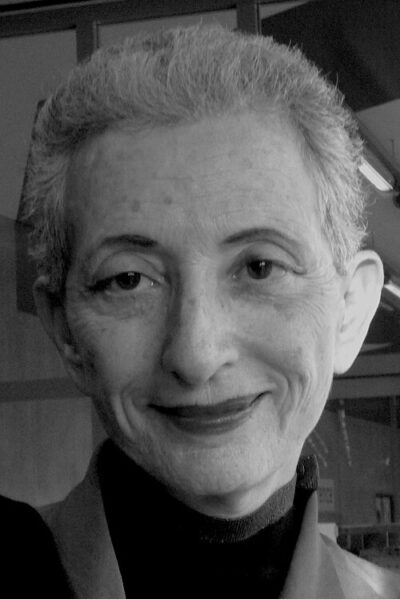
Hélène Cixous
Hélène Cixous is a French philosopher and writer. Born June 5, 1937, in Oran. Educated at Faculty of Arts of Paris. Awards include Prix Médicis, Officer of the Legion of Honour and Prix de la langue française.
Facts
40 facts · 1 confirmed by two sources · 19 cited · 20 from one source
Where this comes from
Papalocal keeps its own record. It started from these sources; what each one said is kept here as it was copied, so a change on their side never changes this page by itself. Tap one to read its version.
What Wikidata says · copied November 16, 2026 · revision 2557926919
- Described as
- French philosopher and writer
- Other names
- Helen Cixous, Helene Cixous
- Born
- June 5, 1937 · 11 references
- Born in
- Oran · 3 references
- Citizen of
- France · 2 references
- Occupation
- poet · 1 reference; essayist · 1 reference; playwright · 3 references; scholar of English · 2 references; women's rights activist · 1 reference; philosopher of language; literary critic · 1 reference; university teacher · 3 references
- Worked for
- Cornell University · 1 reference; European Graduate School · 1 reference; Paris 8 University · 1 reference
- Education
- Faculty of Arts of Paris (–1968) · 1 reference
- Genre
- fiction literature · 1 reference; theatre · 1 reference; poetry · 1 reference; essay · 1 reference
- Awards
- Prix Médicis (1969) · 1 reference; Officer of the Legion of Honour (2014) · 1 reference; Prix de la langue française (2014); Commandeur des Arts et des Lettres (2016) · 1 reference; Francine and Antoine Bernheim Award for Arts, Literature and Science (2017) · 2 references; The prize of the BNF (2021) · 1 reference; Grand Officer of the National Order of Merit (2023) · 1 reference; Prix du Syndicat de la critique; honorary doctor of the University of St Andrews; honorary doctor of Georgetown University; honorary doctorate of the University of York; Honorary doctorate from Queen's University; honorary doctorate from the University of Alberta; honorary doctor of University College London; Grand prix du théâtre (2018) · 1 reference
- Field
- feminist philosophy · 1 reference; belletristic literature · 1 reference; English studies · 1 reference; feminism · 1 reference; psychoanalysis and philosophy · 1 reference
- Siblings
- Pierre Cixous · 1 reference
- Wikipedias with a page
- 54
Wikidata item Q234964 (wikidata.org/wiki/Q234964), public domain (CC0). Copied November 16, 2026.
What Wikipedia says · copied November 16, 2026 · revision 1381905999
Hélène Cixous ( sihk-SOO; French: [siksu]; born 5 June 1937) is a French writer, playwright and literary critic. During her academic career, she was primarily associated with the Centre universitaire de Vincennes (today's University of Paris VIII), which she co-founded in 1969 and where she created the first centre of women's studies at a European university. Known for her experimental writing style and great versatility as a writer and thinker, she has written more than seventy books dealing with multiple genres: theatre, literary and feminist theory, art criticism, autobiography and poetic fiction.
She first gained attention in 1969 with her first work of fiction, Dedans (Inside), a semi-autobiographical novel which won the Prix Médicis and explored the themes of identity, memory, death and writing. She is perhaps best known for her 1976 article "The Laugh of the Medusa", which established her as one of the early thinkers in post-structural feminism. She has collaborated with several artists and directors, such as Adel Abdessemed, Pierre Alechinsky, Simone Benmussa, Jacques Derrida, Simon Hantaï, Daniel Mesguich and Ariane Mnouchkine. She is considered a strong contender for the Nobel Prize in Literature.
- Born, in its opening lines
- June 5, 1937
From the Wikipedia article “Hélène Cixous” (en.wikipedia.org/wiki/Hélène_Cixous), by its contributors, under CC BY-SA 4.0 (creativecommons.org/licenses/by-sa/4.0/). Copied November 16, 2026; not changed.
Confirmed Two sources agree. Cited One source, and it names where it got it. One source One source, without a reference of its own. Sources disagree The sources disagree. We show the best-supported value and keep theirs below.
