
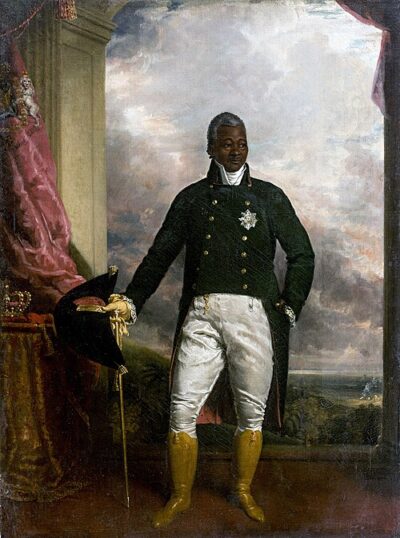
Henri Christophe
Henri Christophe was a President and King of North Haiti. Born October 6, 1767, in Saint Kitts. Died October 8, 1820, in Cap-Haïtien. Positions held include President of Haiti and king.
Facts
17 facts · 2 confirmed by two sources · 1 cited · 14 from one source
Where this comes from
Papalocal keeps its own record. It started from these sources; what each one said is kept here as it was copied, so a change on their side never changes this page by itself. Tap one to read its version.
What Wikidata says · copied November 16, 2026 · revision 2565578383
- Described as
- President and King of North Haiti (1767–1820)
- Other names
- Henri Ier d'Haïti, Roi d'Haïti, General Henri Christophe
- Born
- October 6, 1767 · 3 references
- Died
- October 8, 1820 · 5 references
- Born in
- Saint Kitts
- Died in
- Cap-Haïtien
- Buried in
- Citadelle Laferrière
- Cause of death
- gunshot wound
- Citizen of
- Haiti
- Occupation
- politician; monarch
- Positions held
- President of Haiti; king
- Spouse
- Marie-Louise Coidavid · 1 reference
- Children
- François-Ferdinand Christophe; Françoise-Améthyste Christophe; Jacques-Victor Henry, Prince Royal of Haiti
- Religion
- Catholicism
- Military rank
- generalissimo
- Wikipedias with a page
- 39
Wikidata item Q353458 (wikidata.org/wiki/Q353458), public domain (CC0). Copied November 16, 2026.
What Wikipedia says · copied November 16, 2026 · revision 1373458865
Henri Christophe (French pronunciation: [ɑ̃ʁi kʁistɔf]; 6 October 1767 – 8 October 1820) was a key leader in the Haitian Revolution and the only monarch of the Kingdom of Haiti.
Born in the British Caribbean, Christophe was possibly of Senegambian descent. Beginning with the slave uprising of 1791, he rose to power in the ranks of the Haitian revolutionary military. The revolution succeeded in gaining independence from France in 1804. In 1805 he took part under Jean-Jacques Dessalines in the capture of Santo Domingo (now Dominican Republic), against French forces who acquired the colony from Spain in the Treaty of Basel.
After Dessalines was assassinated, Christophe retreated to the Plaine-du-Nord and created a separate government. On 17 February 1807, he was elected president of the State of Haiti, as he named that area. Alexandre Pétion was elected president of the Republic of Haiti in the south. On 26 March 1811, Christophe created a kingdom in the north and was later proclaimed Henry I, King of Haïti. He also created a nobility and named his legitimate son Jacques-Victor Henry as prince and heir.
He is known for constructing Citadel Henry, now known as Citadelle Laferrière, the Sans-Souci Palace, the royal chapel of Milot, the Palais de la Belle Rivière and numerous other palaces. Under his policies of corvée, or forced labor bordering on slavery, the Kingdom earned revenues from agricultural production, primarily sugar, but the Haitian people resented the system. He reached an agreement with the United Kingdom to respect its Caribbean colonies in exchange for their warnings to his government of any French naval activity threatening Haiti. In 1820, unpopular, ill and fearing a coup, he committed suicide. Jacques-Victor, his son and heir, was assassinated 10 days later. Afterwards, General Jean-Pierre Boyer came to power and reunited the two parts of Haiti.
- Born, in its opening lines
- October 6, 1767
- Died, in its opening lines
- October 8, 1820
From the Wikipedia article “Henri Christophe” (en.wikipedia.org/wiki/Henri_Christophe), by its contributors, under CC BY-SA 4.0 (creativecommons.org/licenses/by-sa/4.0/). Copied November 16, 2026; not changed.
Confirmed Two sources agree. Cited One source, and it names where it got it. One source One source, without a reference of its own. Sources disagree The sources disagree. We show the best-supported value and keep theirs below.
