
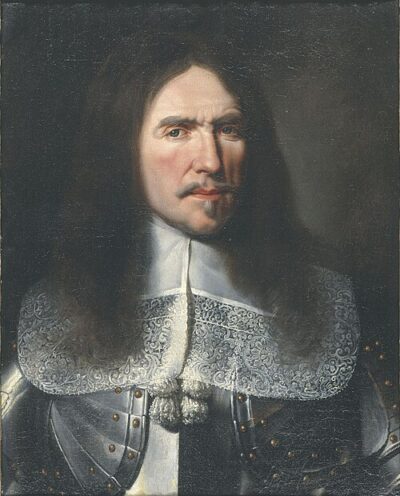
Henri de la Tour d'Auvergne, Vicomte de Turenne
Henri de la Tour d'Auvergne, Vicomte de Turenne was a French nobleman, general, Marshal of France. Born September 11, 1611, in Sedan. Died July 27, 1675, in Sasbach.
Facts
19 facts · 2 confirmed by two sources · 6 cited · 11 from one source
Where this comes from
Papalocal keeps its own record. It started from these sources; what each one said is kept here as it was copied, so a change on their side never changes this page by itself. Tap one to read its version.
What Wikidata says · copied November 16, 2026 · revision 2565545814
- Described as
- French nobleman, general, Marshal of France
- Other names
- Turenne, Vicomte de Turenne, maréchal de Turenne
- Born
- September 11, 1611 · 8 references
- Died
- July 27, 1675 · 7 references
- Born in
- Sedan · 2 references
- Died in
- Sasbach · 2 references
- Buried in
- Cathédrale Saint-Louis-des-Invalides
- Cause of death
- gunshot wound
- Citizen of
- France
- Occupation
- military officer; military commander · 1 reference; military leader · 1 reference
- Field
- military affairs · 1 reference
- Spouse
- Charlotte de Caumont, dame de Saveilles (1651–)
- Father
- Henri de La Tour d'Auvergne, Duke of Bouillon · 1 reference
- Mother
- Countess Elisabeth of Nassau
- Siblings
- Frédéric Maurice de La Tour d'Auvergne; Marie de La Tour d'Auvergne
- Military branch
- army · 1 reference
- Military rank
- generalissimo; Marshal General of France
- Wikipedias with a page
- 39
Wikidata item Q303216 (wikidata.org/wiki/Q303216), public domain (CC0). Copied November 16, 2026.
What Wikipedia says · copied November 16, 2026 · revision 1383210671
Henri de La Tour d'Auvergne, vicomte de Turenne (11 September 1611 – 27 July 1675), commonly known as Turenne (French: [tyʁɛn]), was a French general and one of only six marshals to have been promoted Marshal General of France. The most illustrious member of the La Tour d'Auvergne family, his military exploits over his five-decade career earned him a reputation as one of the greatest military commanders in history.
Born to a Huguenot family, the son of a Marshal of France, he was introduced to the art of war at a young age. He first served as a volunteer in the Dutch States Army under the orders of his maternal uncles Maurice of Nassau and Frederick Henry before pursuing his career in the service of France, where his noble origins and proven qualities soon saw him rise to the top of the military hierarchy. He rose to prominence during the Thirty Years' War by capturing the fortress of Breisach in 1638. Promoted Marshal of France in 1643, he struck against Bavaria the following year, defeating the Bavarian army in three years of campaigning and forcing the Elector of Bavaria to make peace. The Elector soon broke the treaty and in 1648 Turenne invaded again with Swedish support, subduing the Imperial army at Zusmarshausen and pacifying Bavaria.
Turenne initially supported the Fronde but returned to royal service in 1651, emerging as France's foremost general by defeating the rebellious army of the Prince of Condé on the outskirts of Paris and re-occupying the city. His triumphs against Spanish armies at Arras (1654) and at Dunkirk (1658) led to the overrunning of much of the Spanish Netherlands and brought the war against Spain to a victorious conclusion. Two years later, Louis XIV appointed him Marshal General of France. Although a supporter of absolute monarchy, he only converted to Catholicism in 1668, refusing to do so earlier despite political incentives.
During the War of Devolution in 1667, Turenne captured the Spanish Netherlands practically without resistance. In 1672 the French invaded the Dutch Republic and the Marshal General conquered the country up to Amsterdam. Checked by the Dutch flooding of the land, he invaded the Holy Roman Empire the next year, reaching the Elbe and compelling Brandenburg to abandon the anti-French coalition. Faced with the loss of Alsace to superior Allied forces, he crowned his career with a series of battlefield victories, most notably at Turckheim (1675) and a masterful strategic turning movement around the Vosges in mid-winter that drove the Imperials from Alsace. He was killed by an Imperial cannonball at the battle of Salzbach in 1675.
- Born, in its opening lines
- September 11, 1611
- Died, in its opening lines
- July 27, 1675
From the Wikipedia article “Henri de La Tour d'Auvergne, Viscount of Turenne” (en.wikipedia.org/wiki/Henri_de_La_Tour_d'Auvergne,_Viscount_of_Turenne), by its contributors, under CC BY-SA 4.0 (creativecommons.org/licenses/by-sa/4.0/). Copied November 16, 2026; not changed.
Confirmed Two sources agree. Cited One source, and it names where it got it. One source One source, without a reference of its own. Sources disagree The sources disagree. We show the best-supported value and keep theirs below.
