
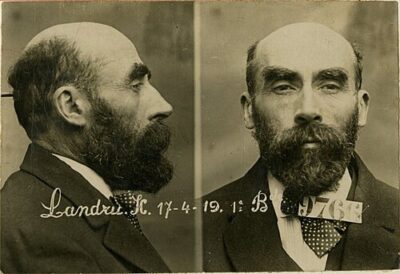
Henri Désiré Landru
Henri Désiré Landru was a serial killer sentenced to death in France. Born April 12, 1869, in 19th arrondissement of Paris. Died February 25, 1922, in Versailles.
Facts
15 facts · 2 confirmed by two sources · 2 cited · 11 from one source
Where this comes from
Papalocal keeps its own record. It started from these sources; what each one said is kept here as it was copied, so a change on their side never changes this page by itself. Tap one to read its version.
What Wikidata says · copied November 17, 2026 · revision 2561467796
- Described as
- serial killer sentenced to death in France
- Other names
- Henri Desire Landru
- Born
- April 12, 1869 · 5 references
- Died
- February 25, 1922 · 5 references
- Born in
- 19th arrondissement of Paris
- Died in
- Versailles · 2 references
- Buried in
- Cimetière des Gonards · 1 reference
- Cause of death
- decapitation by guillotine
- Citizen of
- France
- Occupation
- serial killer; subdeacon (1888); accountant; business person; cartographer; roofer; plumber; con artist
- Wikipedias with a page
- 26
Wikidata item Q534708 (wikidata.org/wiki/Q534708), public domain (CC0). Copied November 17, 2026.
What Wikipedia says · copied November 17, 2026 · revision 1384007465
Henri Désiré Landru (12 April 1869 – 25 February 1922) (French pronunciation: [ɑ̃ʁi deziʁe lɑ̃dʁy]) was a French serial killer, nicknamed the Bluebeard of Gambais and a prolific marriage fraudster. He is confirmed to have murdered at least ten women and the teenage son of his first victim, primarily targeting lonely war widows whom he met through newspaper advertisements, seduced, defrauded of their assets, and then killed, disposing of their bodies by burning them in his stove. He committed these crimes between December 1914 and January 1919, first at a house in Vernouillet and later at an isolated villa in Gambais, near Paris. The true number of Landru's victims remains unknown, as police traced correspondence with 283 women, 72 of whom were never found. He is considered one of France's most famous and notorious murderers, whose investigation and trial became a media sensation in the aftermath of World War I. His case inspired Charlie Chaplin's film Monsieur Verdoux.
Landru was arrested on 12 April 1919 at an apartment near Paris's Gare du Nord, which he shared with his 24-year-old mistress Fernande Segret. Police eventually concluded that Landru had met or been in romantic correspondence with 283 women during the First World War, meticulously categorized by their potential wealth; seventy-two were never traced. In December 1919, Landru's wife Marie-Catherine, 51, and his eldest son Maurice, 25, were arrested on suspicion of complicity in Landru's thefts from his victims. Both denied any knowledge of Landru's criminal activities. Marie-Catherine was released without charge in July 1920 for health reasons. Maurice was released on the same day because the authorities could not establish his guilt.
Landru's trial in November 1921 at Versailles garnered immense public attention, attracting celebrities like Colette and Maurice Chevalier. Although he maintained his innocence and despite the lack of bodies, he was found guilty of eleven murders by a majority verdict on 30 November 1921, largely based on his meticulous notebooks and the circumstantial evidence. He was executed by guillotine on 25 February 1922.
- Born, in its opening lines
- April 12, 1869
- Died, in its opening lines
- February 25, 1922
From the Wikipedia article “Henri Désiré Landru” (en.wikipedia.org/wiki/Henri_Désiré_Landru), by its contributors, under CC BY-SA 4.0 (creativecommons.org/licenses/by-sa/4.0/). Copied November 17, 2026; not changed.
Confirmed Two sources agree. Cited One source, and it names where it got it. One source One source, without a reference of its own. Sources disagree The sources disagree. We show the best-supported value and keep theirs below.
