
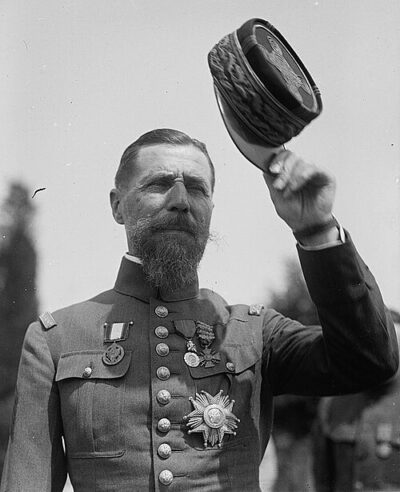
Henri Gouraud
Henri Gouraud was a French general. Born November 17, 1867, in 7th arrondissement of Paris. Died September 16, 1946, in 7th arrondissement of Paris. Positions held include Military governor of Paris (1923–1937) and High Commissioner of the Levant (1919–1922). Educated at École Spéciale Militaire de Saint-Cyr and Collège Stanislas de Paris. Awards include Grand Cross of the Legion of Honour, Croix de guerre 1914–1918 and Colonial Medal.
Facts
38 facts · 2 confirmed by two sources · 6 cited · 30 from one source
Where this comes from
Papalocal keeps its own record. It started from these sources; what each one said is kept here as it was copied, so a change on their side never changes this page by itself. Tap one to read its version.
What Wikidata says · copied November 18, 2026 · revision 2570776574
- Described as
- French general (1867–1946)
- Other names
- Henri Joseph Eugène Gouraud
- Born
- November 17, 1867 · 5 references
- Died
- September 16, 1946 · 5 references
- Born in
- 7th arrondissement of Paris · 1 reference
- Died in
- 7th arrondissement of Paris · 1 reference
- Buried in
- Navarin Ossuary: Monument to the Dead of the Champagne Armies
- Name at birth
- Henri Joseph Eugène Gouraud · 1 reference
- Citizen of
- France
- Occupation
- politician; military personnel; military officer · 1 reference; author · 1 reference
- Positions held
- Military governor of Paris (1923–1937); High Commissioner of the Levant (1919–1922) · 1 reference
- Education
- École Spéciale Militaire de Saint-Cyr; Collège Stanislas de Paris
- Member of
- Académie des sciences d'outre-mer; Académie des Inscriptions et Belles-Lettres (1924–1946) · 1 reference; Académie des sciences, belles-lettres et arts de Rouen
- Awards
- Grand Cross of the Legion of Honour; Croix de guerre 1914–1918; Colonial Medal; Commander of the Order of Nichan el Anouar; Commander of the order of Nichan Iftikhar; Médaille militaire; Order of St. George, 4th class; Knight of the Legion of Honour · 1 reference; Officer of the Legion of Honour · 1 reference; Commander of the Legion of Honour · 1 reference; Grand Officer of the Legion of Honour · 1 reference; Ordre du Nichan El-Anouar · 1 reference; Order of Saints Maurice and Lazarus · 1 reference; Distinguished Service Medal · 1 reference; Order of the White Lion · 1 reference
- Father
- Vincent François Xavier Gouraud
- Siblings
- Pierre Gouraud; F. X. Gouraud
- Military branch
- French Army
- Military rank
- army general
- Wikipedias with a page
- 20
Wikidata item Q2572143 (wikidata.org/wiki/Q2572143), public domain (CC0). Copied November 18, 2026.
What Wikipedia says · copied November 18, 2026 · revision 1382863393
Henri Joseph Eugène Gouraud (French pronunciation: [ɑ̃ʁi ɡuʁo]; 17 November 1867 – 16 September 1946) was a French army general. He played a central role in the colonization of French Africa and the Levant. During World War I, he fought in major battles such as those of the Argonne, the Dardanelles, and Champagne. An important figure in the aftermath of the Ottoman Empire, he served as High Commissioner of the French Republic in the Levant from 1919 to 1922, during which he led military campaigns in Cilicia and Syria.
Affiliated with the colonial party, Gouraud was an active colonizer, influenced by figures such as Joseph Gallieni and Hubert Lyautey. His name remains closely associated with the conquest of Sudan, Mauritania, Chad, and Morocco, and his arrest of Samory Touré in September 1898 marked a turning point in the French colonization of West Africa. This act brought him to prominence at a time when France sought to overcome the humiliation of the Fashoda Incident.
During World War I, Gouraud distinguished himself by his courage and sacrifice. Seriously wounded in the Dardanelles, where he lost his right arm, he became a symbol of resilience and a national hero. His victory over Ludendorff in the Argonne led to the liberation of Strasbourg, the reconquest of Alsace-Lorraine, and the victory of France.
After the war, as High Commissioner in the Levant, he played a key role in reorganizing the region, leading campaigns in Cilicia and Syria, and redrawing the borders of the Middle East. He is particularly famous for proclaiming the creation of Greater Lebanon in 1920, marking a significant step in French colonial policy.
Back in France, Gouraud continued his military career, becoming Military Governor of Paris from 1923 to 1937. At the end of his career, he embodied a figure of transition, having actively participated in the implementation of various colonial regimes (colony, protectorate, mandate). According to historian Julie d'Andurain, "as an actor and witness of these changes, Henri Gouraud understood that the time of colonies would be succeeded by the time of empires and international organizations". He thus linked with the next generation, that of men like Georges Catroux and Jules Bührer.
His policy of dividing Syria into several small states based on confessional criteria marked a significant step in French colonial policy in the Levant, aiming to divide territories to control them better. Set against a backdrop of imperial rivalries and nationalist tensions, it is still criticized today for its consequences on the stability and unity of the region.
- Born, in its opening lines
- November 17, 1867
- Died, in its opening lines
- September 16, 1946
From the Wikipedia article “Henri Gouraud” (en.wikipedia.org/wiki/Henri_Gouraud), by its contributors, under CC BY-SA 4.0 (creativecommons.org/licenses/by-sa/4.0/). Copied November 18, 2026; not changed.
Confirmed Two sources agree. Cited One source, and it names where it got it. One source One source, without a reference of its own. Sources disagree The sources disagree. We show the best-supported value and keep theirs below.
