
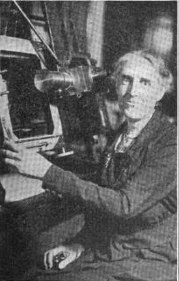
Henrietta Swan Leavitt
Henrietta Swan Leavitt was an American astronomer and human calculator. Born July 4, 1868, in Lancaster. Died December 12, 1921, in Cambridge. Known for standard candle. Educated at Radcliffe College and Oberlin College.
Facts
24 facts · 2 confirmed by two sources · 14 cited · 8 from one source
Where this comes from
Papalocal keeps its own record. It started from these sources; what each one said is kept here as it was copied, so a change on their side never changes this page by itself. Tap one to read its version.
What Wikidata says · copied November 13, 2026 · revision 2568888357
- Described as
- American astronomer and human calculator (1868–1921)
- Other names
- Henrietta Leavitt
- Born
- July 4, 1868 · 3 references
- Died
- December 12, 1921 · 4 references
- Born in
- Lancaster · 3 references
- Died in
- Cambridge · 3 references
- Buried in
- Cambridge Cemetery · 1 reference
- Cause of death
- cancer
- Citizen of
- United States
- Occupation
- astronomer · 1 reference
- Worked for
- Harvard College Observatory (2 times) (1888–1921) · 2 references; Beloit College (1898–1902) · 1 reference
- Education
- Radcliffe College (1888–1892) · 2 references; Oberlin College (1885–1888) · 2 references
- Member of
- Phi Beta Kappa Society; Harvard Computers; American Astronomical Society · 1 reference; American Association for the Advancement of Science · 1 reference; American Association of University Women; American Association of Variable Star Observers
- Known for
- standard candle · 1 reference
- Field
- astronomy · 1 reference
- Father
- Rev. George Roswell Leavitt · 1 reference
- Mother
- Henrietta Swan Kendrick · 1 reference
- Religion
- Eastern Orthodoxy
- Lived in
- Lancaster
- Wikipedias with a page
- 64
Wikidata item Q110181 (wikidata.org/wiki/Q110181), public domain (CC0). Copied November 13, 2026.
What Wikipedia says · copied November 13, 2026 · revision 1385471751
Henrietta Swan Leavitt (; July 4, 1868 – December 12, 1921) was an American astronomer. Her discovery of how to effectively measure vast astronomical distances led to a shift in the understanding of the scale and nature of the universe.
A graduate of Radcliffe College, she worked at the Harvard College Observatory as a human computer, tasked with measuring photographic plates to catalog the positions and brightness of stars. This work led her to discover the relation between the luminosity and the period of Cepheid variables. Leavitt's discovery provided astronomers with the first standard candle with which to measure the distance to other galaxies.
Before Leavitt discovered the period–luminosity relationship for Cepheid variables (sometimes referred to as Leavitt's Law), the only techniques available to astronomers for measuring the distance to a star were based on stellar parallax. Such techniques can only be used for measuring distances out to several hundred light years. Leavitt's great insight was that while no one knew the distance to the Small Magellanic Cloud, all its stars must be roughly the same distance from Earth. Therefore, a relationship she discovered in it, between the period of certain variable stars (Cepheids) and their apparent brightness, reflected a relationship in their absolute brightness. Once calibrated by measuring the distance to a nearby star of the same type via parallax, her discovery became a measuring stick with vastly greater reach.
After Leavitt's death, Edwin Hubble found Cepheids in several nebulae, including the Andromeda Nebula, and, using Leavitt's Law, calculated that their distance was far too great to be part of the Milky Way and were separate galaxies in their own right. This settled astronomy's Great Debate over the size of the universe. Hubble later used Leavitt's Law, together with galactic redshifts, to establish that the universe is expanding (see Hubble's law).
- Born, in its opening lines
- July 4, 1868
- Died, in its opening lines
- December 12, 1921
From the Wikipedia article “Henrietta Swan Leavitt” (en.wikipedia.org/wiki/Henrietta_Swan_Leavitt), by its contributors, under CC BY-SA 4.0 (creativecommons.org/licenses/by-sa/4.0/). Copied November 13, 2026; not changed.
Confirmed Two sources agree. Cited One source, and it names where it got it. One source One source, without a reference of its own. Sources disagree The sources disagree. We show the best-supported value and keep theirs below.
