
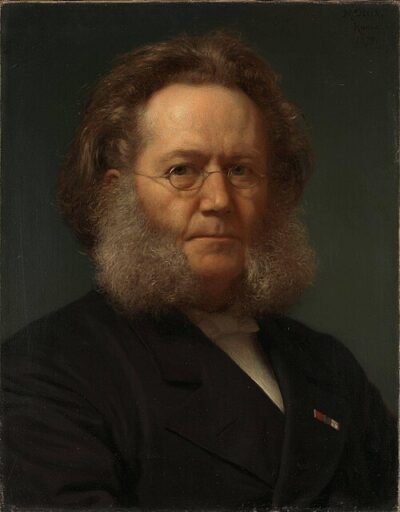
Henrik Ibsen
Henrik Ibsen was a Norwegian playwright and theatre director. Born March 20, 1828, in Stockmanngården. Died May 23, 1906, in Christiania. Known for Peer Gynt, A Doll's House and Ghosts. Awards include Knight Grand Cross of the Order of St. Olav, King Oscar II's reward medal and Grand Cross of the Order of the Dannebrog.
Facts
50 facts · 2 confirmed by two sources · 47 cited · 1 from one source
Where this comes from
Papalocal keeps its own record. It started from these sources; what each one said is kept here as it was copied, so a change on their side never changes this page by itself. Tap one to read its version.
What Wikidata says · copied November 16, 2026 · revision 2569758542
- Described as
- Norwegian playwright and theatre director (1828–1906)
- Other names
- Henrich Ibsen, Henrich Johan Ibsen, Henrik Johan Ibsen
- Born
- March 20, 1828 · 5 references
- Died
- May 23, 1906 · 5 references
- Born in
- Stockmanngården · 2 references
- Died in
- Christiania · 3 references
- Buried in
- Vår Frelsers gravlund (1906) · 2 references
- Cause of death
- stroke · 2 references
- Name at birth
- Henrik Johan Ibsen · 1 reference
- Citizen of
- Norway · 2 references
- Occupation
- playwright · 2 references; poet · 2 references; librettist · 1 reference; director · 1 reference; writer · 3 references
- Genre
- drama · 1 reference; poetry · 1 reference
- Known for
- Peer Gynt · 3 references; A Doll's House · 3 references; Ghosts · 3 references; An Enemy of the People · 3 references; The Wild Duck · 3 references; Hedda Gabler · 3 references; Rosmersholm · 3 references; Brand · 3 references; The Master Builder · 3 references; Catiline · 3 references
- Awards
- Knight Grand Cross of the Order of St. Olav · 2 references; King Oscar II's reward medal · 2 references; Grand Cross of the Order of the Dannebrog · 2 references; Commanders Grand Cross of the Order of the Polar Star · 2 references; Knight Grand Cross of the Order of Vasa · 2 references; Knight Grand Officer of the Order of the Saxe-Ernestine · 2 references; 3rd class, Order of the Medjidie · 2 references
- Field
- performing arts · 1 reference
- Spouse
- Suzannah Ibsen (1858–1906) · 3 references
- Children
- Sigurd Ibsen · 2 references; Hans Jacob Henriksen · 1 reference
- Father
- Knud Ibsen · 2 references
- Mother
- Marichen Altenburg · 2 references
- Siblings
- Hedvig Ibsen · 1 reference; Ole Paus Ibsen · 1 reference; Johan Andreas Altenburg Ibsen · 1 reference; Nicolai Alexander Ibsen · 1 reference; Johan Altenburg Ibsen · 1 reference
- Lived in
- Skien (1828–1843) · 1 reference; Grimstad (1843–1850) · 1 reference; Christiania (4 times) (1850–1906) · 1 reference; Bergen (2 times) (1851–1885) · 1 reference; Copenhagen (3 times) (1864–1898) · 1 reference
- Website
- https://www.hf.uio.no/is/tjenester/virtuelle-ibsensenteret/ · 1 reference; https://www.nb.no/forskning/ibsen/
- Wikipedias with a page
- 172
Wikidata item Q36661 (wikidata.org/wiki/Q36661), public domain (CC0). Copied November 16, 2026.
What Wikipedia says · copied November 16, 2026 · revision 1385099362
Henrik Johan Ibsen (; Norwegian: [ˈhɛ̀nrɪk ˈɪ̀psn̩]; 20 March 1828 – 23 May 1906) was a Norwegian playwright. He is considered one of the world's pre-eminent writers of the 19th century and is often referred to as "the father of modern drama". He pioneered theatrical realism but also wrote lyrical epic works. His major works include Brand, Peer Gynt, Emperor and Galilean, A Doll's House, Ghosts, An Enemy of the People, The Wild Duck, Rosmersholm, Hedda Gabler, The Master Builder, and When We Dead Awaken. In 2014, Ibsen was considered the most frequently performed dramatist in the world after Shakespeare. Store norske leksikon describes him as "the center of the Norwegian literary canon".
Ibsen was born into the merchant elite of the port town of Skien and had strong family ties to the Paus family and other families who had held power and wealth in Telemark since the mid-1500s. He established himself as a theater director in Norway during the 1850s and gained international recognition as a playwright with the plays Brand and Peer Gynt in the 1860s. From 1864, he lived for 27 years in Italy and Germany, primarily in Rome, Dresden, and Munich, making only brief visits to Norway, before moving to Christiania (Oslo) in 1891. Most of Ibsen's plays are set in Norway, often in bourgeois environments and places reminiscent of Skien, and he frequently drew inspiration from family members. Ibsen's early verse play Peer Gynt has strong surreal elements. After Peer Gynt Ibsen abandoned verse and wrote in realistic prose. Several of his later dramas were considered scandalous to many of his era, when European theatre was expected to model strict morals of family life and propriety. Ibsen's later work examined the realities that lay behind the façades, revealing much that was disquieting to a number of his contemporaries. He had a critical eye and conducted a free inquiry into the conditions of life and issues of morality. Critics frequently rate The Wild Duck and Rosmersholm as Ibsen's best works; the playwright himself regarded Emperor and Galilean as his masterpiece.
Ibsen is considered one of the most important playwrights in the history of world literature and is widely regarded as the foremost playwright of the nineteenth century. Sigmund Freud considered him on par with Shakespeare and Sophocles, while George Bernard Shaw argued that Ibsen had surpassed Shakespeare as the world's pre-eminent dramatist. Ibsen influenced other playwrights and novelists such as George Bernard Shaw, Oscar Wilde, and James Joyce. Considered a profound poetic dramatist, he is widely regarded as the most important playwright since Shakespeare. Ibsen is commonly described as the most famous Norwegian internationally. Ibsen wrote his plays in Dano-Norwegian, and they were published by the Danish publisher Gyldendal. He was the father of Prime Minister Sigurd Ibsen and a relative of the singer Ole Paus.
- Born, in its opening lines
- March 20, 1828
- Died, in its opening lines
- May 23, 1906
From the Wikipedia article “Henrik Ibsen” (en.wikipedia.org/wiki/Henrik_Ibsen), by its contributors, under CC BY-SA 4.0 (creativecommons.org/licenses/by-sa/4.0/). Copied November 16, 2026; not changed.
Confirmed Two sources agree. Cited One source, and it names where it got it. One source One source, without a reference of its own. Sources disagree The sources disagree. We show the best-supported value and keep theirs below.
