
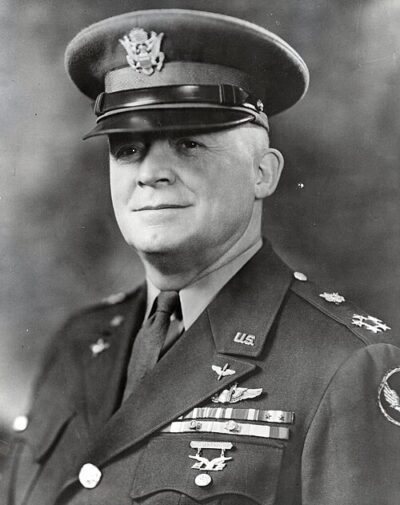
Henry H. Arnold
Henry H. Arnold was an American general officer holding the ranks of General of the Army and General of the Air Force. Born June 25, 1886, in Gladwyne. Died January 15, 1950, in Sonoma. Educated at United States Army Command and General Staff College and United States Military Academy. Awards include Distinguished Flying Cross, Knight Grand Cross of the Order of the Bath and Grand Cross of the Order of Wissam Alaouite.
Facts
35 facts · 2 confirmed by two sources · 9 cited · 24 from one source
Where this comes from
Papalocal keeps its own record. It started from these sources; what each one said is kept here as it was copied, so a change on their side never changes this page by itself. Tap one to read its version.
What Wikidata says · copied November 15, 2026 · revision 2557918912
- Described as
- American general officer holding the ranks of General of the Army and General of the Air Force (1886-1950)
- Other names
- Henry Harley "Hap" Arnold, H. H. Arnold, Henry Harley Arnold, Hap Arnold
- Born
- June 25, 1886 · 6 references
- Died
- January 15, 1950 · 6 references
- Born in
- Gladwyne · 2 references
- Died in
- Sonoma · 2 references
- Buried in
- Arlington National Cemetery (1950) · 1 reference
- Name at birth
- Henry Harley Arnold
- Citizen of
- United States
- Occupation
- military personnel; aircraft pilot
- Education
- United States Army Command and General Staff College; United States Military Academy; Lower Merion High School · 1 reference; Wright Flying School
- Member of
- International Air & Space Hall of Fame; Early Birds of Aviation
- Awards
- Distinguished Flying Cross (1937) · 1 reference; Knight Grand Cross of the Order of the Bath · 1 reference; Grand Cross of the Order of Wissam Alaouite; Legionnaire of Legion of Merit; Air Medal (1943) · 1 reference; Grand Cross of the Order of the Southern Cross; Grand Cross of the Legion of Honour; Grand Cross of the Order of the Crown; Grand Cross of the Order of George I; Grand Cross of the Order of Orange-Nassau (1946) · 1 reference; Royal Order of the Sword; National Aviation Hall of Fame (1967) · 1 reference; World War II Victory Medal · 1 reference; Legion of Merit · 1 reference; Inter-Allied Victory Medals · 1 reference
- Military branch
- United States Air Force; aviation · 1 reference
- Military rank
- General of the Army; General of the Air Force; general · 2 references
- Wikipedias with a page
- 38
Wikidata item Q436102 (wikidata.org/wiki/Q436102), public domain (CC0). Copied November 15, 2026.
What Wikipedia says · copied November 15, 2026 · revision 1384567359
Henry Harley "Hap" Arnold (25 June 1886 – 15 January 1950) was an American general officer holding the ranks of General of the Army and later, General of the Air Force. Arnold was an aviation pioneer, Chief of the Air Corps (1938–1941), commanding general of the United States Army Air Forces, the only United States Air Force general to hold five-star rank, and the only officer to hold a five-star rank in two different U.S. military services. Arnold was also the founder of Project RAND, which evolved into one of the world's largest non-profit global policy think tanks, the RAND Corporation, and was one of the founders of Pan American World Airways.
Instructed in flying by the Wright Brothers, Arnold was one of the first military pilots worldwide, and one of the first three rated pilots in the history of the United States Air Force. He overcame a fear of flying that resulted from his experiences with early flight, supervised the expansion of the Air Service during World War I, and became a protégé of then Brigadier General (later Colonel) Billy Mitchell.
Arnold rose to command the Army Air Forces immediately prior to the American entry into World War II and directed its hundred-fold expansion from an organization of little more than 20,000 men and 800 first-line combat aircraft into the largest and most powerful air force in the world. An advocate of technological research and development, his tenure saw the development of the intercontinental bomber, the jet fighter, the extensive use of radar, global airlift and atomic warfare as mainstays of modern air power.
Arnold's most widely used nickname, "Hap", was short for "Happy", attributed variously to work associates when he moonlighted as a silent film stunt pilot in October 1911, or to his wife, who began using the nickname in her correspondence in 1931 following the death of Arnold's mother. His family called him Harley during his youth, and his mother and wife called him "Sunny". His West Point classmates called Arnold "Pewt" or "Benny" and his immediate subordinates and headquarters staff referred to him as "The Chief".
- Born, in its opening lines
- June 25, 1886
- Died, in its opening lines
- January 15, 1950
From the Wikipedia article “Henry H. Arnold” (en.wikipedia.org/wiki/Henry_H._Arnold), by its contributors, under CC BY-SA 4.0 (creativecommons.org/licenses/by-sa/4.0/). Copied November 15, 2026; not changed.
Confirmed Two sources agree. Cited One source, and it names where it got it. One source One source, without a reference of its own. Sources disagree The sources disagree. We show the best-supported value and keep theirs below.
