
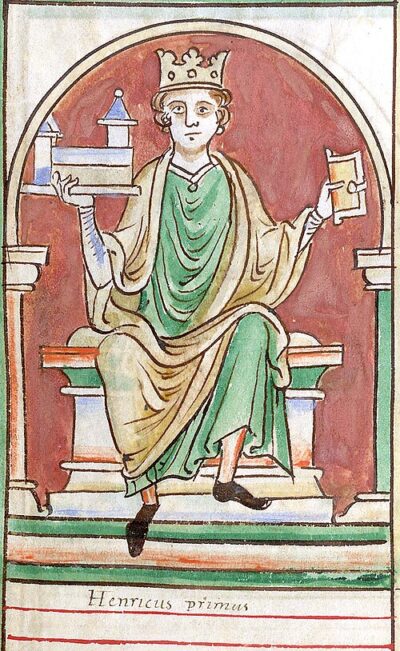
Henry I of England
Henry I of England was a King of England from 1100 to 1135. Born 1068, in Selby. Died December 1, 1135, in Saint-Denis-le-Ferment. Positions held include Monarch of England (1100–1135) and Duke of Normandy.
Facts
33 facts · 2 confirmed by two sources · 17 cited · 12 from one source · 2 where the sources disagree
What’s different
- Died in: we show Saint-Denis-le-Ferment (Sources disagree). Wikidata also lists Lyons-la-Forêt
- Buried in: we show Reading Abbey (Sources disagree). Wikidata also lists Port-du-Salut Abbey
Where this comes from
Papalocal keeps its own record. It started from these sources; what each one said is kept here as it was copied, so a change on their side never changes this page by itself. Tap one to read its version.
What Wikidata says · copied November 16, 2026 · revision 2569168647
- Described as
- King of England from 1100 to 1135 (1068–1135)
- Other names
- Henry Beauclerc, Beauclerk, King Henry I of England, Henry I
- Born
- 1068 · 7 references
- Died
- December 1, 1135 · 1 reference
- Born in
- Selby · 1 reference
- Died in
- Saint-Denis-le-Ferment · 1 reference; Lyons-la-Forêt
- Buried in
- Reading Abbey · 1 reference; Port-du-Salut Abbey
- Cause of death
- foodborne illness
- Citizen of
- Kingdom of England
- Occupation
- king
- Positions held
- Monarch of England (1100–1135); Duke of Normandy
- Spouse
- Matilda of Scotland (1100–1118) · 2 references; Adeliza of Louvain (1121–1135) · 2 references
- Children
- Empress Matilda · 1 reference; William Adelin · 1 reference; Robert, 1st Earl of Gloucester · 1 reference; Reginald de Dunstanville, 1st Earl of Cornwall · 1 reference; Henry FitzRoy · 1 reference; Matilda FitzRoy, Countess of Perche · 1 reference; Matilda FitzRoy, Duchess of Brittany; Matilda FitzRoy, Abbess of Montvilliers · 2 references; Alice FitzRoy · 1 reference; Gilbert FitzRoy · 1 reference; Fulk FitzRoy · 1 reference; Juliane de Fontevrault · 1 reference
- Father
- William the Conqueror · 1 reference
- Mother
- Matilda of Flanders · 1 reference
- Siblings
- Adeliza; Adela of Normandy · 1 reference; Constance of Normandy; Cecilia of Normandy; Robert Curthose; Richard of Normandy; William II of England · 1 reference
- Wikipedias with a page
- 81
Wikidata item Q101384 (wikidata.org/wiki/Q101384), public domain (CC0). Copied November 16, 2026.
What Wikipedia says · copied November 16, 2026 · revision 1382486195
Henry I (c. 1068 – 1 December 1135), also known as Henry Beauclerc, was King of England from 1100 to his death in 1135. He was the fourth son of William the Conqueror and was educated in Latin and the liberal arts. On William's death in 1087, Henry's elder brothers Robert Curthose and William Rufus inherited Normandy and England, respectively, thereby leaving Henry landless. He subsequently purchased the County of Cotentin in western Normandy from Robert, but his brothers deposed him in 1091. He gradually rebuilt his power base in the Cotentin and allied himself with William Rufus against Robert.
When William Rufus died in a hunting accident, Henry seized the English throne ahead of Robert, promising at his coronation to correct many of William's less popular policies. He married Matilda of Scotland and they had two surviving children, Empress Matilda and William Adelin. Robert disputed Henry's control of England and invaded from Normandy in 1101. The ensuing military campaign ended in a negotiated settlement that confirmed Henry as king. The peace was short-lived, however, and Henry invaded the Duchy of Normandy in 1105 and 1106, finally defeating Robert at the Battle of Tinchebray. Henry kept Robert imprisoned for the rest of Robert's life. Henry's control of Normandy was subsequently challenged by Louis VI of France, Baldwin VII of Flanders and Fulk V of Anjou, who promoted the rival claims of Robert's son, William Clito, and supported a major rebellion in the Duchy between 1116 and 1119. Following Henry's victory at the Battle of Brémule, a favourable peace settlement was agreed with Louis in 1120.
Considered by contemporaries to be a harsh but effective ruler, Henry skilfully manipulated the barons in England and Normandy. In England, he drew on the existing Anglo-Saxon system of justice, local government and taxation, but also strengthened it with more institutions such as the royal exchequer and itinerant justices. Many of the officials who ran Henry's system were "new men" of obscure backgrounds, rather than from families of high status, who rose through the ranks as administrators. Henry encouraged ecclesiastical reform but became embroiled in a serious dispute in 1101 with Archbishop Anselm of Canterbury, which was resolved through a compromise solution in 1105. He supported the Cluniac order and played a major role in the selection of the senior clergy in England and Normandy.
Henry's son William drowned in the White Ship disaster of 1120, throwing the royal succession into doubt. Henry took a second wife, Adeliza of Louvain, in the hope of having another son, but their marriage was childless. In response to this, he declared his daughter Matilda his heir and married her to Geoffrey of Anjou. The relationship between Henry and the couple became strained, and fighting broke out along the border with Anjou. Henry died on 1 December 1135 after a week of illness. Despite his plans for Matilda, the King was succeeded by his nephew Stephen of Blois, resulting in a period of civil war known as the Anarchy.
- Born, in its opening lines
- c. 1068
- Died, in its opening lines
- December 1, 1135
From the Wikipedia article “Henry I of England” (en.wikipedia.org/wiki/Henry_I_of_England), by its contributors, under CC BY-SA 4.0 (creativecommons.org/licenses/by-sa/4.0/). Copied November 16, 2026; not changed.
Confirmed Two sources agree. Cited One source, and it names where it got it. One source One source, without a reference of its own. Sources disagree The sources disagree. We show the best-supported value and keep theirs below.
