
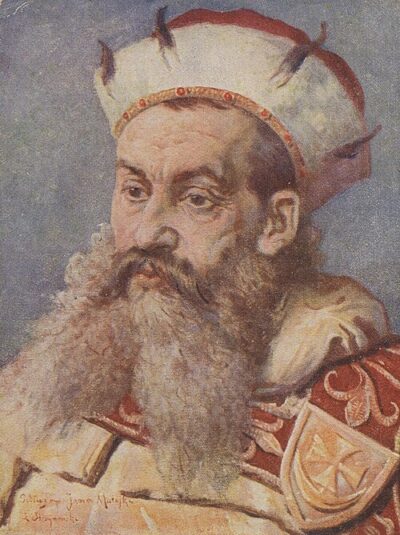
Henry I the Bearded was a High Duke of Poland. Born 1165, in Głogów. Died March 19, 1238, in Krosno Odrzańskie. Positions held include King of Poland (1201–1238) and Duke of Legnica (1201–1238).
Facts
15 facts · 0 confirmed by two sources · 3 cited · 12 from one source
Where this comes from
Papalocal keeps its own record. It started from these sources; what each one said is kept here as it was copied, so a change on their side never changes this page by itself. Tap one to read its version.
What Wikidata says · copied November 16, 2026 · revision 2568894561
- Described as
- High Duke of Poland
- Other names
- Henryk Brodaty I, Henry I, Duke Henry of Silesia, Henryk I Brodaty, Heinrich I, Duke of Cracow
- Born
- 1165 · 1 reference
- Died
- March 19, 1238
- Born in
- Głogów · 1 reference
- Died in
- Krosno Odrzańskie · 1 reference
- Buried in
- Sanctuary of St. Jadwiga in Trzebnica
- Occupation
- monarch
- Positions held
- King of Poland (1201–1238); Duke of Legnica (1201–1238)
- Spouse
- Hedwig of Silesia
- Children
- Henry II the Pious · 1 reference; Konrad the Curly; Gertrud of Silesia
- Father
- Bolesław I the Tall · 1 reference
- Mother
- Christina
- Siblings
- Jarosław, Duke of Opole, bishop of Breslau
- Wikipedias with a page
- 32
Wikidata item Q53445 (wikidata.org/wiki/Q53445), public domain (CC0). Copied November 16, 2026.
What Wikipedia says · copied November 16, 2026 · revision 1370230946
Henry the Bearded (Polish: Henryk (Jędrzych) Brodaty, German: Heinrich der Bärtige; c. 1165/1170 – 19 March 1238) was a Polish duke from the Silesian branch of the Piast dynasty. He was Duke of Silesia at Wrocław from 1201, Duke of Kraków and High Duke of all Poland – internally divided – from 1232 until his death. A competent ruler, he supported the development of mining, carried out a monetary reform, granted the first town charters, and attempted to reunite an internally divided Poland.
Henry succeeded his father, Bolesław I the Tall, as Duke of Silesia, and, through a combination of dynastic marriages, military campaigns, political alliances, and territorial acquisitions, he expanded the influence of the Silesian Piasts. In 1202, he became involved in the struggle for control of Kraków and the seniorate province, although his attempts to establish lasting authority over divided Polish lands there were repeatedly challenged by other Piast princes.
A prominent patron of Christian institutions, Henry supported monasteries and churches and promoted the settlement of German-speaking communities in Silesia. His wife, Hedwig of Andechs, later canonized as Saint Hedwig of Silesia, played an important role in his religious and dynastic affairs. Their rule was associated with economic development, the foundation of settlements and cities under Magdeburg Law, and the growing importance of Silesia within Central Europe. Most notably, Złotoryja was the first town in Poland to be granted town privileges in 1211 under Henry.
Henry I died in 1238 and was succeeded by his son, Henry II the Pious, as Duke of Silesia. While he was unable to achieve the lasting reunification of the Polish lands under a single ruler, Henry I's reign played a crucial role in strengthening the territorial position and political influence of the Silesian Piast dynasty. His rule, alongside that of his son, represents a significant phase in the political history of medieval Poland and reflects the broader developments of the period of regional fragmentation.
From the Wikipedia article “Henry the Bearded” (en.wikipedia.org/wiki/Henry_the_Bearded), by its contributors, under CC BY-SA 4.0 (creativecommons.org/licenses/by-sa/4.0/). Copied November 16, 2026; not changed.
Confirmed Two sources agree. Cited One source, and it names where it got it. One source One source, without a reference of its own. Sources disagree The sources disagree. We show the best-supported value and keep theirs below.
