
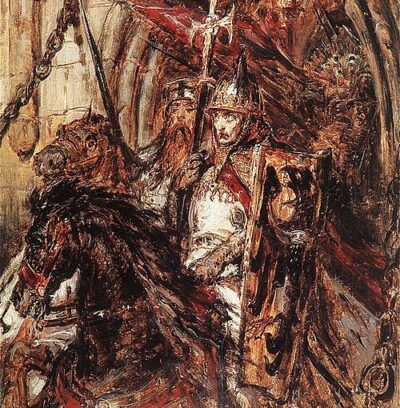
Henry II the Pious
Henry II the Pious was a Grand Duke of Silesia (1192-1241), High Duke of Poland. Born 1196, in Kraków. Died April 9, 1241, in Legnickie Pole. Positions held include Grand Prince.
Facts
21 facts · 2 confirmed by two sources · 1 cited · 18 from one source
What’s different
- Born: we show 1196 (Confirmed). Wikidata also lists 1192 and 1191
Where this comes from
Papalocal keeps its own record. It started from these sources; what each one said is kept here as it was copied, so a change on their side never changes this page by itself. Tap one to read its version.
What Wikidata says · copied November 16, 2026 · revision 2568894567
- Described as
- Grand Duke of Silesia (1192-1241), High Duke of Poland
- Other names
- Heinrich II, Duke of Cracow, Servant of God Henry II the Pious, Henryk II Pravoslavný
- Born
- 1192; 1191 · 1 reference; 1196 · 1 reference
- Died
- April 9, 1241 · 1 reference
- Born in
- Kraków
- Died in
- Legnickie Pole
- Buried in
- Wrocław
- Occupation
- politician
- Positions held
- Grand Prince
- Spouse
- Anne of Bohemia, Duchess of Silesia (1216–) · 1 reference
- Children
- Constance of Wrocław; Bolesław II Rogatka; Mieszko, Duke of Lubusz; Henry III the White; Konrad I, Duke of Głogów; Elisabeth of Wrocław; Ladislaus of Salzburg; Agnes; Gertrud of Wroclaw
- Father
- Henry I the Bearded · 1 reference
- Mother
- Hedwig of Silesia
- Siblings
- Konrad the Curly; Gertrud of Silesia
- Wikipedias with a page
- 32
Wikidata item Q53446 (wikidata.org/wiki/Q53446), public domain (CC0). Copied November 16, 2026.
What Wikipedia says · copied November 16, 2026 · revision 1372645799
Henry II the Pious (Polish: Henryk II Pobożny; 1196 – 9 April 1241) was Duke of Silesia and High Duke of Poland as well as Duke of South-Greater Poland from 1238 until his death. Between 1238 and 1239 he also served as regent of Sandomierz and Opole–Racibórz. A member of the Silesian Piast dynasty, he was the son of Henry the Bearded and Saint Hedwig of Silesia.
Henry II inherited a substantial political position at a time when Poland remained divided among several Piast principalities. His accession marked the continuation of his father’s policy of strengthening the Silesian branch of the dynasty and extending its influence over other Polish territories, though he was unable to reunify Poland. Henry II pursued political consolidation through a combination of dynastic alliances, territorial administration, and cooperation with the Catholic Church. His rule was closely connected with the development of Silesia, which under the Piast dukes had become one of the most economically and politically significant regions of fragmented Poland. He maintained his family’s support for religious institutions and German-speaking settlers, while also seeking to preserve his authority against competing princes. His marriage to Anne of Bohemia, daughter of King Ottokar I of Bohemia, was an attempt to reinforce his position within Central Europe.
Henry's rule ended abruptly with the Mongol invasion of Poland in 1241. He assembled a coalition of forces and confronted the Mongol army at the Battle of Legnica on 9 April 1241, where his army was defeated and Henry was killed. The Mongols subsequently withdrew from Poland, but Henry’s death disrupted the consolidation of his territories, which were divided among his sons and other members of the Piast dynasty. His epithet “the Pious” reflects his reputation for religious devotion and his association with the defence of Christian Europe against the Mongol advance. He was venerated locally as a holy figure and, in October 2015, the Roman Catholic Diocese of Legnica opened up his cause for beatification, obtaining him the title of Servant of God.
- Born, in its opening lines
- 1196
- Died, in its opening lines
- April 9, 1241
From the Wikipedia article “Henry II the Pious” (en.wikipedia.org/wiki/Henry_II_the_Pious), by its contributors, under CC BY-SA 4.0 (creativecommons.org/licenses/by-sa/4.0/). Copied November 16, 2026; not changed.
Confirmed Two sources agree. Cited One source, and it names where it got it. One source One source, without a reference of its own. Sources disagree The sources disagree. We show the best-supported value and keep theirs below.
