
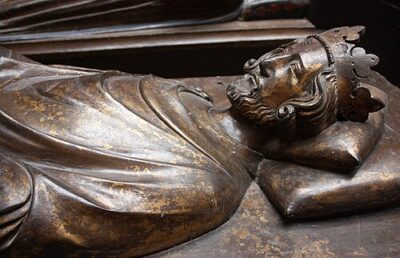
Henry III of England
Henry III of England was a King of England from 1216 to 1272. Born October 1, 1207, in Winchester Castle. Died November 16, 1272, in Palace of Westminster. Positions held include Monarch of England (1216–1272), Lord of Ireland (1216–1272) and Duke of Normandy (–1259).
Facts
34 facts · 2 confirmed by two sources · 19 cited · 13 from one source
Where this comes from
Papalocal keeps its own record. It started from these sources; what each one said is kept here as it was copied, so a change on their side never changes this page by itself. Tap one to read its version.
What Wikidata says · copied November 16, 2026 · revision 2561655375
- Described as
- King of England from 1216 to 1272
- Other names
- Henry III, Henry of Winchester
- Born
- October 1, 1207 · 1 reference
- Died
- November 16, 1272 · 1 reference
- Born in
- Winchester Castle · 1 reference
- Died in
- Palace of Westminster · 1 reference
- Buried in
- Westminster Abbey
- Citizen of
- Kingdom of England
- Occupation
- politician; monarch
- Positions held
- Monarch of England (1216–1272) · 1 reference; Lord of Ireland (1216–1272); Duke of Normandy (–1259) · 1 reference
- Field
- politics · 1 reference
- Spouse
- Eleanor of Provence (1236–1272) · 4 references
- Children
- Edward I of England · 1 reference; Margaret of England · 2 references; Beatrice of England; Edmund Crouchback · 1 reference; Katherine of England; Richard of England · 1 reference; John of England · 1 reference; William of England · 1 reference; Henry of England · 1 reference
- Father
- John, King of England · 1 reference
- Mother
- Isabella of Angoulême · 1 reference
- Siblings
- Joan, Lady of Wales; Isabella of England · 1 reference; Joan of England · 1 reference; Eleanor of Leicester · 1 reference; Isabella of Lusignan; Alice de Lusignan, Countess of Surrey; Aymer de Valence, 2nd Earl of Pembroke; Hugh XI of Lusignan; Richard of Cornwall · 1 reference; William de Valence, 1st Earl of Pembroke
- Wikipedias with a page
- 76
Wikidata item Q160311 (wikidata.org/wiki/Q160311), public domain (CC0). Copied November 16, 2026.
What Wikipedia says · copied November 16, 2026 · revision 1385003314
Henry III (1 October 1207 – 16 November 1272), also known as Henry of Winchester, was King of England, Lord of Ireland and Duke of Aquitaine from 1216 until his death in 1272.
The son of John, King of England, and Isabella of Angoulême, Henry acceded to the throne when he was only nine in the middle of the First Barons' War. Cardinal Guala Bicchieri declared the war against the rebel barons to be a religious crusade and Henry's forces, led by William Marshal, defeated the rebels at the battles of Lincoln and Sandwich in 1217. Henry promised to abide by the Great Charter of 1225, a later version of Magna Carta (1215), which limited royal power and protected the rights of the major barons. Henry's early reign was dominated first by William Marshal, and after his death in 1219 by the magnate Hubert de Burgh, Earl of Kent. In 1230 the King attempted to reconquer the provinces of France that had once belonged to his father, but the invasion was a debacle. A revolt led by William Marshal's son Richard broke out in 1232, ending in a peace settlement negotiated by the Catholic Church.
Following the revolt, Henry ruled England personally, rather than governing through senior ministers. He travelled less than previous monarchs, investing heavily in a handful of his favourite palaces and castles. He married Eleanor of Provence, with whom he had five children. He was known for his piety, holding lavish religious ceremonies and giving generously to charities; he was particularly devoted to the figure of Edward the Confessor, whom he adopted as his patron saint. He extracted huge sums of money from the Jews in England, ultimately crippling their ability to do business. As attitudes towards the Jews hardened, he later introduced the Statute of Jewry, which attempted to segregate the Jewish community from the English populace. In a fresh attempt to reclaim his family's lands in France, he invaded Poitou in 1242, leading to the disastrous Battle of Taillebourg. After this, he relied on diplomacy, cultivating an alliance with Frederick II, Holy Roman Emperor. He supported his brother Richard of Cornwall in his successful bid to become King of the Romans in 1256, but was unable to place his own son Edmund Crouchback on the throne of Sicily, despite investing large amounts of money. He planned to go on crusade to the Levant, but was prevented from doing so by rebellions in Gascony.
By 1258, Henry's rule had grown increasingly unpopular due to the failure of his expensive foreign policies, the notoriety of his Poitevin half-brothers, and the role of his local officials in collecting taxes and debts. In response to this state of affairs, a coalition of his barons seized power in a coup d'état and expelled the Poitevins from England, reforming the royal government through a process called the Provisions of Oxford. In 1259, Henry and the baronial government consented to the Treaty of Paris, under which Henry gave up his rights to his other lands in France in return for King Louis IX recognising him as the rightful ruler of Gascony. Despite the ultimate collapse of the baronial regime, Henry was unable to reform a stable government and instability continued across England.
In 1263 one of the more radical barons, Simon de Montfort, seized power, resulting in the Second Barons' War. Henry persuaded Louis to support his cause and mobilised an army. The Battle of Lewes was fought in 1264 when Henry was defeated and taken prisoner. Henry's eldest son, Edward, escaped from captivity to defeat Simon at the Battle of Evesham the following year and freed his father. Henry initially exacted a harsh revenge on the remaining rebels but was persuaded by the Church to mollify his policies through the Dictum of Kenilworth. Reconstruction was slow, and Henry had to acquiesce to several measures, including further suppression of the Jews, to maintain baronial and popular support. He died in 1272, leaving Edward as his successor. His body was buried in Westminster Abbey, which he had rebuilt in the second half of his reign, and was moved to his current tomb in 1290. Some miracles were declared after his death, but he was not canonised. His reign of 56 years was the longest in medieval English history and would not be surpassed by an English, or later British, monarch until that of George III in the 18th and 19th centuries.
- Born, in its opening lines
- October 1, 1207
- Died, in its opening lines
- November 16, 1272
From the Wikipedia article “Henry III of England” (en.wikipedia.org/wiki/Henry_III_of_England), by its contributors, under CC BY-SA 4.0 (creativecommons.org/licenses/by-sa/4.0/). Copied November 16, 2026; not changed.
Confirmed Two sources agree. Cited One source, and it names where it got it. One source One source, without a reference of its own. Sources disagree The sources disagree. We show the best-supported value and keep theirs below.
