
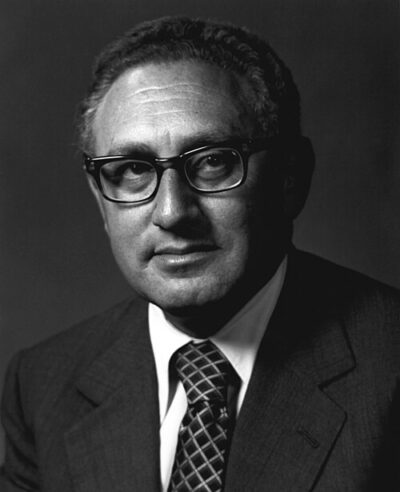
Henry Kissinger
Henry Kissinger was an American diplomat and geopolitical advisor, served as U.S. Secretary of State from 1973 to 1977. Born May 27, 1923, in Fürth. Died November 29, 2023, in Kent. Positions held include United States National Security Advisor (1969–1975), United States Secretary of State (1973–1977) and Chancellor of the College of William & Mary (2000–2005). Educated at George Washington Educational Campus and City College of New York. Awards include Bronze Star Medal, Guggenheim Fellowship and Nobel Peace Prize.
Facts
63 facts · 2 confirmed by two sources · 31 cited · 30 from one source
Where this comes from
Papalocal keeps its own record. It started from these sources; what each one said is kept here as it was copied, so a change on their side never changes this page by itself. Tap one to read its version.
What Wikidata says · copied November 13, 2026 · revision 2567040247
- Described as
- American diplomat and geopolitical advisor, served as U.S. Secretary of State from 1973 to 1977 (1923–2023)
- Other names
- Henry Alfred Kissinger, Heinz Kissinger, Henry A. Kissinger, Heinz Alfred Kissinger, Kissinger
- Born
- May 27, 1923 · 10 references
- Died
- November 29, 2023 · 3 references
- Born in
- Fürth · 4 references
- Died in
- Kent · 1 reference
- Buried in
- Arlington National Cemetery · 1 reference
- Name at birth
- Heinz Alfred Kissinger · 1 reference
- Citizen of
- German Reich · 1 reference; United States (1943–) · 2 references
- Occupation
- politician · 1 reference; political scientist · 1 reference; diplomat; writer; entrepreneur; pedagogue; autobiographer; foreign minister · 1 reference
- Positions held
- United States National Security Advisor (1969–1975); United States Secretary of State (1973–1977) · 1 reference; Chancellor of the College of William & Mary (2000–2005)
- Political party
- Republican Party
- Worked for
- Harvard University; Georgetown University; Kissinger Associates; Rockefeller Brothers Fund (1956–1958)
- Education
- George Washington Educational Campus (1938–1940) · 1 reference; City College of New York (1941–1943) · 1 reference; Harvard University (1947–1954) · 4 references
- Member of
- Trilateral Commission; American Academy of Arts and Sciences; Phi Beta Kappa Society; Harlem Globetrotters (1976–2023) · 1 reference; Academy of the Kingdom of Morocco · 1 reference
- Awards
- Bronze Star Medal (1945) · 1 reference; Guggenheim Fellowship (1965) · 1 reference; Nobel Peace Prize (1973) · 3 references; Knight Grand Cross of the Order of Merit of the Italian Republic (1976) · 1 reference; Presidential Medal of Freedom (1977) · 2 references; Charlemagne Prize (1987) · 1 reference; Eric M. Warburg Award (1992); Knight Commander of the Order of the British Empire (1995) · 1 reference; National Book Award (1980); Bavarian Order of Merit; Order of Tomáš Garrigue Masaryk, 1st class; Order of Merit of Baden-Württemberg (2007); Wateler Peace Prize (1975); Ewald von Kleist Prize (2009); Golden Plate Award
- Field
- international relations; political science · 1 reference; politics · 1 reference; foreign policy · 1 reference; geopolitics · 1 reference; diplomacy · 1 reference
- Spouse
- Ann Fleischer (1949–1964) · 1 reference; Nancy Kissinger (1974–2023) · 1 reference
- Father
- Louis Kissinger · 2 references
- Mother
- Paula Stern · 2 references
- Siblings
- Walter Kissinger · 1 reference
- Religion
- Judaism
- Military branch
- United States Army
- Military rank
- Sergeant
- Height
- 1.73 m (5 ft 8 in) · 1 reference
- Website
- https://www.henryakissinger.com/
- Wikipedias with a page
- 144
Wikidata item Q66107 (wikidata.org/wiki/Q66107), public domain (CC0). Copied November 13, 2026.
What Wikipedia says · copied November 13, 2026 · revision 1381298685
Henry Alfred Kissinger (May 27, 1923 – November 29, 2023) was an American diplomat, political scientist, and politician. A member of the Republican Party, he served as the 7th national security advisor from 1969 to 1975 and as the 56th United States secretary of state from 1973 to 1977, serving under presidents Richard Nixon and Gerald Ford.
Born in Germany, Kissinger emigrated to the United States in 1938 as a Jewish refugee fleeing Nazi persecution. He served in the U.S. Army during World War II. After the war, he attended Harvard University, where he excelled academically. He later became a professor of government at the university and earned an international reputation as an expert on nuclear weapons and foreign policy. He acted as a consultant to government agencies, think tanks, and the presidential campaigns of Nelson Rockefeller and Nixon before being appointed as national security advisor and later secretary of state by President Nixon.
An advocate of a pragmatic approach to geopolitics known as Realpolitik, Kissinger pioneered the policy of détente with the Soviet Union, orchestrated an opening of relations with China, engaged in "shuttle diplomacy" in the Middle East to end the Yom Kippur War, and negotiated the Paris Peace Accords, which ended American involvement in the Vietnam War. For his role in negotiating the accords, he was awarded the 1973 Nobel Peace Prize, which sparked controversy. Kissinger is also associated with controversial U.S. policies including its bombing of Cambodia, involvement in the 1971 Bolivian and 1973 Chilean coups d'état, and support for Argentina's military junta in its Dirty War, Indonesia in its invasion of East Timor, and Pakistan during the Bangladesh Liberation War and Bangladesh genocide. Considered by many American scholars to have been an effective secretary of state, Kissinger was also accused by critics of war crimes for the civilian death toll of the policies he pursued and for his role in facilitating U.S. support for authoritarian regimes.
After leaving government, Kissinger founded Kissinger Associates, an international geopolitical consulting firm which he ran from 1982 until his death. He authored over a dozen books on diplomatic history and international relations. His advice was sought by American presidents of both major political parties.
- Born, in its opening lines
- May 27, 1923
- Died, in its opening lines
- November 29, 2023
From the Wikipedia article “Henry Kissinger” (en.wikipedia.org/wiki/Henry_Kissinger), by its contributors, under CC BY-SA 4.0 (creativecommons.org/licenses/by-sa/4.0/). Copied November 13, 2026; not changed.
Confirmed Two sources agree. Cited One source, and it names where it got it. One source One source, without a reference of its own. Sources disagree The sources disagree. We show the best-supported value and keep theirs below.
