
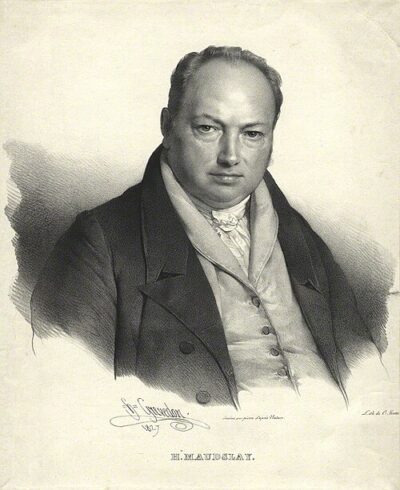
Henry Maudslay was a British engineer. Born August 22, 1771, in Woolwich. Died February 14, 1831, in London Borough of Lambeth.
Facts
12 facts · 2 confirmed by two sources · 3 cited · 7 from one source
Where this comes from
Papalocal keeps its own record. It started from these sources; what each one said is kept here as it was copied, so a change on their side never changes this page by itself. Tap one to read its version.
What Wikidata says · copied November 18, 2026 · revision 2557919728
- Described as
- British engineer
- Born
- August 22, 1771 · 3 references
- Died
- February 14, 1831 · 3 references
- Born in
- Woolwich · 1 reference
- Died in
- London Borough of Lambeth · 1 reference
- Cause of death
- pneumonia
- Citizen of
- United Kingdom of Great Britain and Ireland
- Occupation
- inventor; engineer; businessperson · 1 reference; mechanical technician · 1 reference
- Children
- Thomas Maudslay; Joseph Maudslay
- Wikipedias with a page
- 22
Wikidata item Q936499 (wikidata.org/wiki/Q936499), public domain (CC0). Copied November 18, 2026.
What Wikipedia says · copied November 18, 2026 · revision 1382304864
Henry Maudslay (pronunciation and spelling) (22 August 1771 – 14 February 1831) was an English machine tool innovator, tool and die maker, and inventor. He is considered a founding father of machine tool technology. His inventions were an important foundation for the Industrial Revolution.
Maudslay's invention of a metal lathe to cut metal, circa 1800, enabled the manufacture of standard screw thread sizes. Standard screw thread sizes allowed interchangeable parts and the development of mass production.
- Born, in its opening lines
- August 22, 1771
- Died, in its opening lines
- February 14, 1831
From the Wikipedia article “Henry Maudslay” (en.wikipedia.org/wiki/Henry_Maudslay), by its contributors, under CC BY-SA 4.0 (creativecommons.org/licenses/by-sa/4.0/). Copied November 18, 2026; not changed.
Confirmed Two sources agree. Cited One source, and it names where it got it. One source One source, without a reference of its own. Sources disagree The sources disagree. We show the best-supported value and keep theirs below.
