
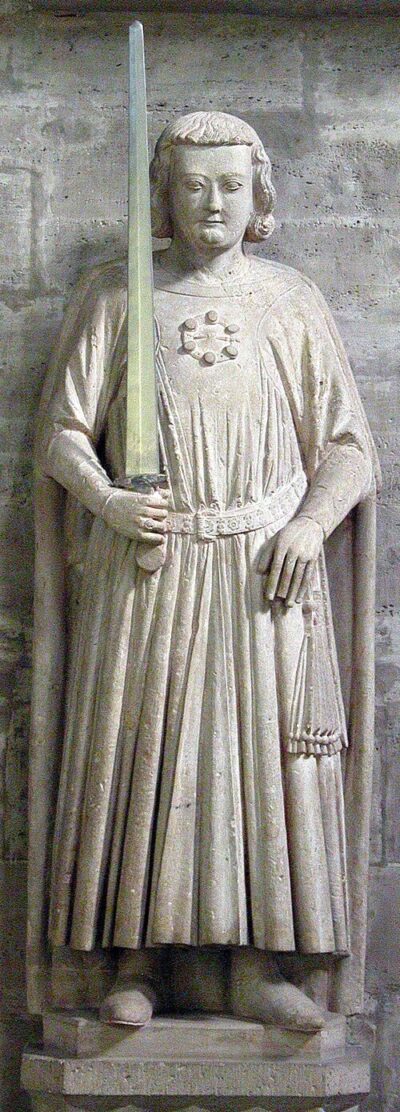
Henry the Lion
Henry the Lion was a Welf dynasty, Duke of Saxony, as Henry III, and Duke of Bavaria, as Henry XII. Born 1129, in Ravensburg. Died August 6, 1195, in Brunswick. Positions held include Duke of Bavaria (1156–1180) and Duke of Saxony.
Facts
24 facts · 0 confirmed by two sources · 17 cited · 7 from one source
Where this comes from
Papalocal keeps its own record. It started from these sources; what each one said is kept here as it was copied, so a change on their side never changes this page by itself. Tap one to read its version.
What Wikidata says · copied November 16, 2026 · revision 2568846831
- Described as
- Welf dynasty, Duke of Saxony, as Henry III, and Duke of Bavaria, as Henry XII (1129-1195)
- Other names
- Henry III, Henry XII
- Born
- 1129
- Died
- August 6, 1195 · 1 reference
- Born in
- Ravensburg · 2 references
- Died in
- Brunswick · 2 references
- Buried in
- Brunswick Cathedral
- Occupation
- monarch
- Positions held
- Duke of Bavaria (1156–1180); Duke of Saxony
- Spouse
- Matilda of England, Duchess of Saxony (1168–) · 2 references; Clementia of Zähringen (1150–) · 1 reference
- Children
- Otto IV, Holy Roman Emperor · 2 references; Henry V, Count Palatine of the Rhine · 1 reference; William of Luneburg · 1 reference; Gertrude of Bavaria · 1 reference; Matilda of Saxony · 1 reference; Maud von Braunschweig · 1 reference; Rixa von Sachsen · 1 reference; Eleanor von Sachsen · 1 reference; Ingibiorg von Sachsen · 1 reference; Lothaire von Sachsen · 1 reference; son von Sachsen · 1 reference
- Father
- Henry X · 1 reference
- Mother
- Gertrude of Süpplingenburg · 1 reference
- Siblings
- Richardis of Babenberg
- Wikipedias with a page
- 52
Wikidata item Q105378 (wikidata.org/wiki/Q105378), public domain (CC0). Copied November 16, 2026.
What Wikipedia says · copied November 16, 2026 · revision 1379453815
Henry the Lion (German: Heinrich der Löwe; 1129/1131 – 6 August 1195), also known as Henry III, Duke of Saxony (ruled 1142–1180) and Henry XII, Duke of Bavaria (ruled 1156–1180), was a member of the Welf dynasty.
Henry was one of the most powerful German princes of his time. As the Duke of Saxony, Henry had had a decisive part in 1152 in his cousin Frederick Barbarossa's campaign for the throne. Because of this, in the following years, he was intensely promoted by Barbarossa. So, in 1156, he received the Dukedom of Bavaria. In North Germany, Henry could now build a kingly presence. He achieved this in Brunswick by building a new collegiate church, St Blaise, and, in the neighbouring Dankwarderode Castle, he placed a statue of a lion, as a symbol of its place as the capital of his duchies. The aggressive building strategy of the Duke in Saxony and north of the Elbe supplanted the influence of the previous greats of Saxony. Next, Henry repaid Barbarossa's sponsorship by putting great effort into his service to the first Italian dynasty.
The agreement between Henry and Barbarossa encountered difficulties when Henry refused to send military assistance in 1176 for Barbarossa's invasion of Italy. With his expedition ending in defeat at the Battle of Legnano against the Lombard League, Barbarossa resented Henry for having failed to support him. In 1176, the rival Hohenstaufen dynasty succeeded in isolating him and eventually deprived him of his duchies of Bavaria and Saxony during the reign of Emperor Frederick Barbarossa and of Frederick's son and successor Henry VI. After the death of Barbarossa, and the failure of the overall Italian political scene and the peace agreement of 1177 (due to campaigning by Pope Alexander III), Henry the Lion overthrew more Dukes, but had to go into exile in southern England.
At the height of his reign, Henry ruled over a vast territory stretching from the coast of the North and Baltic seas to the Alps, and from Westphalia to Pomerania. Alongside Frederick Barbarossa, he was an important protagonist in the Staufen-Welf conflict, which had served as the main political force in the twelfth century. Henry achieved this great power in part by his political and military acumen and in part through the legacies of his four grandparents. He is considered as one of the most important people of this early era.
From the Wikipedia article “Henry the Lion” (en.wikipedia.org/wiki/Henry_the_Lion), by its contributors, under CC BY-SA 4.0 (creativecommons.org/licenses/by-sa/4.0/). Copied November 16, 2026; not changed.
Confirmed Two sources agree. Cited One source, and it names where it got it. One source One source, without a reference of its own. Sources disagree The sources disagree. We show the best-supported value and keep theirs below.
