
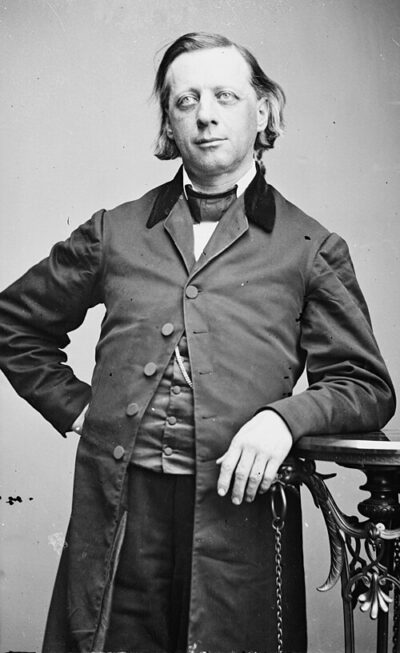
Henry Ward Beecher
Henry Ward Beecher was an American clergyman and activist. Born June 24, 1813, in Litchfield. Died March 8, 1887, in Brooklyn. Educated at Amherst College and Lane Theological Seminary.
Facts
26 facts · 2 confirmed by two sources · 7 cited · 17 from one source
Where this comes from
Papalocal keeps its own record. It started from these sources; what each one said is kept here as it was copied, so a change on their side never changes this page by itself. Tap one to read its version.
What Wikidata says · copied November 13, 2026 · revision 2557920054
- Described as
- American clergyman and activist (1813–1887)
- Born
- June 24, 1813 · 6 references
- Died
- March 8, 1887 · 5 references
- Born in
- Litchfield · 3 references
- Died in
- Brooklyn · 3 references
- Buried in
- Green-Wood Cemetery · 1 reference
- Cause of death
- cerebral hemorrhage
- Citizen of
- United States
- Occupation
- politician; journalist; theologian · 2 references; writer · 1 reference
- Education
- Amherst College; Lane Theological Seminary · 1 reference
- Spouse
- Eunice White Beecher
- Children
- William Constantine Beecher; Herbert Foote Beecher; Harriet Eliza Beecher Scoville; Henry Barton Beecher
- Father
- Lyman Beecher · 2 references
- Mother
- Roxana Foote Beecher · 1 reference
- Siblings
- Harriet Beecher Stowe; Catharine Beecher; Edward Beecher; Thomas K. Beecher; Charles Beecher; Isabella Beecher Hooker
- Wikipedias with a page
- 43
Wikidata item Q1607404 (wikidata.org/wiki/Q1607404), public domain (CC0). Copied November 13, 2026.
What Wikipedia says · copied November 13, 2026 · revision 1384766059
Henry Ward Beecher (June 24, 1813 – March 8, 1887) was an American Congregationalist clergyman, social reformer, and speaker, known for his support of the abolition of slavery, his emphasis on God's love, and his 1875 adultery trial. His rhetorical focus on the love of Christ has influenced mainstream Christianity into the 21st century.
Beecher was the son of Lyman Beecher, a Calvinist minister who became one of the best-known evangelists of his era. Several of his brothers and sisters became well-known educators and activists, most notably Harriet Beecher Stowe, who achieved worldwide fame with her abolitionist novel Uncle Tom's Cabin. Henry Ward Beecher graduated from Amherst College in 1834 and Lane Seminary in 1837 before serving as a minister in Lawrenceburg, Indiana, and later in Indianapolis's Second Presbyterian Church when the congregation resided at Circle Hall at Monument Circle.
In 1847, Beecher became the first pastor of the Plymouth Church in Brooklyn, New York. He soon acquired fame on the lecture circuit for his novel oratorical style in which he employed humor, dialect, and slang. Over the course of his ministry, he developed a theology emphasizing God's love above all else. He also grew interested in social reform, particularly the abolitionist movement. In the years leading up to the Civil War, he raised money to purchase slaves from captivity and to send rifles—nicknamed "Beecher's Bibles"—to abolitionists fighting in Kansas. He toured Europe during the Civil War, speaking in support of the Union.
After the war, Beecher supported social reform causes such as women's suffrage and temperance. He also championed Charles Darwin's theory of evolution, stating that it was not incompatible with Christian beliefs. He was widely rumored to be an adulterer, and in 1872 the Woodhull & Claflin's Weekly published a story about his affair with Elizabeth Richards Tilton, the wife of his friend and former co-worker Theodore Tilton. In 1874, Tilton filed charges for "criminal conversation" against Beecher. The trial resulted in a hung jury and was one of the most widely reported trials of the century.
After the death of his father in 1863, Beecher was unquestionably "the most famous preacher in the nation". Beecher's long career in the public spotlight led biographer Debby Applegate to call her biography of him The Most Famous Man in America.
- Born, in its opening lines
- June 24, 1813
- Died, in its opening lines
- March 8, 1887
From the Wikipedia article “Henry Ward Beecher” (en.wikipedia.org/wiki/Henry_Ward_Beecher), by its contributors, under CC BY-SA 4.0 (creativecommons.org/licenses/by-sa/4.0/). Copied November 13, 2026; not changed.
Confirmed Two sources agree. Cited One source, and it names where it got it. One source One source, without a reference of its own. Sources disagree The sources disagree. We show the best-supported value and keep theirs below.
