
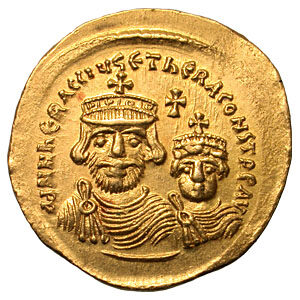
Heraclius was a Byzantine emperor from 610 to 641. Born 575, in Cappadocia. Died February 11, 641, in Constantinople. Positions held include Byzantine emperor (610–641).
Facts
21 facts · 2 confirmed by two sources · 1 cited · 18 from one source
Where this comes from
Papalocal keeps its own record. It started from these sources; what each one said is kept here as it was copied, so a change on their side never changes this page by itself. Tap one to read its version.
What Wikidata says · copied November 16, 2026 · revision 2568259005
- Described as
- Byzantine emperor from 610 to 641
- Other names
- Flavius Heraclius Augustus
- Born
- 575 · 9 references
- Died
- February 11, 641 · 2 references
- Born in
- Cappadocia
- Died in
- Constantinople · 1 reference
- Occupation
- politician
- Positions held
- Byzantine emperor (610–641)
- Spouse
- Fabia Eudokia; Martina · 1 reference
- Children
- Eudoxia Epiphania; Heraclius Constantine; John Athalarichos; Konstantinos Heteros; Theodosius; Heraklonas; David; Martinus; Augoustina; Martina
- Father
- Heraclius the Elder
- Mother
- Epiphania
- Siblings
- Theodore
- Wikipedias with a page
- 90
Wikidata item Q41852 (wikidata.org/wiki/Q41852), public domain (CC0). Copied November 16, 2026.
What Wikipedia says · copied November 16, 2026 · revision 1385067390
Heraclius (Greek: Ἡράκλειος, romanized: Hērákleios; c. 575 – 11 February 641) was Byzantine emperor from 610 to 641. His rise to power began in 608, when he and his father, Heraclius the Elder, the Exarch of Africa, led a revolt against the unpopular emperor Phocas.
Heraclius's reign was marked by wars against the Persians and the Arabs. Heraclius immediately took charge of the Byzantine–Sasanian War of 602–628 upon his accession, but his leadership initially did little to stem Persian ascendency in the war; after personally losing the Battle of Antioch (613), the Persians were able to take Syria and Egypt, reducing the Empire to Asia Minor. Heraclius, however, avoided total defeat and initiated reforms to rebuild and strengthen the military. Heraclius drove the Persians out of Asia Minor and pushed deep into their territory, defeating them in 627 at the Battle of Nineveh and devastating much of Mesopotamia. The Persian Shah Khosrow II was overthrown and executed by his son Kavad II, who soon sued for a peace treaty, agreeing to withdraw from all occupied territory. Heraclius won the war, but his Empire was deeply strained.
Heraclius soon lost many of his newly regained lands to the Rashidun Caliphate. Emerging from the Arabian Peninsula, the Arabs quickly conquered the Sasanian Empire. In 636, the Arabs marched into Syria, defeating Heraclius's brother Theodore. Within a short period of time, the Arabs conquered Mesopotamia, Armenia, and Egypt. Heraclius responded with reforms that allowed his successors to combat the Arabs and avoid total destruction.
Heraclius entered diplomatic relations with the Serbs in the Balkans. He tried to repair the schism in the Christian church regarding the non-Chalcedonians by promoting a compromise doctrine called monothelitism. The Church of the East (commonly called Nestorian) was also involved in the process. Eventually, this project of unity was rejected by all sides of the dispute. During his reign, the Greek language, widely spoken throughout the empire, became the official language of the state, replacing Latin.
- Born, in its opening lines
- c. 575
- Died, in its opening lines
- February 11, 641
From the Wikipedia article “Heraclius” (en.wikipedia.org/wiki/Heraclius), by its contributors, under CC BY-SA 4.0 (creativecommons.org/licenses/by-sa/4.0/). Copied November 16, 2026; not changed.
Confirmed Two sources agree. Cited One source, and it names where it got it. One source One source, without a reference of its own. Sources disagree The sources disagree. We show the best-supported value and keep theirs below.
