
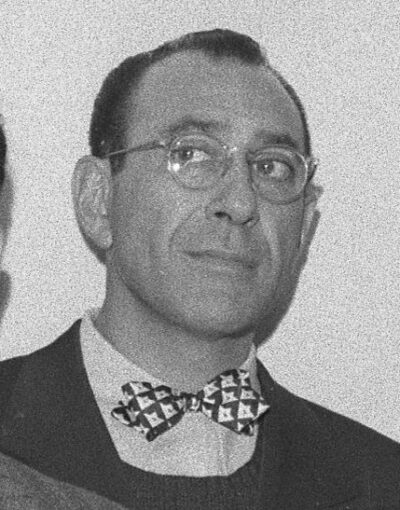
Herbert Biberman
Herbert Biberman was an American screenwriter and film director. Born March 4, 1900, in Philadelphia. Died June 30, 1971, in New York City.
Facts
11 facts · 2 confirmed by two sources · 3 cited · 6 from one source
Where this comes from
Papalocal keeps its own record. It started from these sources; what each one said is kept here as it was copied, so a change on their side never changes this page by itself. Tap one to read its version.
What Wikidata says · copied November 18, 2026 · revision 2530157135
- Described as
- American screenwriter and film director (1900–1971)
- Other names
- Herbert J. Biberman
- Born
- March 4, 1900 · 7 references
- Died
- June 30, 1971 · 1 reference
- Born in
- Philadelphia
- Died in
- New York City
- Cause of death
- bone cancer
- Citizen of
- United States · 1 reference
- Occupation
- screenwriter · 2 references; film director; director · 1 reference
- Member of
- Hollywood Ten
- Spouse
- Gale Sondergaard (1930–1971)
- Wikipedias with a page
- 17
Wikidata item Q254468 (wikidata.org/wiki/Q254468), public domain (CC0). Copied November 18, 2026.
What Wikipedia says · copied November 18, 2026 · revision 1385918915
Herbert J. Biberman (March 4, 1900 – June 30, 1971) was an American screenwriter and film director. He was one of the Hollywood Ten and directed Salt of the Earth (1954), a film barely released in the United States, about a zinc miners' strike in Grant County, New Mexico. His membership in the Directors Guild of America was posthumously restored in 1997; he had been expelled in 1950.
Biberman was born in Philadelphia, Pennsylvania, to Joseph and Eva Biberman and was the brother of American artist, Edward Biberman.
He attended Central High School in Philadelphia, and then went on to the University of Pennsylvania. He graduated from Penn in 1921, being chosen to deliver the "Ivy Oration" at the Commencement ceremony. From 1924 to 1926 he attended the Yale School of Drama, being a member of the first acting classes to study with George Pierce Baker. In the late 1920s he began performing in plays by The Theatre Guild, and joined Cheryl Crawford and Harold Clurman in founding its "Studio Theatre" for experimental productions - which included and translation of "Red Rust," a Russian play about an abusive Communist leader. By 1930 he began his career as a Broadway director with the American premiere production of Sergei Tretyakov's Roar, China! and the world premiere production of Green Grow the Lilacs by Lynn Riggs, which was the basis for the later musical Oklahoma!.
Moving to Hollywood, Biberman's career included writing such films as King of Chinatown (1939), When Tomorrow Comes (1939), Action in Arabia (1944), The Master Race (1944), which he also directed, and New Orleans (1947), as well as directing such films as One Way Ticket (1935) and Meet Nero Wolfe (1936). He married actress Gale Sondergaard in 1930; the marriage lasted for the rest of Biberman's life. Biberman died from bone cancer in 1971 in New York City.
- Born, in its opening lines
- March 4, 1900
- Died, in its opening lines
- June 30, 1971
From the Wikipedia article “Herbert Biberman” (en.wikipedia.org/wiki/Herbert_Biberman), by its contributors, under CC BY-SA 4.0 (creativecommons.org/licenses/by-sa/4.0/). Copied November 18, 2026; not changed.
Confirmed Two sources agree. Cited One source, and it names where it got it. One source One source, without a reference of its own. Sources disagree The sources disagree. We show the best-supported value and keep theirs below.
