
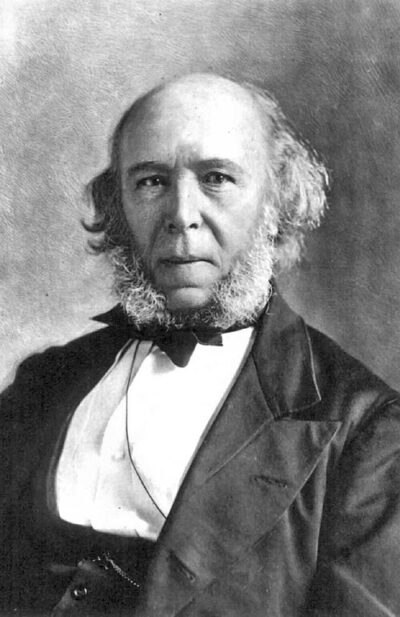
Herbert Spencer
Herbert Spencer was an English philosopher and political theorist. Born April 27, 1820, in Derby. Died December 8, 1903, in Brighton. Known for The Study of Sociology, Mr. Martineau on Evolution and Social Statics.
Facts
25 facts · 2 confirmed by two sources · 6 cited · 17 from one source
What’s different
- Born: we show April 27, 1820 (Confirmed). Wikidata also lists April 28, 1820
Where this comes from
Papalocal keeps its own record. It started from these sources; what each one said is kept here as it was copied, so a change on their side never changes this page by itself. Tap one to read its version.
What Wikidata says · copied November 16, 2026 · revision 2568676329
- Described as
- English philosopher and political theorist (1820–1903)
- Other names
- Gerbert Spencer, Spencert
- Born
- April 27, 1820 · 13 references; April 28, 1820 · 1 reference
- Died
- December 8, 1903 · 13 references
- Born in
- Derby · 7 references
- Died in
- Brighton · 6 references
- Buried in
- Highgate Cemetery
- Citizen of
- United Kingdom of Great Britain and Ireland
- Occupation
- philosopher · 2 references; economist; anthropologist; psychologist; journalist; sociologist · 2 references; writer · 1 reference; botanist
- Worked for
- The Economist · 1 reference
- Member of
- Academy of Sciences of Turin (1880–) · 1 reference; Athenaeum Club · 1 reference; X Club · 1 reference; Accademia Nazionale dei Lincei (1876–) · 1 reference
- Known for
- The Study of Sociology; Mr. Martineau on Evolution; Social Statics · 1 reference
- Field
- botany
- Father
- William George Spencer
- Religion
- agnosticism · 1 reference
- Wikipedias with a page
- 120
Wikidata item Q144535 (wikidata.org/wiki/Q144535), public domain (CC0). Copied November 16, 2026.
What Wikipedia says · copied November 16, 2026 · revision 1381515841
Herbert Spencer (27 April 1820 – 8 December 1903) was an English polymath active as a philosopher, psychologist, biologist, sociologist, and anthropologist. Spencer originated the expression "survival of the fittest", which he coined in Principles of Biology (1864) after reading Charles Darwin's 1859 book On the Origin of Species. The term strongly suggests natural selection, yet Spencer saw evolution as extending into realms of sociology and ethics, so he also supported Lamarckism.
Spencer developed an all-embracing conception of evolution as the progressive development of the physical world, biological organisms, the human mind, and human culture and societies. As a polymath, he contributed to a wide range of subjects, including ethics, religion, anthropology, economics, political theory, philosophy, literature, astronomy, biology, sociology, and psychology. During his lifetime he achieved tremendous authority, mainly in English-speaking academia. Spencer was "the single most famous European intellectual in the closing decades of the nineteenth century" but his influence declined sharply after 1900: "Who now reads Spencer?" asked Talcott Parsons in 1937.
- Born, in its opening lines
- April 27, 1820
- Died, in its opening lines
- December 8, 1903
From the Wikipedia article “Herbert Spencer” (en.wikipedia.org/wiki/Herbert_Spencer), by its contributors, under CC BY-SA 4.0 (creativecommons.org/licenses/by-sa/4.0/). Copied November 16, 2026; not changed.
Confirmed Two sources agree. Cited One source, and it names where it got it. One source One source, without a reference of its own. Sources disagree The sources disagree. We show the best-supported value and keep theirs below.
