
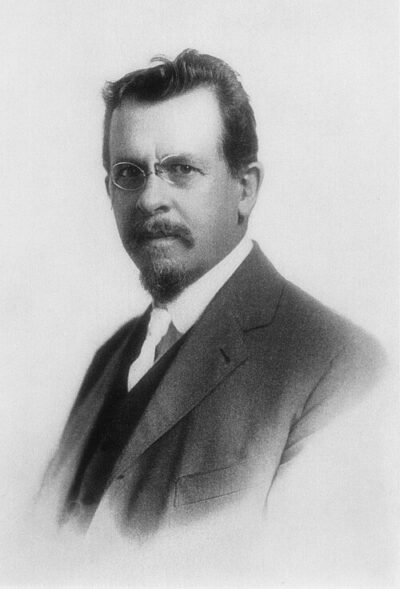
Herbert William Conn
Herbert William Conn was an American bacteriologist and educator. Born January 10, 1859, in Fitchburg. Died April 18, 1917, in Middletown. Educated at Boston University and Johns Hopkins University.
Facts
18 facts · 2 confirmed by two sources · 8 cited · 8 from one source
Where this comes from
Papalocal keeps its own record. It started from these sources; what each one said is kept here as it was copied, so a change on their side never changes this page by itself. Tap one to read its version.
What Wikidata says · copied November 18, 2026 · revision 2564789998
- Described as
- American bacteriologist and educator (1859-1917)
- Other names
- Conn, Herbert W. Conn
- Born
- January 10, 1859 · 1 reference
- Died
- April 18, 1917 · 3 references
- Born in
- Fitchburg · 1 reference
- Died in
- Middletown · 1 reference
- Buried in
- Pine Grove Cemetery · 1 reference
- Cause of death
- myocardial infarction
- Citizen of
- United States
- Occupation
- bacteriologist; botanist · 1 reference; physician · 1 reference; biologist · 1 reference; university teacher · 1 reference
- Education
- Boston University; Johns Hopkins University; Cushing Academy · 1 reference
- Field
- biology · 1 reference; bacteriology · 1 reference; educational system · 1 reference
- Wikipedias with a page
- 16
Wikidata item Q14946759 (wikidata.org/wiki/Q14946759), public domain (CC0). Copied November 18, 2026.
What Wikipedia says · copied November 18, 2026 · revision 1377343330
Herbert William Conn (January 10, 1859 – April 18, 1917) was an American bacteriologist and educator.
Born in Fitchburg, Massachusetts, the son of Reuben Rice Conn and Harriot Elizabeth, he became ill from rheumatic fever during his youth and had to be withdrawn from public school because of his poor health. Instead, he was educated at Cushing Academy, a private school in Ashburnham, Massachusetts, then matriculated to Boston University where he graduated second in his class with an A.B. in 1881. He entered graduate school at Johns Hopkins University in 1881, receiving his Ph.D. on animal morphology, physiology, and histology in 1884 with a thesis titled, "Life-history of Thalassema", for which he received a Walker prize from the Boston Society of Natural History. In August, 1885, he was married to Julia M. Joel; the couple had two children including Harold J. Conn, a soil bacteriologist and stain expert.
Following his graduation, Conn joined the staff of Wesleyan University as a biology instructor, becoming a biology professor in 1887 and founder of the university's biology department. He would hold the chair of biology for the remainder of his career. The same year he was named acting director of the department of zoology at Martha's Vineyard Summer Institute. In 1889–90 he taught biology at Trinity College, then was director of the Cold Springs Biological Laboratory, today's Cold Spring Harbor Laboratory, in 1890–97.
Beginning in December, 1898, he helped to found the American Society for Microbiology; serving as its secretary for three years, then as its president in 1902. In 1901 he became a bacteriology lecturer at the Connecticut Agricultural College. He was chosen as the Connecticut State Bacteriologist in 1905, and helped to organize and direct the State Bacteriological Laboratory. In March 1911, the New York Milk Committee appointed him to be a member of the National Commission on Milk Standards.
During his career, Conn published more than 150 papers, as well as a series of school textbooks. He is notable for discovering that typhoid fever can be distributed by oysters, and was a recognized specialist in the bacteriology of dairy products. Conn was a proponent of home economics, and his text Bacteria, Yeasts, and Moulds in the Home became a standard textbook in home economics courses.
In addition to his work on bacteria and food safety, late in his career Conn also wrote against some of the theories of eugenics which were gaining popularity in the early 20th century. He argued that social factors must be taken into account when trying to understand human outcomes, and not merely genetics.
- Born, in its opening lines
- January 10, 1859
- Died, in its opening lines
- April 18, 1917
From the Wikipedia article “Herbert William Conn” (en.wikipedia.org/wiki/Herbert_William_Conn), by its contributors, under CC BY-SA 4.0 (creativecommons.org/licenses/by-sa/4.0/). Copied November 18, 2026; not changed.
Confirmed Two sources agree. Cited One source, and it names where it got it. One source One source, without a reference of its own. Sources disagree The sources disagree. We show the best-supported value and keep theirs below.
