
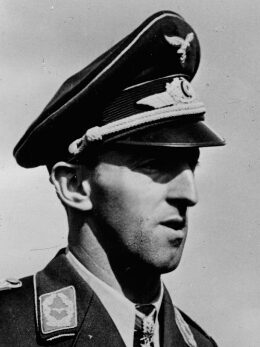
Hermann Graf
Hermann Graf was a German officer and fighter pilot during World War II. Born October 24, 1912, in Engen. Died November 4, 1988, in Engen. Awards include Knight's Cross of the Iron Cross with Oak Leaves, Swords and Diamonds and German Cross in Gold.
Facts
14 facts · 2 confirmed by two sources · 3 cited · 9 from one source
Where this comes from
Papalocal keeps its own record. It started from these sources; what each one said is kept here as it was copied, so a change on their side never changes this page by itself. Tap one to read its version.
What Wikidata says · copied November 17, 2026 · revision 2569055097
- Described as
- German officer and fighter pilot during World War II (1912–1988)
- Born
- October 24, 1912 · 3 references
- Died
- November 4, 1988 · 4 references
- Born in
- Engen · 1 reference
- Died in
- Engen · 1 reference
- Buried in
- Baden-Württemberg
- Cause of death
- Parkinson's disease
- Citizen of
- Germany
- Occupation
- aircraft pilot; military personnel · 1 reference
- Awards
- Knight's Cross of the Iron Cross with Oak Leaves, Swords and Diamonds; German Cross in Gold
- Spouse
- Jola Jobst (1944–1949) · 1 reference
- Military branch
- Luftwaffe
- Military rank
- colonel
- Wikipedias with a page
- 27
Wikidata item Q61240 (wikidata.org/wiki/Q61240), public domain (CC0). Copied November 17, 2026.
What Wikipedia says · copied November 17, 2026 · revision 1385271340
Hermann Graf (24 October 1912 – 4 November 1988) was a German Luftwaffe World War II fighter ace. He served on both the Eastern and Western Fronts. He became the first pilot in aviation history to claim 200 aerial victories—that is, 200 aerial combat encounters resulting in the destruction of the enemy aircraft. In about 830 combat missions, he claimed a total of 212 aerial victories, almost all of which were achieved on the Eastern Front.
Graf, a pre-war football player and glider pilot, joined the Luftwaffe and started flight training in 1936. He was initially selected for transport aviation but was subsequently posted to Jagdgeschwader 51 (JG 51—51st Fighter Wing) in May 1939. At the outbreak of war he was stationed on the Franco–German border flying uneventful patrols. He was then posted as a flight instructor stationed in Romania as part of a German military mission training Romanian pilots. Graf flew a few ground support missions in the closing days of the German invasion of Crete.
Following the start of Operation Barbarossa, the German invasion of the Soviet Union, Graf claimed his first aerial victory on 4 August 1941. He was awarded the Knight's Cross of the Iron Cross after 45 victories on 24 January 1942. It was during the second summer of the eastern campaign; however, that his success rate dramatically increased. By 16 September 1942 his number of victories had increased to 172 for which he was honored with the Knight's Cross of the Iron Cross with Oak Leaves, Swords and Diamonds. At the time of its presentation to Graf it was Germany's highest military decoration. On 26 September 1942 he shot down his 200th enemy aircraft.
By then a national hero, Graf was withdrawn from combat operations and posted to a fighter pilot training school in France before being tasked with the setting up of a new special unit: Jagdgeschwader 50 (JG 50—Fighter Wing 50). Its mission was as a high-altitude unit to intercept the de Havilland Mosquito intruders. In November 1943 Graf returned to combat operations. He was appointed Geschwaderkommodore (Wing Commander) of Jagdgeschwader 11 (JG 11—11th Fighter Wing) and claimed his last and 212th aerial victory on 29 March 1944. He was severely injured during that encounter and, after a period of convalescence, became Geschwaderkommodore of Jagdgeschwader 52 (JG 52—52nd Fighter Wing). He and the remainder of JG 52 surrendered to units of the United States Army on 8 May 1945, but were turned over to the Red Army. Graf was held in Soviet captivity until 1949. After the war he worked as an electronic sales manager and died after a long illness in his home town of Engen on 4 November 1988.
- Born, in its opening lines
- October 24, 1912
- Died, in its opening lines
- November 4, 1988
From the Wikipedia article “Hermann Graf” (en.wikipedia.org/wiki/Hermann_Graf), by its contributors, under CC BY-SA 4.0 (creativecommons.org/licenses/by-sa/4.0/). Copied November 17, 2026; not changed.
Confirmed Two sources agree. Cited One source, and it names where it got it. One source One source, without a reference of its own. Sources disagree The sources disagree. We show the best-supported value and keep theirs below.
