
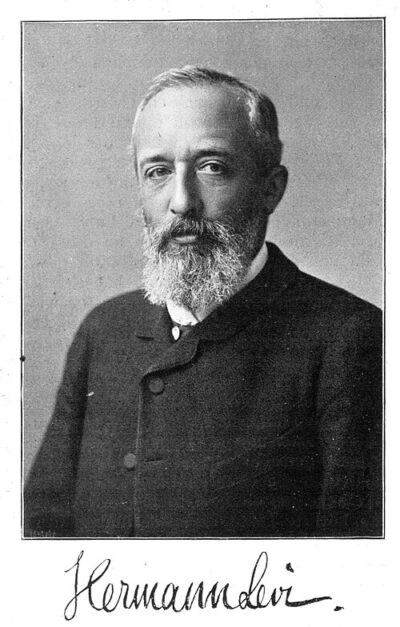
Hermann Levi
Hermann Levi was a German conductor, composer and royal Bavarian general music director. Born November 7, 1839, in Giessen. Died May 13, 1900, in Munich. Positions held include music director, chapelmaster (1861–) and general music director (1872–1896). Educated at University of Music and Theatre Leipzig.
Facts
23 facts · 2 confirmed by two sources · 17 cited · 4 from one source
Where this comes from
Papalocal keeps its own record. It started from these sources; what each one said is kept here as it was copied, so a change on their side never changes this page by itself. Tap one to read its version.
What Wikidata says · copied November 18, 2026 · revision 2568956099
- Described as
- German conductor, composer and royal Bavarian general music director (1839-1900)
- Born
- November 7, 1839 · 7 references
- Died
- May 13, 1900 · 7 references
- Born in
- Giessen · 2 references
- Died in
- Munich · 3 references
- Buried in
- Garmisch-Partenkirchen
- Citizen of
- Grand Duchy of Hesse · 1 reference
- Occupation
- conductor · 3 references; composer · 4 references; pianist; general music director · 1 reference; musician · 1 reference
- Positions held
- music director · 1 reference; chapelmaster (1861–) · 1 reference; general music director (1872–1896) · 1 reference; court chapel master (1872–1896) · 1 reference
- Education
- University of Music and Theatre Leipzig (1855–1858) · 2 references
- Genre
- classical music · 1 reference; opera · 1 reference
- Instrument
- piano
- Spouse
- Mary Balling (1896–) · 1 reference
- Father
- Benedikt Levi · 1 reference
- Siblings
- Wilhelm Lindeck
- Religion
- Judaism · 1 reference
- Wikipedias with a page
- 20
Wikidata item Q61175 (wikidata.org/wiki/Q61175), public domain (CC0). Copied November 18, 2026.
What Wikipedia says · copied November 18, 2026 · revision 1353992752
Hermann Levi (7 November 1839 – 13 May 1900) was a German Jewish orchestral conductor.
Levi was born in Giessen, Germany, the son of a rabbi. He was educated at Giessen and Mannheim, and came to Vinzenz Lachner's notice. From 1855 to 1858 Levi studied at the Leipzig Conservatory, and after a series of travels which took him to Paris, he obtained his first post as music director at Saarbrücken, which post he exchanged for that at Mannheim in 1861. From 1862 to 1864 he was chief conductor of the German Opera in Rotterdam, then until 1872 at Karlsruhe, when he went to Munich, a post he held until 1896, when ill health compelled him to resign. Levi also taught at the Leipzig Conservatory, where his pupils included the conductor Emil Steinbach.
Levi's name is indissolubly connected with the increased public appreciation of Richard Wagner's music. He was a long-time friend of Wagner; when preparing for the inaugural Bayreuth Festival, he wrote to his father, "Wagner is the best and noblest of men ... I thank God daily for the privilege to be close to such a man. It is the most beautiful experience of my life". He conducted the first performance of Parsifal at Bayreuth in 1882, even though Wagner initially objected to this and was quoted as saying that Levi should be baptized before conducting it. However, Ludwig II of Bavaria, who was Wagner's patron, told him in a letter that "Nothing is more repugnant, nothing less edifying than such squabbles; people after all are brothers, in spite of all denominational differences." Levi was connected with the musical life at Bayreuth during the remainder of his career. He visited London in 1895, and died in Munich in 1900. He was interred in a mausoleum in the grounds of his villa later that year in Garmisch-Partenkirchen.
During his early years, Levi also worked as a composer. His first opus number was a piano concerto published in Paris, besides which he also wrote a violin sonata.
- Born, in its opening lines
- November 7, 1839
- Died, in its opening lines
- May 13, 1900
From the Wikipedia article “Hermann Levi” (en.wikipedia.org/wiki/Hermann_Levi), by its contributors, under CC BY-SA 4.0 (creativecommons.org/licenses/by-sa/4.0/). Copied November 18, 2026; not changed.
Confirmed Two sources agree. Cited One source, and it names where it got it. One source One source, without a reference of its own. Sources disagree The sources disagree. We show the best-supported value and keep theirs below.
