
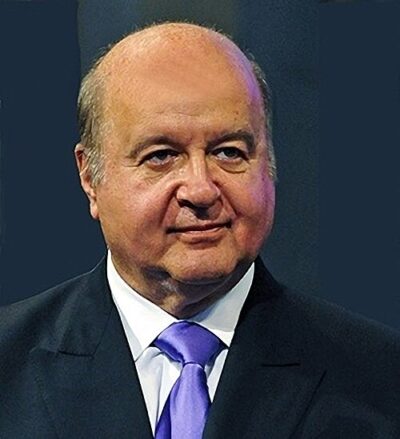
Hernando de Soto
Hernando de Soto is a Peruvian economist. Born June 2, 1941, in Arequipa. Known for The Mystery of Capital - Why Capitalism Triumphs in the West and Fails Everywhere Else. Educated at International School of Geneva and University of Geneva. Awards include Global Award for Entrepreneurship Research and Hayek Medal.
Facts
17 facts · 1 confirmed by two sources · 6 cited · 10 from one source
Where this comes from
Papalocal keeps its own record. It started from these sources; what each one said is kept here as it was copied, so a change on their side never changes this page by itself. Tap one to read its version.
What Wikidata says · copied November 17, 2026 · revision 2565545529
- Described as
- Peruvian economist
- Other names
- Hernando de Soto Polar
- Born
- June 2, 1941 · 1 reference
- Born in
- Arequipa · 1 reference
- Citizen of
- Peru
- Occupation
- economist · 1 reference; writer; politician · 1 reference; entrepreneur · 1 reference
- Education
- International School of Geneva; University of Geneva; Graduate Institute of International Studies
- Known for
- The Mystery of Capital - Why Capitalism Triumphs in the West and Fails Everywhere Else
- Awards
- Global Award for Entrepreneurship Research (2017) · 1 reference; Hayek Medal (2010) · 1 reference
- Spouse
- Dona Gerarda de Orléans-Borbón y Parodi Delfino
- Father
- Alberto Soto de la Jara
- Siblings
- Álvaro de Soto · 1 reference
- Website
- https://www.hernandodesoto.pe/
- Wikipedias with a page
- 25
Wikidata item Q357946 (wikidata.org/wiki/Q357946), public domain (CC0). Copied November 17, 2026.
What Wikipedia says · copied November 17, 2026 · revision 1381605373
Hernando de Soto Polar (; born 2 June 1941) is a Peruvian economist. He is known for his work on the informal economy and on the importance of business and property rights. He is the current president of the Institute for Liberty and Democracy (ILD), a think tank located in Lima, Peru, that is devoted to promoting economic development in developing countries.
In Peru, de Soto's advisory has been recognized as inspiring the economic guidelines—including the loosening of economic regulation, the introduction of austerity measures and the utilization of neoliberal policies—that were ultimately adopted by the government of Alberto Fujimori and established in the 1993 Constitution of Peru. De Soto would go on to support Alberto's daughter, Keiko Fujimori, serving as an advisor during her presidential campaigns. De Soto worked closely with various Peruvian governments, even serving as a negotiator for the Peru–United States Trade Promotion Agreement. After years of speculation, de Soto ran for the Peruvian presidency in the 2021 presidential election, placing fourth in an atomized race of 18 nominees. He subsequently held meetings with Pedro Castillo during his administration, asked Dina Boluarte to resign from the presidency during the social unrest, and attempted to run in the 2026 elections for the Progresemos party, although he ultimately withdrew his candidacy.
Internationally, de Soto helped inspire the Washington Consensus macroeconomic prescriptions and was credited by economist John Williamson, who coined the consensus' name. He also supported the creation of the North American Free Trade Agreement (NAFTA), with George H.W. Bush praising his promotion of free trade when announcing the North American agreement. Other heads of state have recognized de Soto, including Bill Clinton, Vladimir Putin, Emmanuel Macron, Ronald Reagan and Margaret Thatcher. The ILD has received praise from other people including Nobel laureate Milton Friedman, World Bank President James Wolfensohn, and former UN Secretary-General Javier Pérez de Cuéllar.
- Born, in its opening lines
- June 2, 1941
From the Wikipedia article “Hernando de Soto (economist)” (en.wikipedia.org/wiki/Hernando_de_Soto_(economist)), by its contributors, under CC BY-SA 4.0 (creativecommons.org/licenses/by-sa/4.0/). Copied November 17, 2026; not changed.
Confirmed Two sources agree. Cited One source, and it names where it got it. One source One source, without a reference of its own. Sources disagree The sources disagree. We show the best-supported value and keep theirs below.
