
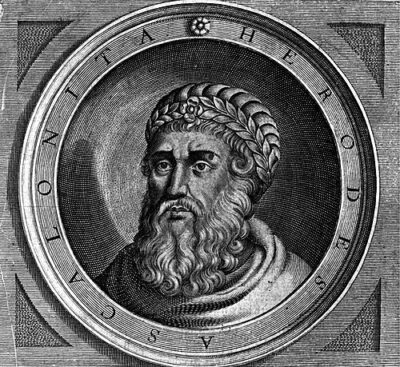
Herod the Great
Herod the Great was a king of Judea from 37/6 BCE to 4/1 BCE. Born 74 BC, in Edom. Died 4 BC, in Jericho. Positions held include King of Judea (–-4).
Facts
37 facts · 0 confirmed by two sources · 8 cited · 28 from one source · 1 where the sources disagree
What’s different
- Cause of death: we show kidney failure (Sources disagree). Wikidata also lists arteriosclerosis
Where this comes from
Papalocal keeps its own record. It started from these sources; what each one said is kept here as it was copied, so a change on their side never changes this page by itself. Tap one to read its version.
What Wikidata says · copied November 16, 2026 · revision 2568735196
- Described as
- king of Judea from 37/6 BCE to 4/1 BCE
- Other names
- Herod I
- Born
- 74 BC
- Died
- 4 BC · 3 references
- Born in
- Edom
- Died in
- Jericho · 4 references
- Buried in
- Herodium
- Cause of death
- kidney failure; arteriosclerosis
- Citizen of
- Herodian Kingdom of Judea
- Occupation
- sovereign; politician · 3 references; monarch
- Positions held
- King of Judea (–-4) · 1 reference
- Spouse
- Doris · 1 reference; Mariamne I · 1 reference; Mariamne II · 1 reference; Malthace; Cleopatra of Jerusalem · 1 reference; Pallas
- Children
- Antipater · 1 reference; Aristobulus IV · 1 reference; Alexander · 1 reference; Salampsio; Cypros; Herod II; Herod Antipas · 1 reference; Olympias; Herod Archelaus; Philip the Tetrarch · 1 reference; Herod IV · 1 reference; Roxanne
- Father
- Antipater the Idumaean
- Mother
- Cypros
- Siblings
- Pheroras; Phasael; Salome I · 1 reference; Joseph · 1 reference
- Religion
- paganism; Judaism · 1 reference
- Wikipedias with a page
- 80
Wikidata item Q51672 (wikidata.org/wiki/Q51672), public domain (CC0). Copied November 16, 2026.
What Wikipedia says · copied November 16, 2026 · revision 1382687996
Herod I or Herod the Great (c. 72 – 4 or 1 BCE) was a Roman Jewish client king of the Herodian kingdom of Judea. He is known for his colossal building projects. Among these works are the rebuilding of the Second Temple in Jerusalem and the expansion of its base—the Western Wall being part of it. Many of the crucial details of his life are recorded in the works of the 1st century CE Roman–Jewish historian Josephus.
Despite Herod's successes, including forging a new aristocracy, he has been criticized by various historians. Some consider his reign to have been tyrannical.
Herod the Great is described in the Christian Bible as the coordinator of the Massacre of the Innocents. Most other New Testament references to 'Herod' are either to his son Herod Antipas (such as the events leading to the executions of John the Baptist and Jesus of Nazareth in Matthew 14), or his grandson Herod Agrippa (in Acts 12). Upon Herod's death, the Romans divided his kingdom among three of his sons and his sister: his son Herod Antipas received the tetrarchy of Galilee and Peraea.
Other family members of Herod the Great include Herod's son Herod Archelaus, who became ethnarch of Judea, Samaria, and Idumea; Herod's son Philip who became tetrarch of territories north and east of the Jordan River; and Herod's sister Salome I, who was given a toparchy including the cities of Jabneh, Ashdod, and Fasayil (Phasaelis).
From the Wikipedia article “Herod the Great” (en.wikipedia.org/wiki/Herod_the_Great), by its contributors, under CC BY-SA 4.0 (creativecommons.org/licenses/by-sa/4.0/). Copied November 16, 2026; not changed.
Confirmed Two sources agree. Cited One source, and it names where it got it. One source One source, without a reference of its own. Sources disagree The sources disagree. We show the best-supported value and keep theirs below.
