
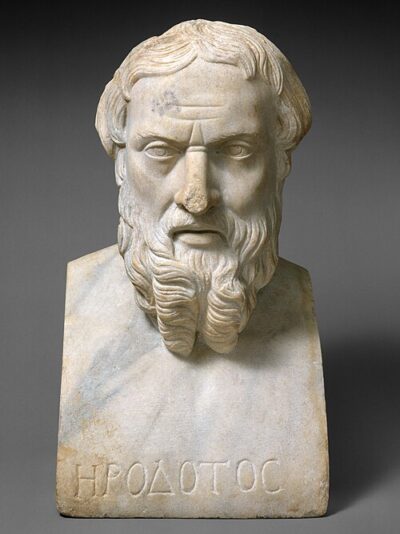
Herodotus
Herodotus was a Greek historian and geographer (c. 484–c. 425 BC). Born 484 BC, in Halicarnassus. Died 425 BC, in Thurii. Known for Histories.
Facts
17 facts · 0 confirmed by two sources · 12 cited · 4 from one source · 1 where the sources disagree
What’s different
- Died in: we show Thurii (Sources disagree). Wikidata also lists Pella
Where this comes from
Papalocal keeps its own record. It started from these sources; what each one said is kept here as it was copied, so a change on their side never changes this page by itself. Tap one to read its version.
What Wikidata says · copied November 16, 2026 · revision 2565594869
- Described as
- Greek historian and geographer (c. 484–c. 425 BC)
- Other names
- Herodotus of Halicarnassus, Herodotos, Father of History
- Born
- 484 BC · 1 reference
- Died
- 425 BC · 1 reference
- Born in
- Halicarnassus · 1 reference
- Died in
- Thurii · 2 references; Pella · 1 reference
- Citizen of
- Halicarnassus
- Occupation
- historian · 3 references; writer · 3 references; geographer · 1 reference; politician · 1 reference; ethnologist · 1 reference
- Known for
- Histories
- Field
- history · 1 reference; politics · 1 reference; creative and professional writing · 1 reference
- Lived in
- Halicarnassus; Samos · 1 reference; Thurii
- Wikipedias with a page
- 199
Wikidata item Q26825 (wikidata.org/wiki/Q26825), public domain (CC0). Copied November 16, 2026.
What Wikipedia says · copied November 16, 2026 · revision 1384291490
Herodotus (Ancient Greek: Ἡρόδοτος, romanised: Hēródotos; c. 484 – c. 425 BC) was a Greek historian and geographer from the Greek city of Halicarnassus (now Bodrum, Turkey), under Persian control in the 5th century BC, and a later citizen of Thurii in modern Calabria, Italy. He wrote the Histories, a detailed account of the Greco-Persian Wars, among other subjects such as the rise of the Achaemenid dynasty of Cyrus. He has been described as "The Father of History", a title conferred on him by the ancient Roman orator Cicero.
The Histories primarily cover the lives of prominent kings and famous battles such as Marathon, Thermopylae, Artemisium, Salamis, Plataea, and Mycale. His work deviates from the main topics to provide a cultural, ethnographical, geographical, and historiographical background that forms an essential part of the narrative and provides readers with a wellspring of additional information.
Herodotus was criticised in his times for his inclusion of "legends and fanciful accounts" in his work. The contemporaneous historian Thucydides, who covered the Peloponnesian War in his History of the Peloponnesian War, would separately accuse Herodotus of making up stories for entertainment. Herodotus retorted that he reported what he could see and what he was told.
From the Wikipedia article “Herodotus” (en.wikipedia.org/wiki/Herodotus), by its contributors, under CC BY-SA 4.0 (creativecommons.org/licenses/by-sa/4.0/). Copied November 16, 2026; not changed.
Confirmed Two sources agree. Cited One source, and it names where it got it. One source One source, without a reference of its own. Sources disagree The sources disagree. We show the best-supported value and keep theirs below.
