
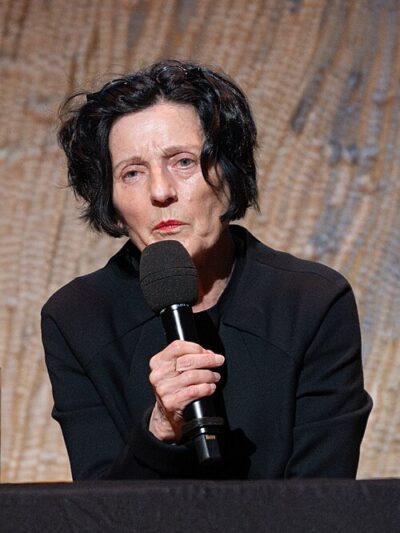
Herta Müller
Herta Müller is a German-Romanian novelist, poet and essayist. Born August 17, 1953, in Nițchidorf. Known for Nadirs, The Passport and The Land of Green Plums. Educated at West University of Timișoara. Awards include Nobel Prize in Literature, Adam Müller-Guttenbrunn-Förderpreis and Premiul UTC la secțiunea „lucrări în limbile naționalităților conlocuitoare".
Facts
43 facts · 1 confirmed by two sources · 9 cited · 33 from one source
Where this comes from
Papalocal keeps its own record. It started from these sources; what each one said is kept here as it was copied, so a change on their side never changes this page by itself. Tap one to read its version.
What Wikidata says · copied November 16, 2026 · revision 2565554153
- Described as
- German-Romanian novelist, poet and essayist (born 1953)
- Other names
- Herta Muller, H. Müller, H. Muller, H. Mueller, Herta Mueller
- Born
- August 17, 1953 · 6 references
- Born in
- Nițchidorf · 1 reference
- Citizen of
- Germany; Romania · 1 reference
- Occupation
- writer · 2 references; linguist; poet; translator; novelist; essayist; artist · 1 reference
- Worked for
- Freie Universität Berlin; Nikolaus Lenau High School
- Education
- West University of Timișoara
- Member of
- Writers' Union of Romania; Literaturkreis Adam Müller-Guttenbrunn; German Academy for Language and Literature
- Genre
- essay
- Known for
- Nadirs; The Passport; The Land of Green Plums; The Hunger Angel
- Awards
- Nobel Prize in Literature (2009) · 1 reference; Adam Müller-Guttenbrunn-Förderpreis (1981); Premiul UTC la secțiunea „lucrări în limbile naționalităților conlocuitoare" (1982); Aspekte-Literaturpreis (1984) · 1 reference; Rauriser Literaturpreis (1985) · 1 reference; Förderpreis zum Literaturpreis der Stadt Bremen (1985) · 1 reference; Marieluise-Fleißer-Preis (1989); Deutscher Sprachpreis (1989) · 1 reference; Roswitha Prize (1990); Kranichsteiner Literaturpreis (1991); Kleist Prize (1994); Aristeion Prize (1995); Franz Nabl Prize (1997); Ida-Dehmel-Literaturpreis (1998); Dublin Literary Award (1998)
- Field
- poetry; essay; literature · 1 reference
- Spouse
- Richard Wagner (1984–1989) · 1 reference; Harry Merkle
- Lived in
- Berlin
- Wikipedias with a page
- 127
Wikidata item Q38049 (wikidata.org/wiki/Q38049), public domain (CC0). Copied November 16, 2026.
What Wikipedia says · copied November 16, 2026 · revision 1381929795
Herta Müller (German: [ˈhɛʁta ˈmʏlɐ] ; born 17 August 1953) is a Romanian-German novelist, poet, essayist and recipient of the 2009 Nobel Prize in Literature. She was born in Nițchidorf, Timiș County in Romania; her native languages are German and Romanian. Since the early 1990s, she has been internationally established, and her works have been translated into more than twenty languages.
Müller is noted for her works depicting the effects of violence, cruelty and terror, usually in the setting of the Socialist Republic of Romania under the repressive Nicolae Ceaușescu regime which she has experienced herself. Many of her works are told from the viewpoint of the German minority in Romania and are also a depiction of the modern history of the Germans in the Banat and Transylvania. Her much acclaimed 2009 novel The Hunger Angel (Atemschaukel) portrays the deportation of Romania's German minority to Soviet Gulags during the Soviet occupation of Romania for use as German forced labour.
Müller has received more than twenty awards to date, including the Kleist Prize (1994), the Aristeion Prize (1995), the International Dublin Literary Award (1998) and the Franz Werfel Human Rights Award (2009). On 8 October 2009, the Swedish Academy announced that she had been awarded the Nobel Prize in Literature, describing her as a woman "who, with the concentration of poetry and the frankness of prose, depicts the landscape of the dispossessed".
- Born, in its opening lines
- August 17, 1953
From the Wikipedia article “Herta Müller” (en.wikipedia.org/wiki/Herta_Müller), by its contributors, under CC BY-SA 4.0 (creativecommons.org/licenses/by-sa/4.0/). Copied November 16, 2026; not changed.
Confirmed Two sources agree. Cited One source, and it names where it got it. One source One source, without a reference of its own. Sources disagree The sources disagree. We show the best-supported value and keep theirs below.
