
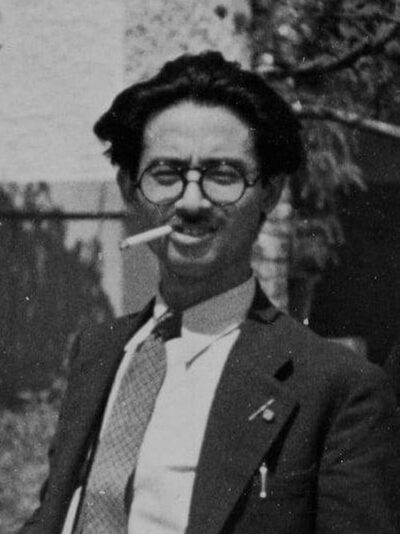
Hiroshi Inagaki
Hiroshi Inagaki was a Japanese director, screenwriter, producer, actor. Born December 30, 1905, in Tokyo. Died May 21, 1980, in Tokyo.
Facts
12 facts · 1 confirmed by two sources · 7 cited · 3 from one source · 1 where the sources disagree
What’s different
- Died: we show May 21, 1980 (Sources disagree). Wikipedia says May 1, 1980
Where this comes from
Papalocal keeps its own record. It started from these sources; what each one said is kept here as it was copied, so a change on their side never changes this page by itself. Tap one to read its version.
What Wikidata says · copied November 17, 2026 · revision 2568047414
- Described as
- Japanese director, screenwriter, producer, actor (1905–1980)
- Born
- December 30, 1905 · 3 references
- Died
- May 21, 1980 · 3 references
- Born in
- Tokyo · 1 reference
- Died in
- Tokyo · 1 reference
- Buried in
- Yanaka Cemetery
- Citizen of
- Japan; Empire of Japan (–1947)
- Occupation
- actor · 1 reference; film director · 1 reference; screenwriter · 1 reference; film producer · 2 references; director · 1 reference
- Wikipedias with a page
- 26
Wikidata item Q960868 (wikidata.org/wiki/Q960868), public domain (CC0). Copied November 17, 2026.
What Wikipedia says · copied November 17, 2026 · revision 1370865772
Hiroshi Inagaki (Japanese: 稲垣 浩, Hepburn: Inagaki Hiroshi; 30 December 1905 – 1 May 1980) was a Japanese filmmaker who worked on over 100 films in a career spanning over five decades. He is one of the most successful and critically acclaimed filmmakers in the history of Japanese cinema, having directed several jidaigeki epics such as the 1954 Academy Award-winning film Samurai I: Musashi Miyamoto, and its two sequels Samurai II: Duel at Ichijoji Temple (1955) and Samurai III: Duel at Ganryu Island (1956).
- Born, in its opening lines
- December 30, 1905
- Died, in its opening lines
- May 1, 1980
From the Wikipedia article “Hiroshi Inagaki” (en.wikipedia.org/wiki/Hiroshi_Inagaki), by its contributors, under CC BY-SA 4.0 (creativecommons.org/licenses/by-sa/4.0/). Copied November 17, 2026; not changed.
Confirmed Two sources agree. Cited One source, and it names where it got it. One source One source, without a reference of its own. Sources disagree The sources disagree. We show the best-supported value and keep theirs below.
