
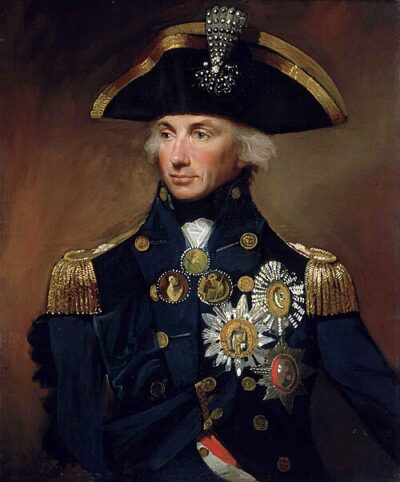
Horatio Nelson
Horatio Nelson was a British admiral. Born September 29, 1758, in Burnham Thorpe. Died October 21, 1805, in Cape Trafalgar. Positions held include member of the House of Lords. Educated at Norwich School and Paston College. Awards include Knight Commander of the Order of the Bath, Order of the Crescent and Knight Grand Cross of the Order of Saint Ferdinand and of Merit.
Facts
31 facts · 2 confirmed by two sources · 13 cited · 16 from one source
Where this comes from
Papalocal keeps its own record. It started from these sources; what each one said is kept here as it was copied, so a change on their side never changes this page by itself. Tap one to read its version.
What Wikidata says · copied November 16, 2026 · revision 2567537350
- Described as
- British admiral (1758–1805)
- Other names
- Nelson, Horatio, Viscount Nelson Nelson, Admiral Nelson, Lord Nelson, Admiral Lord Nelson, Admiral Horatio Nelson, 1st and last Viscount Nelson of the Nile and Burnham Thorpe, Horatio, Lord Nelson, Viscount Horatio Nelson Nelson, Horatio Nelson, 1st Viscount Nelson, Horatio, Viscount Nelson, Horatio Nelson, Viscount Nelson
- Born
- September 29, 1758 · 11 references
- Died
- October 21, 1805 · 11 references
- Born in
- Burnham Thorpe · 1 reference
- Died in
- Cape Trafalgar · 1 reference
- Buried in
- St Paul's Cathedral
- Cause of death
- gunshot wound
- Citizen of
- United Kingdom of Great Britain and Ireland (1801–); Kingdom of Great Britain (–1801)
- Occupation
- naval officer · 1 reference; politician · 1 reference; admiral · 1 reference
- Positions held
- member of the House of Lords
- Education
- Norwich School; Paston College
- Awards
- Knight Commander of the Order of the Bath; Order of the Crescent; Knight Grand Cross of the Order of Saint Ferdinand and of Merit; Chelengk; Knight Grand Cross of the Order of Saint Joachim
- Spouse
- Frances Herbert Woolward (1787–) · 2 references
- Children
- Horatia Nelson · 1 reference
- Father
- Edmund Nelson · 2 references
- Mother
- Catherine Suckling · 2 references
- Siblings
- Susannah Nelson · 1 reference; William Nelson, 1st Earl Nelson · 1 reference; Suckling Nelson · 1 reference; Maurice Nelson · 1 reference
- Military branch
- Royal Navy
- Military rank
- vice admiral (1801–); counter admiral (1797–); captain (1779–)
- Wikipedias with a page
- 106
Wikidata item Q83235 (wikidata.org/wiki/Q83235), public domain (CC0). Copied November 16, 2026.
What Wikipedia says · copied November 16, 2026 · revision 1384890035
Vice-Admiral of the White Horatio Nelson, 1st Viscount Nelson (29 September 1758 – 21 October 1805) was a British Royal Navy officer whose leadership, grasp of strategy and unconventional tactics led to multiple decisive naval victories during the French Revolutionary and Napoleonic Wars. He is widely regarded as one of the greatest admirals in history.
Nelson was born into a moderately prosperous Norfolk family and joined the British navy in 1771 through the influence of his uncle Maurice Suckling, a post-captain in the Royal Navy. Developing a reputation for valour and a firm grasp of tactics, Nelson obtained his first command in 1778 but suffered from bouts of illness and following the end of the American War of Independence in 1783 was put on half-pay. Britain's entry into the French Revolutionary Wars in 1793 allowed him to return to active service and participate in the siege of Toulon and invasion of Corsica, the latter of which resulted in Nelson partially losing sight in his right eye. Rising rapidly through the ranks in 1797 Nelson distinguished himself at the Battle of Cape St. Vincent and shortly afterwards took part in a failed attack on Santa Cruz de Tenerife at which he lost his right arm, forcing him to return to England to recuperate. In 1798 Nelson won a decisive victory at the Battle of the Nile but subsequently became involved in Neapolitan politics and began an affair with Emma Hamilton, both of which severely damaged his reputation in his navy, leading to a period of inactivity.
In 1801 Nelson was sent to the Baltic Sea and helped to break up the Second League of Armed Neutrality by defeating a Danish fleet at the Battle of Copenhagen. His career was again interrupted by the Peace of Amiens in 1802 but after the Napoleonic Wars began in 1803 he soon resumed active service. Nelson commanded the British fleet which blockaded a Franco-Spanish fleet at Toulon, and after the allied fleet escaped pursued it to the West Indies and back but failed to bring about a battle. After a brief return to England, Nelson took over the British fleet blockading Cádiz in 1805. On 21 October the Franco-Spanish fleet in Cádiz came out of port and Nelson's fleet engaged them at the Battle of Trafalgar. The battle was a decisive British victory, but Nelson, aboard HMS Victory, was fatally wounded by a French marksman. His body was brought back to England and given a state funeral.
Nelson's death at Trafalgar had secured his position as one of Britain's national heroes. His signal just prior to the commencement of the battle, "England expects that every man will do his duty", has been widely quoted and paraphrased. Numerous monuments, including Nelson's Column at Trafalgar Square in London and the Nelson Monument in Edinburgh, have been created to honour him. In 2002, Nelson was ranked 9th out of the 100 Greatest Britons of all time.
- Born, in its opening lines
- September 29, 1758
- Died, in its opening lines
- October 21, 1805
From the Wikipedia article “Horatio Nelson, 1st Viscount Nelson” (en.wikipedia.org/wiki/Horatio_Nelson,_1st_Viscount_Nelson), by its contributors, under CC BY-SA 4.0 (creativecommons.org/licenses/by-sa/4.0/). Copied November 16, 2026; not changed.
Confirmed Two sources agree. Cited One source, and it names where it got it. One source One source, without a reference of its own. Sources disagree The sources disagree. We show the best-supported value and keep theirs below.
