
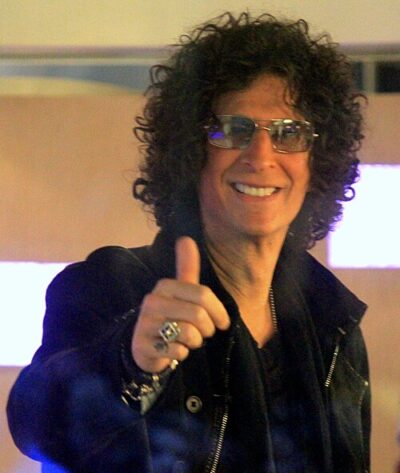
Howard Stern
Howard Stern is an American radio and television personality. Born January 12, 1954, in Queens. Educated at Boston University and Boston University College of Communication.
Facts
23 facts · 1 confirmed by two sources · 1 cited · 21 from one source
Where this comes from
Papalocal keeps its own record. It started from these sources; what each one said is kept here as it was copied, so a change on their side never changes this page by itself. Tap one to read its version.
What Wikidata says · copied November 13, 2026 · revision 2567406556
- Described as
- American radio and television personality (born 1954)
- Other names
- Howard Allan Stern
- Born
- January 12, 1954 · 3 references
- Born in
- Queens · 1 reference
- Name at birth
- Howard Allan Stern
- Citizen of
- United States
- Occupation
- actor; radio personality; photographer; television presenter; writer; autobiographer; journalist; businessperson · 1 reference
- Political party
- Libertarian Party
- Worked for
- NBC · 1 reference
- Education
- Boston University; Boston University College of Communication; South Side High School · 1 reference; Roosevelt High School · 1 reference
- Member of
- The Losers
- Spouse
- Beth Ostrosky Stern (2008–)
- Religion
- atheism
- Lived in
- New York City
- Website
- http://www.howardstern.com
- Wikipedias with a page
- 43
Wikidata item Q348603 (wikidata.org/wiki/Q348603), public domain (CC0). Copied November 13, 2026.
What Wikipedia says · copied November 13, 2026 · revision 1381565064
Howard Allan Stern (born January 12, 1954) is an American broadcaster, comedian, and media personality. He is best known for The Howard Stern Show, which rose to prominence through national syndication on terrestrial radio from 1986 to 2005; he has broadcast on SiriusXM since 2006.
Stern began his radio career while at Boston University. From 1976 to 1982, he developed his on-air style at WRNW (Briarcliff Manor, NY), WCCC (Hartford, CT), WWWW (Detroit, MI), and WWDC (Washington, D.C.). He later worked afternoons at WNBC in New York City from 1982 until his firing in 1985, before starting a 20-year run at WXRK. His morning show entered syndication in 1986, eventually reaching 60 markets and peaking at 20 million listeners. From 2012 to 2015, he served as a judge on America's Got Talent. In his SiriusXM years, he gained renewed attention for long-form interviews, including The Howard Stern Interview: Bruce Springsteen (2022) and 2024 interviews with Then President Joe Biden and Vice President Kamala Harris.
Stern has received numerous awards, including Billboard's Nationally Syndicated Air Personality of the Year for eight consecutive years, and became the first host to hold the number one morning show in both New York City and Los Angeles. He is also the most fined radio host, with the Federal Communications Commission issuing $2.5 million in fines to station owners over indecent content. In 2004, he signed a five-year, $500 million deal with Sirius, making him one of the highest-paid figures in radio; he renewed his SiriusXM contract for three more years in December 2025.
Calling himself the "King of All Media" since 1992, Stern has worked across television, pay-per-view, and home video. His books Private Parts (1993) and Miss America (1995) both debuted at number one on The New York Times Best Seller list and sold over one million copies. Private Parts was adapted into a 1997 biographical comedy film starring Stern and his radio team, topping the U.S. box office in its opening week and grossing $41.2 million domestically. Its soundtrack reached number one on the Billboard 200 and was certified platinum. His third book, Howard Stern Comes Again, was released in 2019.
- Born, in its opening lines
- January 12, 1954
From the Wikipedia article “Howard Stern” (en.wikipedia.org/wiki/Howard_Stern), by its contributors, under CC BY-SA 4.0 (creativecommons.org/licenses/by-sa/4.0/). Copied November 13, 2026; not changed.
Confirmed Two sources agree. Cited One source, and it names where it got it. One source One source, without a reference of its own. Sources disagree The sources disagree. We show the best-supported value and keep theirs below.
