
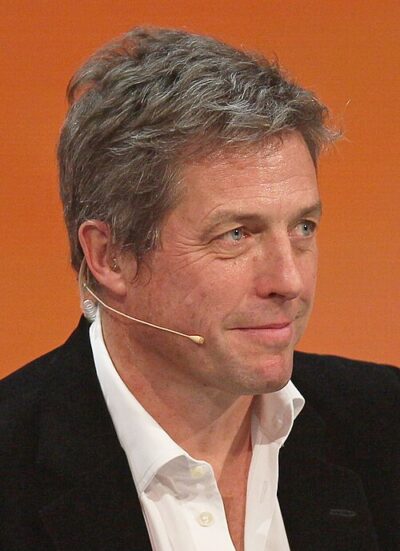
Hugh Grant
Hugh Grant is a British actor. Born September 9, 1960, in Charing Cross Hospital. Educated at New College and Latymer Upper School. Awards include BAFTA Award for Best Actor in a Leading Role, Golden Globes and Volpi Cup for Best Actor.

Facts
21 facts · 1 confirmed by two sources · 7 cited · 13 from one source
Where this comes from
Papalocal keeps its own record. It started from these sources; what each one said is kept here as it was copied, so a change on their side never changes this page by itself. Tap one to read its version.
What Wikidata says · copied November 16, 2026 · revision 2563906666
- Described as
- British actor
- Other names
- Hugh John Mungo Grant
- Born
- September 9, 1960 · 11 references
- Born in
- Charing Cross Hospital
- Name at birth
- Hugh John Mungo Grant
- Citizen of
- United Kingdom · 2 references
- Occupation
- comedian; film actor · 2 references; film producer; stage actor; television actor; actor · 3 references; musician · 2 references
- Worked for
- The Hacked Off Campaign Limited (2012–) · 1 reference
- Education
- New College; Latymer Upper School; Wetherby School
- Awards
- BAFTA Award for Best Actor in a Leading Role (1995); Golden Globes (1995); Volpi Cup for Best Actor (1987); Empire Awards
- Father
- James Murray Grant · 1 reference
- Mother
- Fyvola Susan MacLean · 1 reference
- Wikipedias with a page
- 85
Wikidata item Q163286 (wikidata.org/wiki/Q163286), public domain (CC0). Copied November 16, 2026.
What Wikipedia says · copied November 16, 2026 · revision 1385281173
Hugh John Mungo Grant (born 9 September 1960) is an English actor. He established himself early in his career as a charming and vulnerable romantic leading man, and has since transitioned into a character actor. His accolades include a British Academy Film Award and a Golden Globe Award as well as nominations for two Primetime Emmy Awards. He received an Honorary César in 2006. In 2022, Time Out magazine listed Grant as one of Britain's 50 greatest actors of all time. As of 2025, his films have grossed over US$4 billion worldwide.
Grant made his feature film acting debut in Privileged (1982), followed by the romantic drama Maurice (1987) for which he gained acclaim as well as the Volpi Cup for Best Actor. He then acted in a string of successful period dramas such as The Remains of the Day (1993), Sense and Sensibility (1995) and Restoration (1995). Grant emerged as a star with Richard Curtis's romantic comedy Four Weddings and a Funeral (1994), for which he won the Golden Globe and BAFTA Award for Best Actor. He starred in further romantic comedies such as Notting Hill (1999), Bridget Jones's Diary (2001) and its 2004 and 2025 sequels, About a Boy (2002), Two Weeks Notice (2002), Love Actually (2003) and Music and Lyrics (2007).
Grant began to take against-type parts earning three BAFTA Award nominations for his roles as St. Clair Bayfield in the biopic comedy Florence Foster Jenkins (2016), a haughty actor in the family film Paddington 2 (2017), and a charming yet sinister man in the horror film Heretic (2024). He has also acted in the science fiction epic Cloud Atlas (2012), the crime comedy The Gentlemen (2019), the fantasy comedy Dungeons & Dragons: Honor Among Thieves (2023), and the musical fantasy Wonka (2023). He earned two Primetime Emmy Award nominations for his roles as Jeremy Thorpe in the BBC miniseries A Very English Scandal (2018) and a man accused of murder in the HBO miniseries The Undoing (2020).
Grant has been outspoken about his antipathy towards the profession of acting, his disdain towards the culture of celebrity, and his hostility towards the media. He emerged as a prominent critic of the conduct of Rupert Murdoch's News Corporation during the News International phone hacking scandal.
- Born, in its opening lines
- September 9, 1960
From the Wikipedia article “Hugh Grant” (en.wikipedia.org/wiki/Hugh_Grant), by its contributors, under CC BY-SA 4.0 (creativecommons.org/licenses/by-sa/4.0/). Copied November 16, 2026; not changed.
Confirmed Two sources agree. Cited One source, and it names where it got it. One source One source, without a reference of its own. Sources disagree The sources disagree. We show the best-supported value and keep theirs below.
