
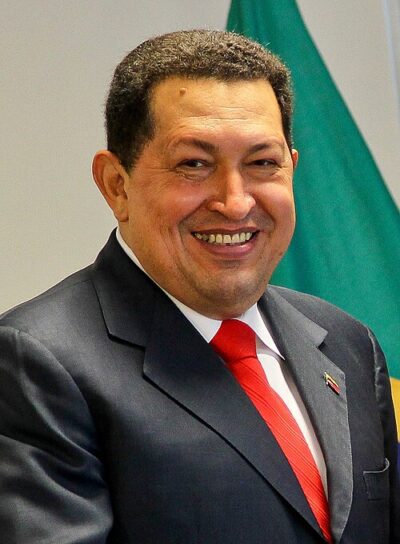
Hugo Chávez
Hugo Chávez was the 30th and 33rd President of Venezuela. Born July 28, 1954, in Sabaneta. Died March 5, 2013, in Hospital Militar de Caracas. Positions held include President of Venezuela (1999–2013) and party leader (2008–2013). Educated at Military Academy of the Bolivarian Army. Awards include Al-Gaddafi International Prize for Human Rights, Order of Francisco Morazán and Grand Collar of the Order of Prince Henry.
Facts
51 facts · 2 confirmed by two sources · 35 cited · 14 from one source
Where this comes from
Papalocal keeps its own record. It started from these sources; what each one said is kept here as it was copied, so a change on their side never changes this page by itself. Tap one to read its version.
What Wikidata says · copied November 16, 2026 · revision 2566102538
- Described as
- 30th and 33rd President of Venezuela
- Other names
- Hugo Rafael Chávez Frías
- Born
- July 28, 1954 · 10 references
- Died
- March 5, 2013 · 10 references
- Born in
- Sabaneta · 1 reference
- Died in
- Hospital Militar de Caracas · 1 reference
- Buried in
- Historical museum in Caracas
- Cause of death
- colorectal cancer · 1 reference
- Name at birth
- Hugo Rafael Chávez Frías
- Citizen of
- Venezuela · 1 reference
- Occupation
- politician · 1 reference; military officer · 2 references; television presenter · 1 reference; witness filmed · 1 reference
- Positions held
- President of Venezuela (1999–2013) · 2 references; party leader (2008–2013) · 1 reference
- Political party
- Revolutionary Bolivarian Movement-200 (1982–1997) · 1 reference; Fifth Republic Movement (1997–2007) · 1 reference; United Socialist Party of Venezuela (2007–2013) · 1 reference
- Education
- Military Academy of the Bolivarian Army (1971–1975) · 1 reference
- Sport
- baseball · 1 reference
- Awards
- Al-Gaddafi International Prize for Human Rights; Order of Francisco Morazán (2014) · 1 reference; Grand Collar of the Order of Prince Henry (2001) · 1 reference; Order of the Liberator; Order of Francisco de Miranda; Order of the Star of Carabobo; Order of José Martí (1999) · 1 reference; National Order of Merit Carlos Manuel de Céspedes (2004) · 1 reference; Ribbon of the Order of the Republic of Serbia (2013) · 1 reference; Order of the Umayyads; Uatsamonga Order; Order of the Friendship of Peoples (2008); Blue Planet Award (2008) · 1 reference; honorary doctor of the University of International Business and Economics (2001) · 1 reference; Order of Augusto César Sandino (2007) · 1 reference
- Spouse
- Nancy Colmenares (1977–1995) · 1 reference; Marisabel Rodríguez de Chávez (1997–2004) · 1 reference
- Children
- María Gabriela Chávez · 1 reference; Rosinés Chávez · 1 reference
- Father
- Hugo de los Reyes Chávez · 1 reference
- Mother
- Elena Frías de Chávez · 1 reference
- Siblings
- Adán Chávez · 1 reference; Argenis Chávez · 1 reference; Aníbal Chávez · 1 reference
- Religion
- Catholicism · 1 reference
- Military branch
- Bolivarian Army · 1 reference
- Military rank
- Lieutenant Colonel (1991–) · 2 references; commander-in-chief · 1 reference
- Lived in
- La Casona · 1 reference
- Height
- 1.73 m (5 ft 8 in) · 1 reference
- Website
- http://www.chavez.org.ve; http://todochavez.gob.ve
- Wikipedias with a page
- 187
Wikidata item Q8440 (wikidata.org/wiki/Q8440), public domain (CC0). Copied November 16, 2026.
What Wikipedia says · copied November 16, 2026 · revision 1385490522
Hugo Rafael Chávez Frías (28 July 1954 – 5 March 2013) was a Venezuelan politician, revolutionary, and military officer who was the president of Venezuela from 1999 until his death in 2013. Chávez changed the country's name from the Republic of Venezuela to the Bolivarian Republic of Venezuela, creating the fifth republic in Venezuelan history and led the Bolivarian Revolution. Chávez was the leader of the Fifth Republic Movement political party from its foundation in 1997 until it merged with several other parties to form the United Socialist Party of Venezuela (PSUV), the ruling party of Venezuela since 2007. The political ideology centered around Chávez's ideas is known as Chavismo.
Born into a middle-class family in Sabaneta, Barinas, Chávez became a career military officer. After becoming dissatisfied with the Venezuelan political system based on the Puntofijo Pact, he founded the Revolutionary Bolivarian Movement-200 (MBR-200) in the early 1980s. Chávez led the MBR-200 in its unsuccessful coup d'état against the Democratic Action government of President Carlos Andrés Pérez in 1992, for which he was imprisoned. Pardoned from prison two years later, he founded the Fifth Republic Movement political party, and then receiving 56.2% of the vote, was elected president of Venezuela in 1998.
Chávez was reelected in the 2000 Venezuelan general election with 59.8% of the vote and again in the 2006 Venezuelan presidential election, with 62.8% of the vote. After winning his fourth term as president in the 2012 Venezuelan presidential election with 55.1% of the vote, he was to be sworn in on 10 January 2013. However, the inauguration was cancelled due to his cancer treatment, and on 5 March at age 58, he died in Caracas.
Following the adoption of the 1999 Venezuelan Constitution, Chávez focused on enacting social reforms as part of the Bolivarian Revolution. Using record-high oil revenues of the 2000s, his government nationalized key industries, created participatory democratic Communal Councils and implemented social programs known as the Bolivarian missions to expand access to food, housing, healthcare and education. While these initiatives led to temporary improvements in poverty reduction and social welfare during periods of high oil revenue, their reliance on state control and centralized planning exposed significant structural weaknesses as oil prices declined.
The high oil profits coinciding with the start of Chávez's presidency resulted in temporary improvements in areas such as poverty, literacy, income equality and quality of life between primarily 2003 and 2007, though extensive changes in structural inequalities did not occur. On 2 June 2010, Chávez declared an "economic war" on Venezuela's upper classes due to shortages, arguably beginning the crisis in Venezuela. By Chávez's death in 2013, economic actions performed by his government during the preceding decade, such as deficit spending and price controls, proved to be unsustainable, with Venezuela's economy faltering. At the same time, poverty, inflation and shortages increased.
Under Chávez, Venezuela experienced democratic backsliding, as he suppressed the press, manipulated electoral laws, and arrested and exiled government critics. His use of enabling acts and his government's use of propaganda were controversial. Chávez's presidency saw significant increases in the country's murder rate.
Across the political spectrum, Chávez is regarded as one of the most influential and controversial politicians in the modern history of Venezuela and Latin America. His 14-year presidency marked the start of the socialist "pink tide" sweeping Latin America—he supported Latin American and Caribbean cooperation and was instrumental in setting up the pan-regional Union of South American Nations, the Community of Latin American and Caribbean States, the Bolivarian Alliance for the Americas, the Bank of the South and the regional television network TeleSUR.
Internationally, Chávez aligned himself with the Marxist–Leninist governments of Fidel and then Raúl Castro in Cuba, as well as the socialist governments of Evo Morales in Bolivia, Rafael Correa in Ecuador and Daniel Ortega in Nicaragua. Chávez's ideas, programs, and style form the basis of Chavismo, a political ideology closely associated with Bolivarianism and socialism of the 21st century. Chávez described his policies as anti-imperialist, being a prominent adversary of the United States's foreign policy as well as a vocal opponent of neoliberalism and laissez-faire capitalism. He described himself as a Marxist.
- Born, in its opening lines
- July 28, 1954
- Died, in its opening lines
- March 5, 2013
From the Wikipedia article “Hugo Chávez” (en.wikipedia.org/wiki/Hugo_Chávez), by its contributors, under CC BY-SA 4.0 (creativecommons.org/licenses/by-sa/4.0/). Copied November 16, 2026; not changed.
Confirmed Two sources agree. Cited One source, and it names where it got it. One source One source, without a reference of its own. Sources disagree The sources disagree. We show the best-supported value and keep theirs below.
