
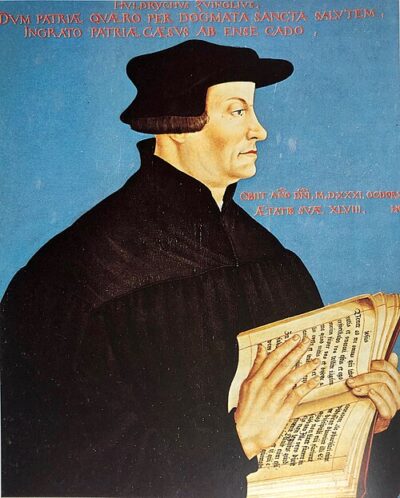
Huldrych Zwingli
Huldrych Zwingli was a Protestant Reformation leader in Switzerland, Swiss Reformed Church founder. Born January 1, 1484, in Wildhaus. Died October 11, 1531, in Kappel am Albis. Positions held include Antistes. Educated at University of Vienna and University of Basel.
Facts
26 facts · 2 confirmed by two sources · 11 cited · 13 from one source
Where this comes from
Papalocal keeps its own record. It started from these sources; what each one said is kept here as it was copied, so a change on their side never changes this page by itself. Tap one to read its version.
What Wikidata says · copied November 16, 2026 · revision 2567632372
- Described as
- Protestant Reformation leader in Switzerland, Swiss Reformed Church founder (1484-1531)
- Other names
- Ulricus Zurlinglius, Huldreich Zwingli, Zwingli
- Born
- January 1, 1484 · 5 references
- Died
- October 11, 1531 · 5 references
- Born in
- Wildhaus · 2 references
- Died in
- Kappel am Albis · 2 references
- Name at birth
- Ulrich Zwingli
- Citizen of
- Old Swiss Confederacy
- Occupation
- theologian · 2 references; translator; priest; Protestant reformer · 2 references; writer · 1 reference; preacher · 1 reference; composer · 1 reference
- Positions held
- Antistes
- Education
- University of Vienna; University of Basel
- Spouse
- Anna Reinhart · 1 reference
- Children
- Regula Gwalther-Zwingli · 1 reference; Wilhelm Zwingli · 1 reference; Huldrich Zwingli · 1 reference; Anna Zwingli · 1 reference
- Siblings
- Jakob Zwingli · 1 reference; Andreas Zwingli · 1 reference; Klaus Zwingli · 1 reference; Heini Zwingli · 1 reference
- Religion
- Reformed Christianity
- Wikipedias with a page
- 100
Wikidata item Q123034 (wikidata.org/wiki/Q123034), public domain (CC0). Copied November 16, 2026.
What Wikipedia says · copied November 16, 2026 · revision 1383267014
Huldrych Zwingli (born Ulrich Zwingli; 1 January 1484 – 11 October 1531) was a Swiss Christian theologian, musician, and leader of the Reformation in Switzerland. Born during a time of emerging Swiss patriotism and increasing criticism of the Swiss mercenary system, he attended the University of Vienna and the University of Basel, a scholarly center of Renaissance humanism. He continued his studies while he served as a pastor in Glarus and later in Einsiedeln, where he was influenced by the writings of Erasmus. During his tenures at Basel and Einsiedeln, Zwingli began to familiarize himself with many criticisms Christian institutions were facing regarding their reform guidance and garnered scripture which aimed to address such criticisms.
In 1519, Zwingli became the Leutpriester (people's priest) of the Grossmünster in Zurich where he began to preach ideas on reform of the Catholic Church. In his first public controversy in 1522, he attacked the custom of fasting during Lent. In his publications, he noted corruption in the ecclesiastical hierarchy, promoted clerical marriage, and attacked the use of images in places of worship. Among his most notable contributions to the Reformation was his expository preaching, starting in 1519, through the Gospel of Matthew, before eventually using Biblical eisegesis to go through the entire New Testament, a radical departure from the Catholic Mass. In 1525, he introduced a new communion liturgy to replace the Mass. He also clashed with the Anabaptists, which resulted in their persecution. Historians have debated whether or not he turned Zurich into a theocracy.
The Reformation spread to other parts of the Swiss Confederation, but several cantons resisted, preferring to remain Catholic. Zwingli formed an alliance of Reformed cantons which divided the Confederation along religious lines. In 1529, a war was averted at the last moment between the two sides. Meanwhile, Zwingli's ideas came to the attention of Martin Luther and other reformers. They met at the Marburg Colloquy and agreed on many points of doctrine, but they could not reach an accord on the doctrine of the Real Presence of Christ in the Eucharist.
In 1531, Zwingli's alliance applied an unsuccessful food blockade on the Catholic cantons. The cantons responded with an attack at a moment when Zurich was ill-prepared, and Zwingli died on the battlefield. His legacy lives on in the confessions, liturgy, and church orders of the Reformed churches of today.
- Born, in its opening lines
- January 1, 1484
- Died, in its opening lines
- October 11, 1531
From the Wikipedia article “Huldrych Zwingli” (en.wikipedia.org/wiki/Huldrych_Zwingli), by its contributors, under CC BY-SA 4.0 (creativecommons.org/licenses/by-sa/4.0/). Copied November 16, 2026; not changed.
Confirmed Two sources agree. Cited One source, and it names where it got it. One source One source, without a reference of its own. Sources disagree The sources disagree. We show the best-supported value and keep theirs below.
