
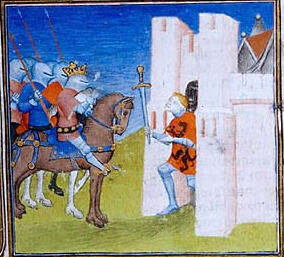
Hunald of Aquitaine
Hunald of Aquitaine was a Frankish duke. Born 705. Died 774, in Pavia. Positions held include duke of Aquitaine (735–744) and Duke of Gascony (735–744).
Facts
11 facts · 0 confirmed by two sources · 0 cited · 11 from one source
Where this comes from
Papalocal keeps its own record. It started from these sources; what each one said is kept here as it was copied, so a change on their side never changes this page by itself. Tap one to read its version.
What Wikidata says · copied November 18, 2026 · revision 2553925971
- Described as
- Frankish duke
- Other names
- Hunoald
- Born
- 705
- Died
- 774
- Died in
- Pavia
- Cause of death
- stoning
- Occupation
- aristocrat
- Positions held
- duke of Aquitaine (735–744); Duke of Gascony (735–744)
- Children
- Waifer of Aquitaine
- Father
- Odo the Great
- Siblings
- Hatto of Aquitaine; Remistan
- Wikipedias with a page
- 22
Wikidata item Q965437 (wikidata.org/wiki/Q965437), public domain (CC0). Copied November 18, 2026.
What Wikipedia says · copied November 18, 2026 · revision 1369994310
Hunald I, also spelled Hunold, Hunoald, Hunuald or Chunoald (died 756), was the Duke of Aquitaine from 735 until 745. Although nominally he was an officer of the Merovingian kings of Francia, in practice Aquitaine was completely autonomous when he inherited it. His rule corresponds to the lowest point of the Merovingian monarchy, when the kingdom was in fact ruled by the mayors of the palace. Hunald was forced at the outset of his reign to accept the authority of the mayor of the palace Charles Martel, but he tried three times to throw it off in open revolt (736, 742 and 745). He was unsuccessful, although he did manage to retain Aquitaine undiminished. In 745, he retired to a monastery, giving power to his son Waiofar. He later went to Rome, where he died during an attack on the city.
In spite of the opinion of certain historians that Hunald left his monastery to lead Aquitaine again in 768, Hunald I seems to have been a different person from the Hunald II, probably his grandson, who led the revolt that followed the death of Waiofar.
From the Wikipedia article “Hunald I” (en.wikipedia.org/wiki/Hunald_I), by its contributors, under CC BY-SA 4.0 (creativecommons.org/licenses/by-sa/4.0/). Copied November 18, 2026; not changed.
Confirmed Two sources agree. Cited One source, and it names where it got it. One source One source, without a reference of its own. Sources disagree The sources disagree. We show the best-supported value and keep theirs below.
