
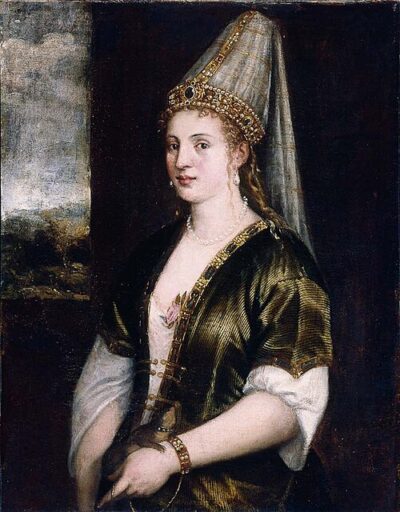
Hürrem Sultan
Hürrem Sultan was a wife of Suleiman the Magnificent. Born 1505, in Rohatyn. Died April 15, 1558, in Topkapı Palace. Positions held include haseki sultan (1531–) and empress consort (1534–).
Facts
20 facts · 2 confirmed by two sources · 11 cited · 7 from one source
What’s different
- Born: we show 1505 (Confirmed). Wikidata also lists 1507
- Died: we show April 15, 1558 (Confirmed). Wikidata also lists 1561
Where this comes from
Papalocal keeps its own record. It started from these sources; what each one said is kept here as it was copied, so a change on their side never changes this page by itself. Tap one to read its version.
What Wikidata says · copied November 16, 2026 · revision 2569328182
- Described as
- wife of Suleiman the Magnificent
- Other names
- Alexandra Anastasia Lisowska, Roxelana, Roxalana, Roxolana
- Born
- 1505 · 1 reference; 1507 · 1 reference
- Died
- April 15, 1558 · 1 reference; 1561 · 1 reference
- Born in
- Rohatyn · 1 reference
- Died in
- Topkapı Palace · 1 reference
- Buried in
- Hurrem Sultan Tomb
- Citizen of
- Ottoman Empire (1531–1558) · 2 references
- Occupation
- writer · 2 references; patron of the arts · 1 reference
- Positions held
- haseki sultan (1531–); empress consort (1534–)
- Member of
- Ottoman dynasty · 1 reference
- Spouse
- Suleiman the Magnificent (1534–1558) · 1 reference
- Children
- Şehzade Mehmed · 1 reference; Mihrimah Sultan · 1 reference; Selim II · 1 reference; Şehzade Bayezid; Șehzade Cihangir; Şehzade Abdullah
- Religion
- Byzantine Catholic Churches · 1 reference; Sunni Islam
- Wikipedias with a page
- 87
Wikidata item Q255809 (wikidata.org/wiki/Q255809), public domain (CC0). Copied November 16, 2026.
What Wikipedia says · copied November 16, 2026 · revision 1384166210
Hürrem Sultan (Turkish pronunciation: [hyɾˈɾæm suɫˈtan]; Ottoman Turkish: خرّم سلطان; c. 1505 – 15 April 1558), also known as Roxelana, was the chief consort and legal wife of Ottoman sultan Suleiman the Magnificent, mother of his successor Selim II, and the first haseki sultan of the Ottoman Empire. She became one of the most powerful and influential women in Ottoman history, and the first in a series of prominent women who lived during the period that came to be known as the Sultanate of Women. She is commonly considered the most powerful Haseki Sultan of the Ottoman Empire.
Presumably born in Ruthenia to a Ruthenian Orthodox family, she was captured by Crimean Tatars during a slave raid and eventually taken via the Crimean trade to Constantinople, the Ottoman capital.
She entered the imperial harem, rose through the ranks and became the favorite concubine of Sultan Suleiman. Breaking Ottoman tradition, he unprecedentedly freed and married Hürrem, making her his legal wife. Sultans had previously married only foreign freeborn noblewomen, if at all, and even then they usually reproduced through slave concubines. She remained in the sultan's court for the rest of her life, enjoying an extremely loving and intimate relationship with her husband, and having at least six children with him, including the future sultan, Selim II, which makes her an ancestor of all the following sultans and present descendants of the Ottoman dynasty. Of Hürrem's six known children, five were male, breaking one of the oldest Ottoman customs according to which each concubine could only give the sultan one male child, to maintain a balance of power between the various women. However, not only did Hürrem bear more children to the sultan after the birth of her first son in 1521, but she was also the mother of all of Suleiman's children born after her entry in the harem at the very beginning of his reign.
Hürrem eventually wielded enormous power, influencing and playing a central role in the politics of the Ottoman Empire. The correspondence between Suleiman and Hürrem, unavailable until the nineteenth century, along with Suleiman's own diaries, confirms her status as the Sultan's most trusted confidant and adviser. During his frequent absences, the pair exchanged passionate love letters. Hürrem included political information and warned of potential uprisings. She also played an active role in the affairs of the empire and even intervened in affairs between the empire and her former home, apparently helping Poland attain its privileged diplomatic status. She supposedly brought a "feminine touch" to diplomatic relations, sending diplomatic letters accompanied by personally embroidered articles to foreign leaders and their relatives. Two of these notable contemporaries were Sigismund II Augustus, King of Poland and Grand Duke of Lithuania, and Mahinbanu Sultan, the favorite sister and intimate counselor of Tahmasp I, who exchanged official letters with Hürrem as well as with an Ottoman imperial princess who was probably Mihrimah Sultan, daughter of Hürrem and Suleiman.
Hürrem patronized major public works (including the Haseki Sultan Complex and the Hürrem Sultan Hamam). She died in April 1558, in Constantinople and was buried in an elegant and beautifully adorned mausoleum adjacent to the site where her husband would join her eight years later in another mausoleum within the grand Süleymaniye Mosque complex in Istanbul.
- Born, in its opening lines
- c. 1505
- Died, in its opening lines
- April 15, 1558
From the Wikipedia article “Hürrem Sultan” (en.wikipedia.org/wiki/Hürrem_Sultan), by its contributors, under CC BY-SA 4.0 (creativecommons.org/licenses/by-sa/4.0/). Copied November 16, 2026; not changed.
Confirmed Two sources agree. Cited One source, and it names where it got it. One source One source, without a reference of its own. Sources disagree The sources disagree. We show the best-supported value and keep theirs below.
